

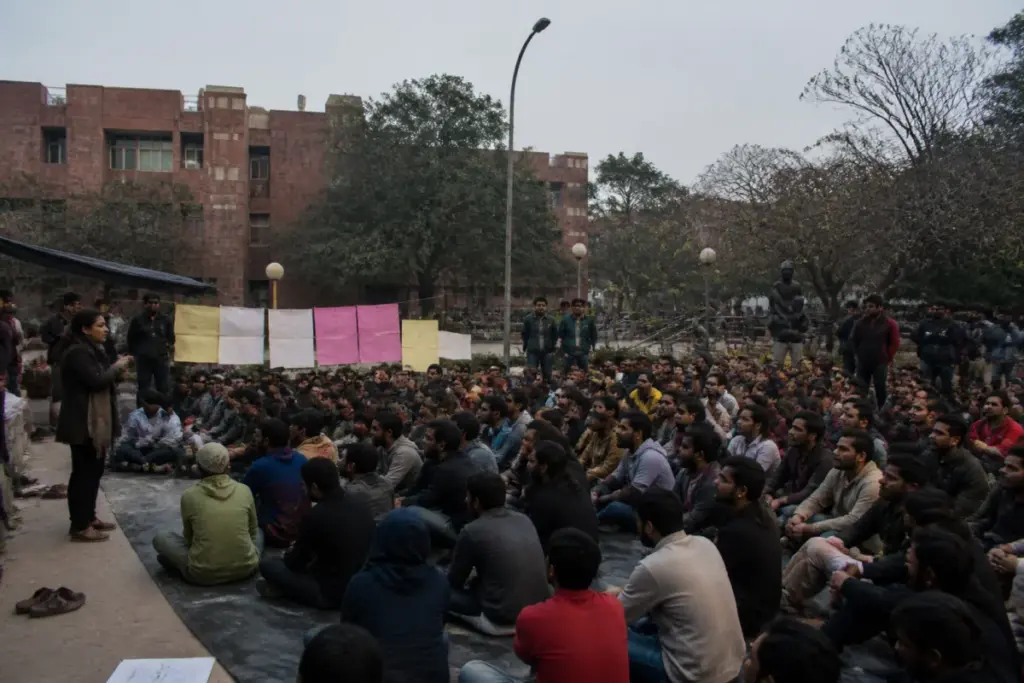
The JNU hunger strike ended on October 19 after Jawaharlal Nehru University agreed to revoke the rustication of five students, withdraw FIRs and review several campus policies and infrastructure-related demands raised by the Jawaharlal Nehru University Students’ Union (JNUSU).
The agreement followed a 17-day indefinite hunger strike that began on October 3. Minutes of a meeting held on October 19 and signed by Dean of the School of Social Sciences Vivek Kumar and student representatives recorded the decisions taken by the administration and the student body.
In a separate notice dated October 19, JNU said Vice-Chancellor Santishree Dhulipudi Pandit had directed the administration to revoke the rustication of five students with immediate effect. The students are Aditi Mishra, K. Gopika Babu, Sunil Yadav, Danish Ali and former JNUSU president Nitish Kumar. The first four are current JNUSU office-bearers. The university advised the students to pay their respective fines immediately.
The meeting minutes also stated that all FIRs against students would be withdrawn. Proctorial inquiries initiated during protests related to the rustication orders, University Grants Commission regulations and a hostel infrastructure protest would also be withdrawn.
Several decisions relate to the university’s disciplinary and administrative systems. A committee comprising a JNUSU office-bearer and an elected member will review contentious clauses in the Chief Proctor’s Office manual and recommend their removal. The student body had opposed provisions that restricted protests and allowed penalties including fines, suspension and rustication.
The administration also agreed to form a committee with a JNUSU representative to examine the Jawaharlal Nehru University Entrance Examination. An audit report on the Equal Opportunity Cell is to be provided within a week, after which the cell will be reorganised in consultation with JNUSU office-bearers.
The agreement includes measures concerning student welfare and campus facilities. JNU agreed to consider a 25% increase in the Merit-cum-Means scholarship and to initiate structural audits of Tapti and Mahi-Mandavi hostels, as well as the Transgender and Gender Equality Facilitation Areas. Renovation work is to be carried out according to the prescribed procedure.
The administration also committed to making geysers functional in all hostels within two weeks and opening a canteen in the Centre for Studies in Languages and Literature. School library hours will be extended until 9 p.m. A committee will examine the opening of the Barak hostel mess and the provision of Wi-Fi facilities.
The decisions place campus infrastructure and everyday services alongside questions of disciplinary procedure and student representation. The agreement does not immediately complete all the demands; several issues have been assigned to committees, audits or further administrative consideration.
According to the meeting minutes, the committee will meet again after 14 working days to take forward the specific demands and discuss the modalities for implementing them.


