

The Jauhar University FIR in Rampur has brought an unusually important urban governance question into focus: how can a privately controlled university campus become entangled with public contracts, constituency funds and government-built assets? The Enforcement Directorate’s probe, as reported by the Times of India, centres on an alleged Rs 416.14 crore gap between the value of construction at Mohammad Ali Jauhar University and the capital expenditure disclosed by the trust that runs it.
The FIR names Samajwadi Party leader Mohammad Azam Khan, the Maulana Mohammad Ali Jauhar Trust, SS and S Enterprises, SS Chik Associates Private Limited and other persons. It was registered at Azeemnagar police station in Rampur under provisions of the Bharatiya Nyaya Sanhita, 2023, and the Prevention of Corruption Act, 1988. The allegations remain subject to investigation and legal process; registration of an FIR does not establish guilt.
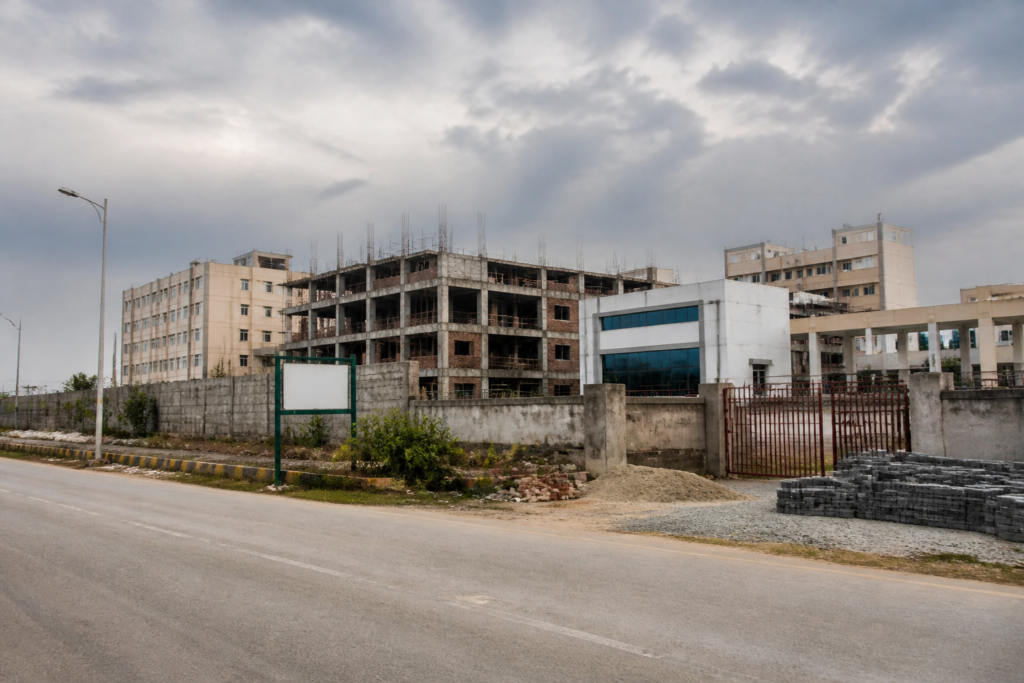
What makes the case relevant beyond the individuals named is the infrastructure trail described in the report. The campus, located in Signankheda village within the Azeem Nagar police station area, is not being examined only as a site of alleged financial irregularity. It is also the setting where the ED says construction assets, government-linked resources and private institutional control may have converged without sufficiently clear boundaries.
The reported mismatch is the starting point. An income tax department valuation report dated November 10, 2023, estimated the cost of buildings on the campus at Rs 494.46 crore. Against this, the trust’s income-tax returns for financial years 2013-14 to 2024-25 disclosed capital expenditure of Rs 78.32 crore. The ED has described the difference, Rs 416.14 crore, as unexplained expenditure.
That figure does not by itself identify the source of every rupee spent on construction. It does, however, explain why the investigation has moved beyond a routine examination of trust accounts. In a large institutional campus, the gap between declared expenditure and assessed construction value can raise questions about procurement, accounting, ownership of assets, the role of contractors and the flow of material and money. The source report presents these as investigative questions and agency allegations, not as final findings.
The case also illustrates why construction valuation and financial disclosure can produce different pictures of the same urban asset. The valuation report concerns the estimated cost of buildings, while the returns disclose capital expenditure reported by the trust. Establishing how the two figures relate would require examining the valuation methodology, the accounting records, the timing of construction and the ownership or funding status of individual assets. The supplied report does not provide those underlying documents, but the discrepancy is central to the ED’s case.
A second strand of the investigation concerns the alleged use of public resources. According to the ED, contractors, largely based in Rampur, obtained government contracts through Azam Khan’s influence when he was a cabinet minister in Uttar Pradesh and diverted construction material purchased for public works to the university campus. The agency cited the statement of Pawan Kumar Jain, managing director of Ceekay Associates Pvt Ltd, who allegedly told investigators that his company secured government contracts worth about Rs 186 crore between 2013-14 and 2016-17 and diverted 30-40% of the contract value towards university construction.
Using the lower end of that alleged diversion range, the ED calculated at least Rs 55.8 crore. The calculation is an agency claim based on the statement cited in the report. Its significance for urban governance is that public procurement is designed to link expenditure to a defined public work, contract scope and beneficiary. If material purchased for one project is diverted to another site, the issue is not limited to accounting. It can affect the cost, quality, completion and accountability of the original public project as well as the ownership of the asset eventually created.
The ED has separately flagged three projects executed by Uttar Pradesh Jal Nigam on the university campus: a grand pandal, an OBC boys’ hostel and a hospital. The report says Rs 23.41 crore was sanctioned for these works and that the agency alleged assets created with public money were ultimately transferred to the private university. Another Rs 6.60 crore was allegedly spent on works inside the campus through MLA and MLC constituency development funds.
Together, the agency has put the alleged use of government-linked funds and resources through these routes at Rs 85.81 crore. The figure is important because constituency development funds and public-utility projects carry a stated public purpose. A hostel, hospital or other facility may be physically located within a campus, but its legal ownership, operating responsibility, public access and funding conditions determine whether it remains a public asset or becomes part of a private institution’s infrastructure. The report does not establish the legal status of each asset, making that an important issue for the investigation.
The institutional governance question is equally significant. The ED alleged that Azam Khan, described as the university’s founder-chancellor and lifetime chairman of the trust, exercised complete control over its affairs. Statements attributed to trust members Mohd Faseeh Zaidi, Mushtaq Ahmad Siddique and ZR Siddique reportedly indicated that they neither attended executive committee meetings nor participated in key decisions.
For any trust-funded educational institution, the formal structure of committees matters only if it is matched by actual participation, recorded decisions and financial oversight. The reported statements, if borne out by the investigation, would raise questions about whether the trust’s governance mechanisms were functioning as intended. At this stage, the report records the ED’s allegations and the statements cited by the agency; it does not provide a final determination on the trust’s internal administration.
Donations form another part of the financial trail. The ED alleged that contractors who benefited from government contracts routed part of their gains to the trust. It cited AS Enterprises, which allegedly secured contracts worth around Rs 25 crore and later donated Rs 40 lakh to the trust. Investigators are also examining Rs 6.235 crore in donations received from KSD Charitable Trust, Meerut, and City Educational Social Welfare Society between 2013-14 and 2016-17.
The larger policy issue is the difficulty of tracking infrastructure when funding streams overlap. A campus may receive money through trust donations, private construction contracts, government departments and elected representatives’ development funds. Each channel can have different documentation, approval procedures and audit requirements. Without a clear asset register linking each building to its funding source, contractor, sanction order and ownership conditions, it becomes harder to determine whether public money created a public facility, supported a private institution or was used outside the approved purpose.
The Jauhar University case therefore sits at the intersection of three systems: public procurement, private educational infrastructure and trust governance. The ED’s allegations suggest that the same network of contractors and institutional relationships may have connected government works with construction on the university campus. Whether those connections amount to criminal offences will depend on evidence tested through the investigation and courts. But the reported facts already show why urban infrastructure accountability cannot stop at the point when a building is completed.
The next stages will require the agencies and authorities involved to establish the chain of custody for construction material, the sanction and execution records for the Jal Nigam projects, the use of MLA and MLC funds, the trust’s books of account and the legal status of the buildings on the campus. The FIR records the beginning of that process, not its conclusion. What remains to be established is whether the construction gap can be accounted for through legitimate expenditure and whether assets supported by public funds were used and held in accordance with the conditions attached to that funding.


