

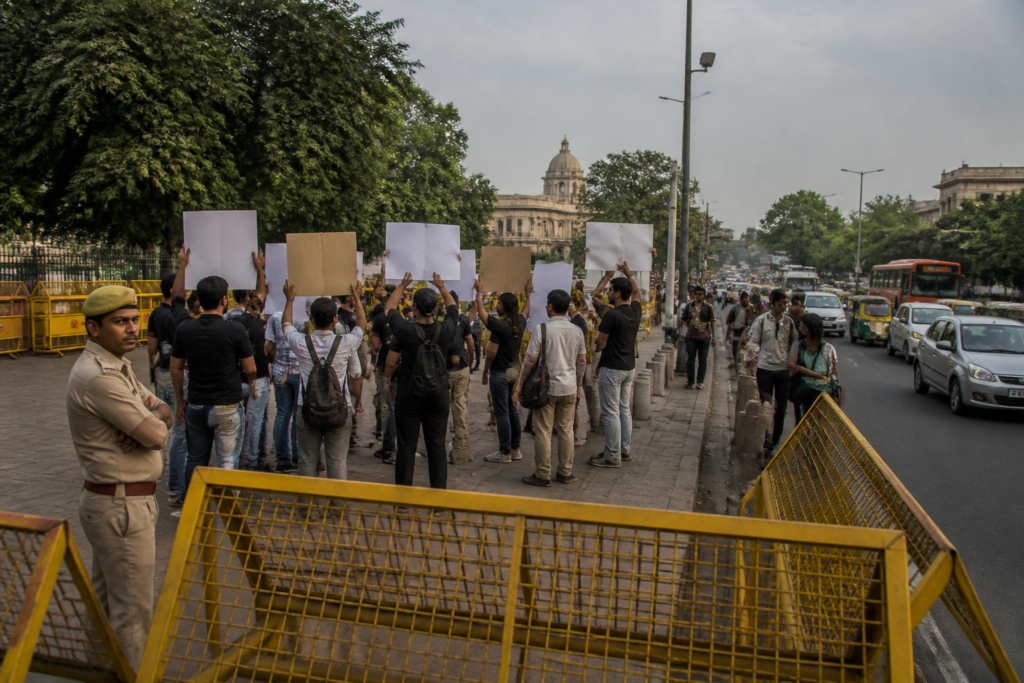
The challenge to Delhi Police’s decision to remove Jantar Mantar from the list of designated protest venues is not only a legal dispute over one location. It is also a question about how Delhi plans, regulates and distributes access to civic space in a capital where demonstrations must be visible enough to communicate but controlled enough to manage security, traffic and public order.
According to a report by Jagran – New Delhi, petitions were filed on October 14 in both the Supreme Court and the Delhi High Court against the Delhi Police order dated October 11. The Indian Youth Congress moved an application in an already pending Delhi High Court case, while advocate Swati Singh filed a separate petition in the Supreme Court. The petitioners have questioned the removal of Jantar Mantar as a protest site and argued that shifting demonstrations to remote locations could weaken the fundamental rights associated with peaceful assembly and freedom of expression.
Delhi Police has notified three new alternative locations for protests, the report said. The dispute therefore involves more than the closure or continuation of a single venue. It concerns the criteria by which a city decides where public dissent may be expressed, who can reach those places, how visible a protest remains once it is relocated, and whether administrative restrictions can address security and traffic concerns without making participation practically difficult.
Jantar Mantar occupies a distinctive position in Delhi’s civic geography because the location has long been identified with public demonstrations in the city’s central area. The present report does not provide the full text of the October 11 police order, the names of the three alternative locations or the specific conditions attached to their use. Those details will be important in determining whether the change is a straightforward venue substitution or a broader reorganisation of how demonstrations are permitted in the capital.
The institutional structure visible in the dispute is already significant. Delhi Police is the authority that issued the order and notified alternative sites. The Delhi High Court is considering an application connected to a pending case involving permission for a protest against Chief Election Commissioner Gyanesh Kumar. The Supreme Court petition separately challenges the removal of Jantar Mantar from the list of protest venues. This creates parallel legal scrutiny of an administrative decision that affects the use of urban public space.
The Indian Youth Congress’s application seeks reconsideration of the refusal to allow a protest against the Chief Election Commissioner. It also asks for a fresh assessment of whether concerns related to security, traffic and law and order can be addressed through reasonable conditions. That request points to the central administrative issue: whether authorities must choose between allowing a demonstration at a central venue and prohibiting it, or whether calibrated conditions can manage the risks associated with a protest.
The distinction matters because a designated protest site is not merely an empty parcel of land. Its value depends on accessibility, visibility and its relationship with the institutions, streets and audiences that make a demonstration meaningful. Moving a protest to a distant location may leave the formal permission intact while changing the practical character of the event. Participants may face greater travel barriers, fewer passers-by may see the demonstration and the connection between the protest and the public institutions it addresses may become weaker.
These are analytical implications of the dispute rather than findings established by the police order. The supplied report does not state how far the new sites are from central Delhi, whether they have public transport access, what their capacity is or how many protests they can accommodate. Without that information, it is not possible to assess whether the alternatives offer comparable civic access. But the absence of these details also shows why venue policy cannot be evaluated only by counting the number of replacement sites.
For city administration, the question is one of balancing competing uses of limited central space. Demonstrations can affect traffic movement, security arrangements and the operation of surrounding public areas. At the same time, a protest venue is part of the city’s democratic infrastructure. The administrative challenge is therefore not simply to identify a location where people can gather, but to establish transparent and predictable conditions under which public assembly can take place without being rendered ineffective.
The Delhi High Court proceedings could bring greater clarity to how these competing considerations should be assessed in individual cases. The application linked to the Indian Youth Congress’s pending matter asks authorities to reconsider whether security, traffic and law-and-order concerns can be addressed through conditions. That framing shifts the focus from an automatic refusal to an examination of what specific restrictions might be proportionate to the stated risks.
The Supreme Court petition raises the question at a wider level by challenging the removal of Jantar Mantar from the protest list itself. The supplied report does not indicate whether the court has issued notice, granted interim relief or fixed a hearing. It also does not provide the government or Delhi Police’s response to either petition. Those procedural and institutional details remain important because the immediate legal status of the October 11 order is not established in the report.
The case also highlights the difference between formal rights and usable rights in an urban setting. A right may exist in law, but its exercise can be affected by location, travel time, public transport connections, crowd capacity, operating hours and permission procedures. The report specifically records the petitioners’ concern that distant protest venues could affect peaceful assembly and freedom of expression. Whether that concern is accepted by the courts will depend on the evidence and reasoning placed before them.
The choice of protest venue also shapes the relationship between a demonstration and the wider public. A centrally located protest can be encountered by workers, visitors, journalists and officials moving through the city. A remote venue may create a more controlled environment, but it can also narrow the audience that sees or participates in the event. This does not establish that every central protest should be permitted without conditions. It does show why accessibility and visibility are relevant administrative considerations alongside security and traffic.
The report’s limited data makes several comparisons impossible at this stage. There is no information on the size or facilities of the three alternative sites, their distance from major transport links, the number of protests previously held at Jantar Mantar, or the traffic and security incidents cited in the police order. There is also no stated timeline for implementation beyond the existence of the October 11 order. These gaps should be addressed through the court record or official documents before firm conclusions are drawn about the effectiveness of the new arrangement.
What is clear is that Delhi Police has attempted to redesign the geography of protest through an administrative order, and that the decision has immediately entered judicial review. The dispute brings together three systems that often operate separately in city governance: policing, transport and public-space management. A decision taken for one system can alter the functioning of the others. Relocating a protest may change traffic patterns, security requirements, pedestrian movement and the ability of residents to engage with public institutions.
The larger urban question is whether Delhi’s public spaces are managed only as sites of order and circulation, or also as places where civic participation is expected to occur. A durable policy would require more than a list of approved locations. It would need clear reasons for venue decisions, an explanation of the risks being managed, information about the accessibility and capacity of alternatives, and a process for reviewing restrictions when circumstances change.
The legal challenges do not, by themselves, decide whether Jantar Mantar must remain a designated protest site. They do, however, ensure that the police order will be examined through the language of rights, administrative discretion and practical access to the city. The next significant developments will be the courts’ treatment of the petitions, the responses filed by the authorities and the details of the three alternative venues. Until those are available, the central fact is that Delhi’s protest geography is being contested not only as a policing decision, but as a question about who can reach the capital’s civic spaces and how visibly citizens can engage with public power.


