

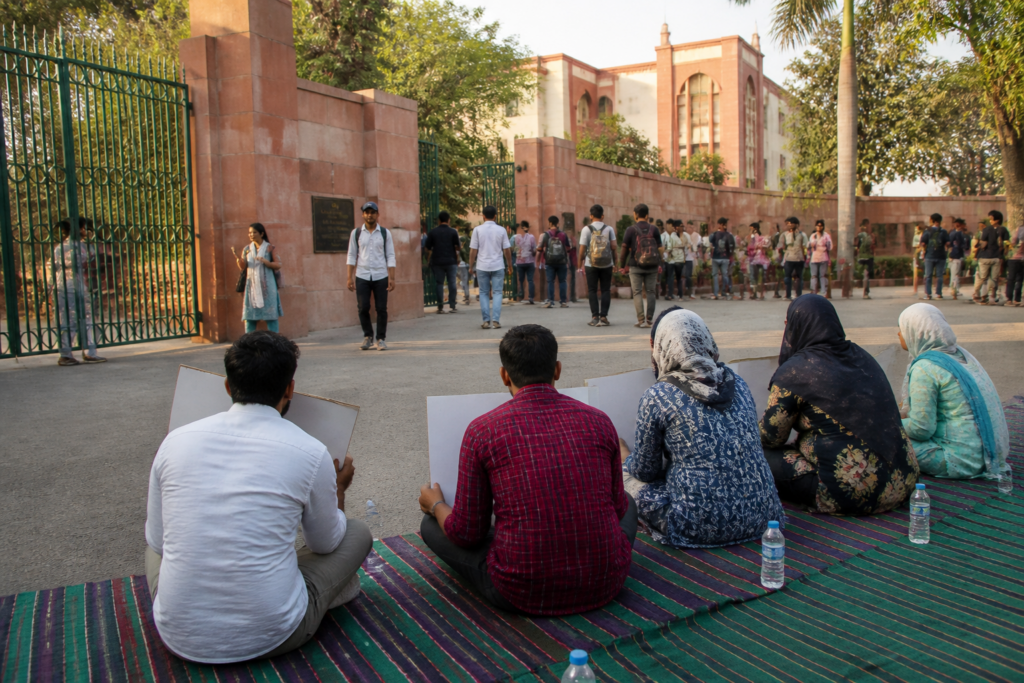
Five students at Jamia Millia Islamia began an indefinite hunger strike on October 12 demanding the restoration of a university-wide elected students’ union, reopening a governance question that has remained unresolved since the institution dissolved its elected body in 2006. The immediate trigger was Aligarh Muslim University’s October 9 notification restoring the process for student union elections, but the dispute at Jamia is rooted in a longer argument over who can represent students across faculties, centres and departments.
The protesters say the absence of a university-wide union has weakened students’ ability to raise concerns before the administration. In a statement issued on Wednesday, they listed issues ranging from hostels, drinking water, washrooms, classrooms, libraries and lifts to wider academic problems. Their position is that these concerns require an elected body with a mandate extending beyond individual departments.
The administration has presented a different institutional rationale. Senior officials from the Proctor’s Office told The Indian Express that the protest was not being held at the designated site, Gate No. 18, and disputed the identity of the participants, describing them as “outsiders”. An administration official also said that subject association elections are conducted in every department and argued that the law-and-order situation would not be good if university-wide student union elections were held.
The five students identified in the report are Mohd Jasim Khan, a postgraduate student of International Studies at the India-Arab Cultural Centre; Ebin Basil, a BA LLB (Hons) student at the Faculty of Law; Najmul, a third-year BTech student; Rehaan Haider, an MA Social Work student; and Faizan Ali Khan, a first-year MA Gender Studies student. Faizan, who is also president of the National Students’ Union of India at Jamia, said students had submitted a memorandum to the administration. Ebin Basil described the demand as one for representation, rights and participation in campus decision-making.
The institutional history explains why the current protest is not simply a dispute over whether elections should be scheduled. Jamia’s last students’ union elections were held in 2005. The university dissolved the elected body on March 31, 2006, amid allegations of campus violence and disruption. The administration also said student representatives had begun interfering in administrative matters and that union activity was affecting the academic environment.
Since then, Jamia has favoured representation through subject associations. In its Self-Study Report submitted to the National Assessment and Accreditation Council, the university said a subject association had been constituted for every programme, with members informally elected by the students concerned. These associations are intended to raise academic and administrative concerns and organise academic and co-curricular activities.
That arrangement creates a specific institutional distinction. A subject association can represent students within a programme or department, but it does not provide a single elected platform for students across the university. The present dispute is therefore about the scale and authority of representation: whether concerns that cut across faculties should be handled through separate departmental channels or by a body elected by the wider student community.
Jamia’s own earlier responses show that the issue has not been settled by a single administrative decision. In 2012, then Vice-Chancellor Najeeb Jung ruled out student union elections for that academic session, citing the university’s past experiences, and proposed strengthening subject associations instead. In March 2017, the university proposed a Jamia Student Council under which class representatives could contest for key office-bearer positions. Students criticised the proposal because it differed from restoring a directly elected students’ union.
The legal history has also shaped the institution’s position. A petition filed in the Delhi High Court in 2012 sought directions for Jamia to conduct free, fair and peaceful students’ union elections in accordance with the Lyngdoh Committee recommendations. When students renewed the demand in 2017, the university cited the pending case and legal hurdles as reasons it could not proceed.
The High Court disposed of the petition on December 20, 2022, after the university submitted that the students’ union had been dissolved and that the question of holding elections did not arise. According to the report, the order did not prohibit Jamia from holding elections in the future. That detail leaves the dispute primarily within the space of institutional decision-making rather than establishing a continuing judicial ban.
This is where the comparison with other universities becomes important, but also limited. The protesting students point to AMU’s October 9 notification restoring the process for student union elections. They also refer to student elections at Delhi University and Jawaharlal Nehru University, arguing that Jamia’s location among institutions with elected student bodies makes its own absence more difficult to justify.
The comparison does not, by itself, resolve Jamia’s concerns about law and order, administrative interference or academic disruption. It does, however, expose the absence of a common institutional standard across universities. Student representation can take the form of departmental associations, class representatives, a council or a directly elected union. Each structure distributes access, authority and accountability differently. At Jamia, that design question has remained open for nearly two decades.
The dispute also demonstrates why campus governance is connected to the built and operational environment of an institution. The students’ list of concerns includes physical facilities and basic services: hostels, drinking water, washrooms, classrooms, libraries and lifts. These are not only academic matters. They involve the daily functioning of a large public institution and the mechanisms through which users report failures, seek responses and press for correction.
A university-wide representative body is not automatically a guarantee that these services will improve. Nor does the existence of subject associations prove that student concerns cannot be addressed. But the disagreement makes clear that the question is not merely whether students have any channel of communication. It is whether the available channels have sufficient reach and legitimacy to represent issues shared by students across different departments and centres.
The administration’s reference to subject association elections indicates that Jamia has not removed all forms of student participation. Its model instead places representation closer to academic units. The protesters’ objection is that this fragmented system cannot substitute for an elected body with a university-wide mandate. The two positions therefore differ not only over elections, but over how the university defines representation and where it locates responsibility for collective concerns.
The current protest follows a familiar institutional pattern: a long-standing unresolved demand gains momentum when a comparable university changes course. AMU’s notification has provided the immediate reference point, but the underlying Jamia dispute predates it by many years. The sequence from the dissolution of the union in 2006, through the 2012 and 2017 proposals, to the 2022 court proceeding shows that the issue has moved between administrative policy, alternative representative structures and legal argument without producing a settlement accepted by the protesting students.
The available account does not establish whether Jamia will agree to restore elections, create a revised council, retain subject associations or propose another model. It also does not provide an independent assessment of the administration’s claims about the protesters’ identities or the likely law-and-order consequences of elections. Those remain contested positions attributed to the respective sides.
What the evidence does establish is a persistent governance gap. Jamia has had no university-wide students’ union since its elected body was dissolved in 2006, while students continue to demand a formal platform for collective representation. The next important development will be the administration’s response to the memorandum and whether it addresses the distinction between departmental participation and a directly elected institution-wide body.


