

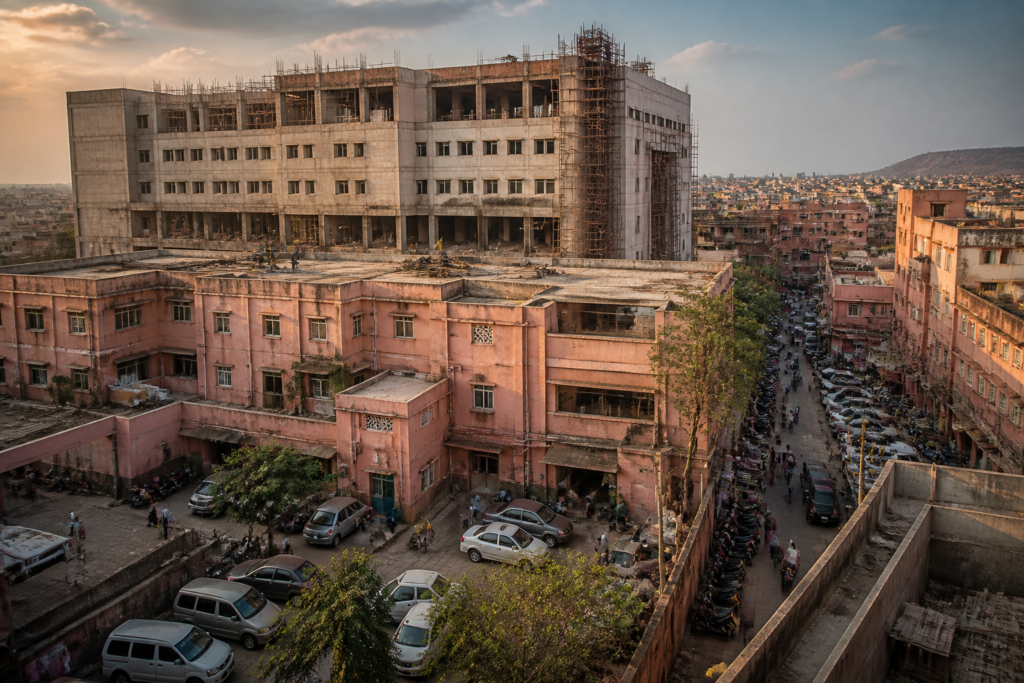
The delayed expansion of Pt Deendayal Upadhyay Hospital has left Jaipur’s walled city with a promised healthcare upgrade but without the additional capacity it was meant to provide. Five years after a temple, a mazaar and a government school building were demolished for the project, the Rs 52-crore superspecialty block remains incomplete and the existing hospital continues to manage patients within severely constrained space.
The project was intended to address the growing healthcare needs of residents of the walled city, nearby Shahpura town and settlements along Delhi Road. It was being built by Jaipur Smart City Limited on 5,998 square metres of land. The project’s scheduled completion deadline was October 2024, but the facility had still not become operational by October 2026.
The delay is not simply a construction schedule problem. It has created a gap between the public land and buildings that were removed to make way for expansion and the healthcare capacity that was supposed to replace them. The site was cleared in 2021, but the hospital has yet to receive the additional clinical, diagnostic and emergency facilities that justified the disruption.
The existing hospital is the area’s only government-run multispecialty facility. Its superintendent, Dr Leeneshwar Harshvardhan, said the hospital was functioning in limited space while the new building remained unfinished. His description captures the institutional problem facing the project: the old facility must continue serving patients, but the new block cannot yet absorb the services for which it was planned.
A site inspection cited in the report found substantial work pending. Civil construction was incomplete, modular operation theatres had not been started, and electrical and firefighting systems remained unfinished. Air-conditioning, false ceilings, floor tiling, internal and external painting and sanitary fittings were also incomplete or stalled. The medical gas pipeline, a basic requirement for a functioning hospital with surgical and critical-care capacity, had not been installed.
These are not cosmetic finishing tasks. In a hospital project, electrical systems, fire safety, medical gases, operating theatres and sanitation are linked to approvals, safety and the ability to begin clinical operations. A building can appear substantially constructed and still remain unusable for patients until these systems are completed, tested and commissioned. The supplied report does not establish a revised completion date or explain which agency is responsible for each remaining milestone.
The consequences are already visible in the services that the existing hospital cannot provide. The facility still lacks a CT scanner, MRI, blood bank and trauma emergency unit. It operates only a blood storage centre because of space constraints. The promised expansion was therefore expected to do more than increase floor area: it was meant to widen the hospital’s diagnostic, emergency and specialist-care capacity.
The shortage of space is also affecting everyday access. The hospital’s existing campus covers 7,189 square metres, with a built-up area of 1,12,165 square feet across the basement, ground floor and three upper floors. Patients face congested outpatient departments and long waits, while attendants have limited parking because the available space is reserved for staff.
Patient volumes show why the expansion was considered necessary, although the figures cited in the report require careful reading. The hospital recorded 3.8 lakh outpatient visits between January 1 and September 30 of the reported year, while the report also states that it registered 49.7 lakh OPD visits in 2025. The supplied material does not explain the basis for the difference between these figures, so they cannot be used reliably to establish a year-on-year trend. They do, however, indicate the scale of demand being placed on a 303-bed facility.
Nearly half of the hospital’s beds are earmarked for maternal care, and rising maternal footfall has led the hospital to issue antenatal check-up slots a day in advance to manage crowding. This is an example of how capacity constraints are converted into administrative controls. Advance slots may organise patient flow, but they do not create more consultation rooms, diagnostic equipment, beds or emergency space.
The project also illustrates the difference between land availability and usable public infrastructure. Land was assembled by removing existing structures and uses from the site, but the public benefit depends on what happens after demolition. Until construction, services, safety systems and commissioning are completed, the cleared land does not function as healthcare capacity. The delay therefore leaves the community carrying the disruption of redevelopment without receiving its intended service improvement.
Jaipur Smart City Limited’s role places the project within the broader institutional structure of urban infrastructure delivery. The hospital is a public healthcare facility, but its expansion is being executed through the city’s smart-city vehicle. That arrangement can bring access to a dedicated project structure, but it also creates the need for clear coordination between the implementing agency, the hospital administration and health authorities. The supplied report does not identify the cause of the delay, the revised cost, the status of contractor payments or the authority responsible for commissioning the building.
Those missing details matter because a delayed public building can face risks beyond lost time. Unfinished electrical and firefighting systems may require fresh testing after prolonged construction. Equipment procurement and installation must be coordinated with building readiness. Medical gas networks, modular operation theatres and diagnostic services require integration rather than isolated completion. The report establishes that these components are pending, but it does not establish whether procurement, design changes, contractor performance or approvals are responsible.
The hospital’s condition also shows why infrastructure performance cannot be measured only by sanctioned project value or visible construction. The expansion was announced as a Rs 52-crore upgrade, but its practical value will be determined by whether the new space becomes a functioning clinical facility. Until that happens, the old hospital continues to carry demand with 303 beds, limited parking and gaps in diagnostic and emergency services.
The urban question extends beyond one hospital. In dense and historic parts of Jaipur, public facilities serve residents from adjoining settlements as well as the immediate neighbourhood. The hospital’s catchment includes the walled city, Shahpura and settlements along Delhi Road, making its capacity relevant to a wider urban and peri-urban population. When a central public hospital is delayed, patients may have to wait longer, travel farther or depend on facilities that the report does not identify as available alternatives.
The project’s five-year delay also raises a basic governance question: how are public authorities tracking the link between demolition, construction, commissioning and service delivery? A project milestone such as completing civil work is not the same as opening a hospital. For citizens, the meaningful endpoint is operational capacity—working theatres, installed medical gases, commissioned safety systems, available diagnostics and services that can accept patients.
The evidence supplied confirms that Pt Deendayal Upadhyay Hospital remains overcrowded, that its expansion missed the October 2024 deadline and that multiple core systems are incomplete. It does not establish a new opening date, the reasons for the delay or the revised financial position of the project. The next significant public information should therefore be a verified completion schedule from Jaipur Smart City Limited and the health authorities, along with a clear account of the remaining construction, equipment and commissioning milestones.


