

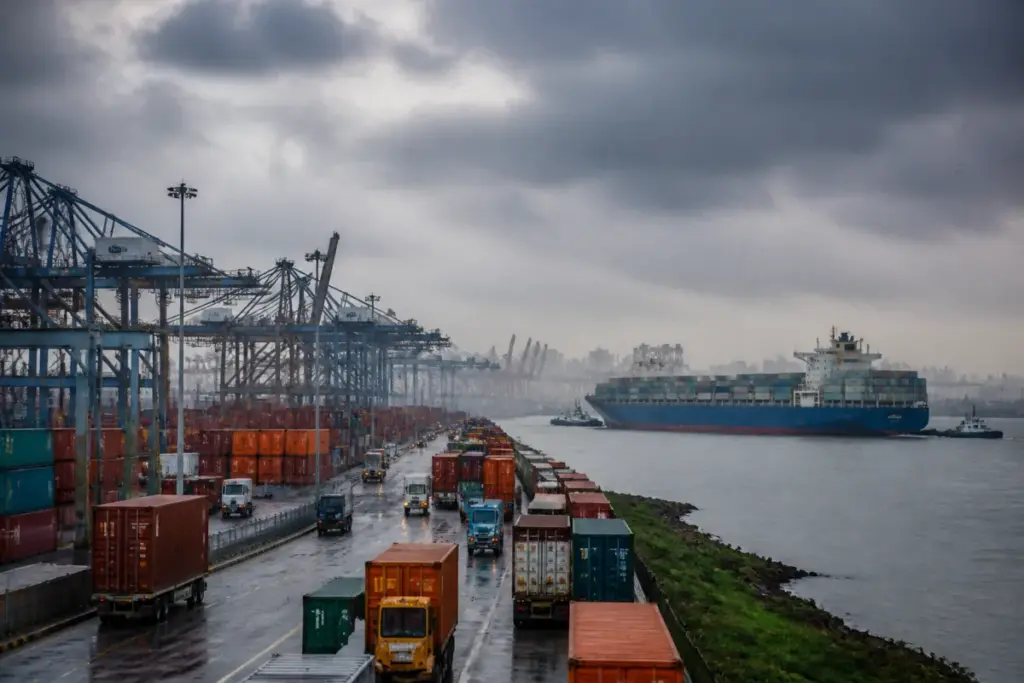
Global freight costs have surged even as India’s container-based trade continues to expand, exposing a central vulnerability in the country’s trade infrastructure: rising cargo volumes do not necessarily mean that the logistics system is insulated from geopolitical shocks. A Jefferies report cited by the Times of India said global container freight rates had risen 130 per cent since February 2026, while India’s containerisable exports and imports grew 23 per cent year on year in September.
The immediate trigger identified in the report is renewed tension in the Middle East. Average freight rates, which were around $2,000–2,500 in February, had increased to approximately $4,000–4,500 by October. The increase reverses a period of easing rates through much of 2025 and early 2026, when the demand-supply balance improved after freight prices had remained elevated in 2024.
That reversal matters because shipping costs are not simply a concern for shipping companies. They influence the cost and reliability of moving goods between factories, warehouses, ports and overseas markets. The supplied report does not establish that the freight increase has already reduced India’s export-import growth. It does, however, show that trade expansion is taking place alongside a sharp increase in the cost of the global routes on which containerised commerce depends.
The freight market’s sensitivity to events in the Middle East is also a reminder that the physical geography of trade remains difficult to separate from geopolitical risk. The Jefferies report specifically identified the possibility of shipping lines returning to the Suez Canal as a key factor to monitor, despite continuing tensions in the region. Changes in route choice can alter sailing patterns and freight prices, although the report does not quantify how quickly or by how much rates would change in that scenario.
The Suez Canal reference is significant because shipping routes are part of the infrastructure system supporting urban and industrial economies. Ports may be located at the edge of cities, but their performance affects manufacturing clusters, distribution centres, exporters, importers and employment across wider metropolitan regions. A disruption on a major maritime corridor can therefore appear locally as a change in delivery schedules, inventory planning or the cost of moving goods through a port-linked logistics network.
India’s September trade figures present a mixed picture. The value of container-based exports and imports increased 23 per cent year on year, according to the Jefferies report. Exports rose 22 per cent and imports 23 per cent. The increase to the United States was particularly strong, with Indian exports to that market rising 48 per cent compared with September of the previous year.
The pattern was weaker in West Asian destinations mentioned in the report. Shipments to the United Arab Emirates and Saudi Arabia declined by 12–15 per cent year on year. These figures do not by themselves show that Middle East tensions caused the declines, because the supplied material does not provide a causal breakdown. They do show that the overall growth in India’s container trade was not evenly distributed across destination markets.
The same unevenness appears in the port data. Cargo volumes at India’s major ports rose 13 per cent year on year in September, while non-major ports recorded a 1 per cent decline. Within the non-major port segment, Gujarat reported a 3 per cent increase, and ports in Maharashtra and Tamil Nadu recorded growth of 6–7 per cent. At the same time, major and non-major ports along India’s eastern coast saw a sharp fall in volumes, the report said.
This divergence is important for how port capacity and connectivity are assessed. A national growth figure can conceal substantial differences between coastlines, port categories and trade corridors. The figures cited in the report suggest that September’s container activity was stronger in some western and southern locations while eastern ports faced a decline. The supplied material does not identify the operational or trade-specific reasons for those differences, so it would be premature to treat the regional pattern as evidence of a permanent shift.
The numbers also complicate a common assumption that higher trade volumes automatically demonstrate infrastructure strength. India’s container trade grew in September even as global freight costs rose sharply. That combination indicates that demand for international cargo movement remained strong during the month, but it does not reveal how much additional cost, delay or commercial risk was absorbed by exporters, importers, carriers or other participants in the logistics chain.
The distinction between trade growth and logistics resilience is central. Trade growth measures the value or volume of goods moving through the system. Resilience concerns whether the system can continue to move those goods predictably when routes, prices or operating conditions change. The information available in the report establishes the first trend clearly and points to the second question, but it does not provide enough data to determine the full impact on Indian businesses or consumers.
The recent rate movement also sits within a broader cycle. Global container freight rates reached highs in 2021–22, then fell substantially before recovering in 2024. They declined again through much of 2025 and early 2026, only to rise sharply from February to October 2026. This sequence shows that freight pricing has been moving through repeated periods of expansion and correction rather than following a single, stable trend.
For ports and logistics operators, such volatility makes planning more difficult. Decisions about vessel deployment, terminal capacity and cargo routing are made against conditions that can change faster than physical infrastructure can be expanded or reconfigured. The report’s focus on a possible return to the Suez Canal highlights how route decisions by shipping lines can affect the wider freight market, even when the underlying port facilities in India have not changed.
The institutional picture is therefore distributed across several levels. Shipping lines make route and transit decisions; ports handle cargo and connect maritime movement to land-based networks; exporters and importers respond to freight prices and destination demand; and national trade performance reflects the combined outcome. The supplied report does not identify a single Indian authority responsible for managing the rate increase, because the immediate pressure originates in an international shipping environment and in decisions taken across a global network.
India’s port data nevertheless gives policymakers and infrastructure planners a set of signals to watch. Major ports grew faster than non-major ports in September, but the eastern coast recorded a sharp decline while selected western and southern locations grew. The geographical variation raises questions about corridor concentration, the distribution of cargo between ports and the ability of different regions to absorb changes in shipping routes. The supplied material does not answer those questions, but it establishes why a single national port-growth number is insufficient for understanding system performance.
The destination data provides another layer. Stronger exports to the United States coincided with declines in shipments to the UAE and Saudi Arabia. This means that the direction of trade mattered alongside the aggregate increase. A port or logistics corridor serving a growing market may experience different conditions from one connected to a market where shipments have weakened. For urban economies built around port activity, those differences can affect the distribution of warehousing, trucking and industrial demand, although the report does not quantify those local effects.
The central evidence is therefore mixed rather than uniformly positive or negative. India’s containerisable trade expanded, major-port cargo volumes increased and exports to the United States rose sharply. At the same time, global freight rates more than doubled from their February range, non-major port volumes declined overall, eastern ports recorded a sharp fall and shipments to two West Asian destinations weakened.
What remains uncertain is how durable the rate increase will be and how shipping lines will respond to conditions around the Suez Canal. The Jefferies report identifies a possible return to the canal as a key monitorable, but the supplied material does not confirm that such a shift has occurred or establish its eventual effect on freight prices. The next stage of the story will depend on route decisions, subsequent freight-rate data, destination-wise trade performance and whether the regional differences in Indian port activity persist.


