

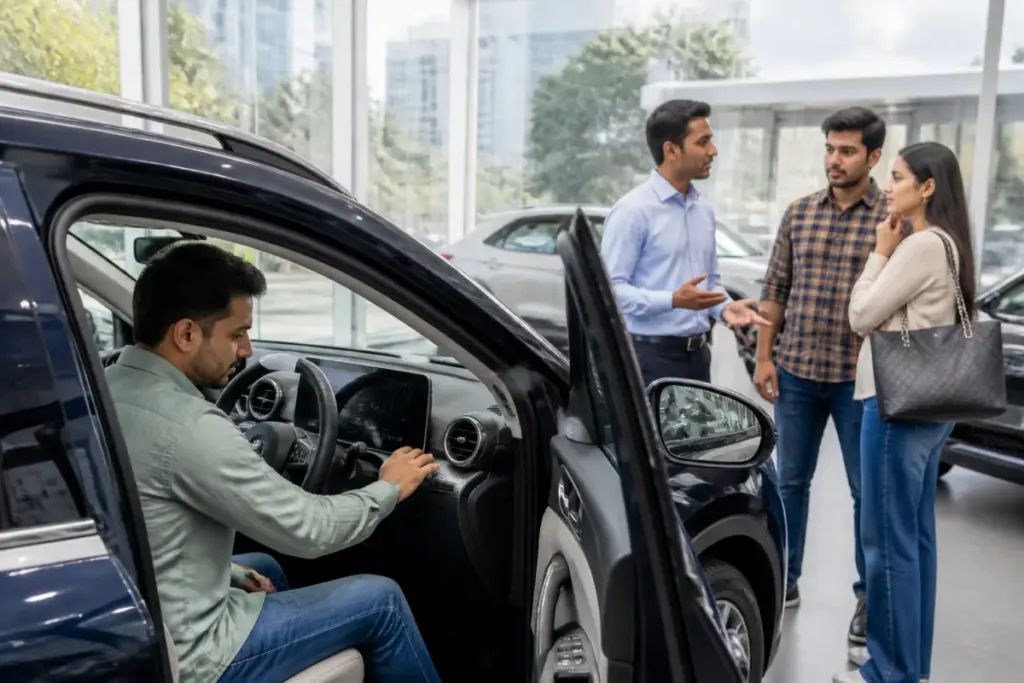
India car-buying decisions are increasingly being shaped by technology and vehicle features rather than brand alone, according to a Bain & Co survey of more than 12,000 automotive consumers globally. The finding points to a change in how mobility is being evaluated in India: consumers still trust established manufacturers, but they are placing greater weight on the practical value delivered by the vehicle itself.
The survey, conducted online in the first quarter of 2026, ranked technology and features as the top considerations for Indian car buyers. Service ranked third and price fourth. That order does not mean price has become unimportant in a price-sensitive market. Instead, it suggests that consumers are weighing affordability alongside expectations of better equipment, stronger digital interfaces and features that were previously associated mainly with luxury cars.
This shift matters beyond the showroom. Cars are becoming technology products as well as transport assets, and that is changing the basis on which consumers compare vehicles. For manufacturers, the competitive question is no longer limited to brand reputation, engine performance or price. It increasingly includes whether technology is easy to understand, useful in daily travel and credible enough to justify the price paid.
The survey finding also exposes a tension at the centre of India’s passenger-vehicle market. Brand trust remains powerful, even as the features attached to a vehicle become a stronger differentiator. Sixty-eight per cent of premium-car buyers and 71% of mass-market buyers said they had considered only established brands during their last purchase. New entrants therefore face a difficult route into the market: they must introduce a product that is visibly differentiated while also convincing customers that the company can deliver dependable ownership.
That combination is important because advanced features are moving down the price ladder. Rahul Mishra, a partner at Bain & Co, told Economic Times that features once largely confined to luxury vehicles are increasingly becoming standard in mass-market cars priced between ₹15 lakh and ₹30 lakh. The implication is not simply that cars are becoming more expensive or more sophisticated. It is that technology is becoming part of the expected value proposition across a larger section of the market.
For buyers, the value of a feature will depend on how it performs in everyday conditions. A technology package may attract attention during a purchase, but service, reliability and ease of use determine whether it remains valuable after delivery. The survey’s ranking of service as the third-most important consideration indicates that consumers are not separating the product from the ownership system around it. The vehicle, dealership, maintenance network and support experience are being assessed together.
Mishra described technology features that come with a brand and clearly explain the value for money as a stronger differentiator. That observation captures the changing institutional relationship between automakers and consumers. Manufacturers are not only selling vehicles; they are required to explain the purpose of the technology, establish confidence in its operation and connect it to a broader promise of affordability and service.
## AI is entering the purchase journey
Nearly 80% of Indian buyers surveyed said they used artificial intelligence during their vehicle purchase journey. Usage was higher among younger consumers, reaching around 90% for Gen Y and Gen Z, compared with about 79% among older generations. The figures indicate that AI is becoming part of how consumers research and narrow their choices before they reach a dealership.
The survey does not establish exactly which AI tools consumers used or how those tools affected final purchases. It does, however, show that the buying journey is no longer confined to manufacturer advertising, personal recommendations and showroom visits. Consumers are using digital systems while comparing models, features and likely value. This gives technology platforms a growing role in shaping demand before a salesperson enters the conversation.
For automakers, that creates a new challenge in communicating product value. If consumers use AI-assisted tools to compare vehicles, brands may have less control over how their products are presented. A company’s visibility will depend not only on advertising but also on whether its specifications, features and ownership claims can be understood and compared across digital channels.
The continued importance of dealerships shows that this digital shift has not made physical evaluation irrelevant. The survey found that the vehicle purchase journey continues across digital and physical channels, with dealerships remaining important for evaluation and completion of the purchase. Consumers may research online and use AI before visiting a showroom, but the final decision still includes a physical interaction with the vehicle and the dealer.
This creates a connected retail system rather than a simple replacement of offline sales by online sales. Digital research can bring an informed customer to the dealership, while the dealership remains the place where consumers assess the vehicle, seek clarification and complete the transaction. The quality of the transition between those stages can influence whether interest becomes a purchase.
## Electric vehicles need more than awareness
The survey also offers a measure of consumer openness to battery electric vehicles. Fifty-seven per cent of Indian consumers said they were open to buying a BEV, with the share rising to 61% among Gen Y. Among consumers who had test-driven a BEV, 82% said they would consider buying one, compared with 66% of those who had not taken a test drive.
These figures do not prove that a test drive causes a purchase decision, because the survey does not provide that causal finding. They do show a substantial difference in stated consideration between consumers who had experienced a BEV and those who had not. The result places the test drive at an important point in the transition from general awareness to personal evaluation.
Mishra said automakers and dealers must reduce the friction between a customer requesting a test drive and actually experiencing the vehicle. That issue is especially relevant for electric mobility because many consumers may still be comparing a new ownership experience with a familiar internal-combustion vehicle. The dealership’s role therefore extends beyond displaying the car. It becomes a channel for translating unfamiliar technology into an experience that consumers can assess directly.
The survey’s EV findings also reveal a gap between openness and conversion. A majority of respondents being open to a BEV does not mean that they have committed to purchasing one. The supplied findings do not provide information on charging access, running costs, financing, resale values or the availability of public charging infrastructure. Those factors may shape the final decision, but their effect is not established by this report and cannot be inferred from the survey alone.
## The larger market question
Taken together, the findings describe a market in which technology has become a central part of value, brand trust remains a barrier to new entrants and the purchase journey is divided between digital research and physical verification. This is a more complex consumer landscape than a simple shift from brand-led to feature-led buying.
Established manufacturers retain an advantage because consumers continue to consider them first. Yet that advantage does not remove the need to update products. If technology and features are now the leading considerations, brand credibility must be supported by visible product value. Conversely, new entrants cannot rely on novelty alone. They must establish both what their technology does and why consumers should trust the company behind it.
The findings also connect vehicle purchasing to the broader urban mobility system. Passenger cars are bought through a network that includes manufacturers, dealerships, service providers, financing channels and increasingly digital information systems. As buyers use AI and demand advanced features, the institutions around the vehicle must adapt alongside the vehicle itself.
The Bain survey confirms a change in the language of car buying in India: technology is moving closer to the centre, while brand remains a crucial filter. It also shows that EV consideration is higher among consumers who have experienced a battery-electric vehicle, although the evidence supplied does not establish what ultimately converts that consideration into a purchase. The developments to monitor are how automakers explain technology, how dealerships manage digital-to-physical journeys and whether openness to EVs translates into actual adoption.


