

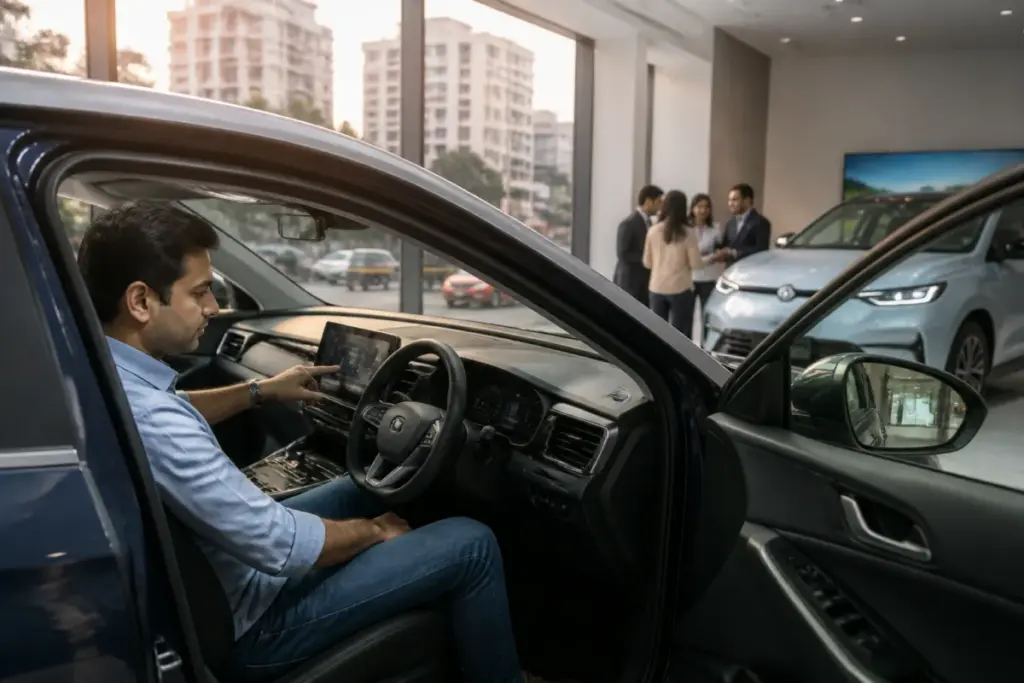
India car-buying trends are being reshaped by technology, advanced features and digital decision-making, even as established brands retain a powerful advantage with consumers. A Bain & Co survey of more than 12,000 automotive consumers globally found that technology and features have become the leading considerations for Indian car buyers, ahead of brand, service and price.
The finding is significant because it complicates the familiar description of India as a purely price-sensitive automobile market. Price remains important, but the survey indicates that consumers are assessing value through a wider combination of technology, financing access, aspirational upgrades, service quality and the credibility of the manufacturer. For automakers, the challenge is no longer simply to sell a vehicle at a competitive price. It is to explain why its features are useful, dependable and worth paying for.
That shift is also visible in the spread of features once associated mainly with luxury vehicles. According to Rahul Mishra, a partner at Bain & Co, advanced features are increasingly becoming standard in mass-market cars priced between ₹15 lakh and ₹30 lakh. The survey finding suggests that technology is moving down price segments, raising expectations among buyers who may previously have viewed connected systems, driver-assistance functions or other digital features as premium additions.
Mishra told Economic Times that the technology accompanying a brand, and the way the value for money is explained to consumers, has become a stronger differentiator. This places greater pressure on manufacturers to connect product design with customer understanding. A feature may be technically advanced, but its influence on the buying decision depends on whether consumers see a clear benefit and trust the company to support it over the life of the vehicle.
The survey does not, however, show that brand has become irrelevant. Established manufacturers continue to dominate consideration sets. Sixty-eight per cent of premium car buyers and 71% of mass-market buyers said they had considered only established brands during their last purchase. This creates a two-part market test for newer entrants: they must provide differentiated products while also building confidence in what their brand and technology represent.
That combination is particularly important in a market where the vehicle purchase extends beyond the showroom. Buyers are not evaluating only the car’s visible features. They are also assessing the company’s service network, the reliability of support and the risk associated with choosing a less familiar manufacturer. The survey’s ranking of service as the third-most-important consideration underlines the continuing role of institutional capacity behind the product.
The importance of service also explains why the shift towards technology is not only a question of marketing. More digital and electronically enabled vehicles require consumers to understand new functions and manufacturers to maintain systems that may not be visible in a conventional test drive. The supplied survey findings do not quantify service performance or after-sales failures, but they establish that service remains ahead of price in the list of considerations reported by buyers.
The buying journey itself is becoming more digitally mediated. Nearly 80% of Indian buyers surveyed said they use artificial intelligence during their vehicle purchase journey. Use was higher among younger consumers, reaching around 90% among Gen Y and Gen Z, compared with about 79% among older generations.
This does not mean dealerships are being displaced. The survey found that the purchase journey continues across digital and physical channels, with dealerships remaining important for vehicle evaluation and completion of the purchase. The emerging model is therefore not an online replacement for the showroom. It is a connected process in which consumers may use digital tools and AI to compare products, understand features and narrow their choices before relying on a physical dealership to assess the vehicle and finalise the transaction.
For manufacturers and dealers, this changes where influence is exerted. Earlier stages of the journey increasingly involve digital information, while the dealership remains a critical point of trust and experience. A mismatch between what a consumer sees online and what is available at the dealership could weaken confidence. Conversely, a smoother transition from online research to an informed test drive could help manufacturers convert interest into purchase.
The survey’s findings on battery electric vehicles add another layer to this changing decision process. Fifty-seven per cent of Indian consumers surveyed said they were open to buying a battery electric vehicle. Among Gen Y consumers, the share rose to 61%. Openness was substantially higher among people who had already experienced the technology: 82% of consumers who had test-driven a BEV said they would consider buying one, compared with 66% of those who had not.
The difference between these groups points to the importance of direct experience in a technology-led market. The survey does not establish that a test drive causes consumers to choose an electric vehicle, and it does not provide a breakdown of the factors behind the gap. It does show, however, that consumers who have driven a BEV report greater willingness to consider one. That makes the connection between product access and purchase consideration especially important for automakers and dealers.
Mishra said companies and dealerships must reduce the friction between a customer requesting a test drive and actually experiencing the vehicle. He also said consumer data and technology would be important in developing products suited to future demand. Within the evidence supplied by the report, this is the clearest operational implication: the industry must make it easier for consumers to move from curiosity to first-hand evaluation.
The findings also reveal how the transition to electric mobility is being shaped at the consumer interface. Public discussion of electric vehicles often focuses on manufacturing, charging infrastructure and policy support. The Bain survey examines a different but connected part of the system: whether buyers are willing to consider the product and what helps them cross the threshold from awareness to evaluation. Its results suggest that exposure and experience matter, although the survey does not measure charging access, ownership costs or regional differences.
The same limits apply to the broader technology findings. The report identifies the considerations consumers rank most highly, but the supplied material does not provide a detailed breakdown by city, income group, vehicle body type or specific feature. It also does not establish whether AI is being used mainly for price comparison, feature research, financing, reviews or dealership discovery. Those distinctions would matter for understanding how digital tools are changing the market in practice.
Even with those limitations, the survey places established brands and new entrants in different strategic positions. Established manufacturers benefit from the trust reflected in the consideration data, but they must continue updating their vehicles and communicating the value of those updates. New entrants may have technology-led products, yet they face the harder task of earning consideration in a market where most buyers still restrict their choices to familiar names.
The price question remains central to this competition. The report describes India as price-sensitive and identifies vehicle financing and aspirations to upgrade as influences on purchasing decisions. At the same time, technology and features rank ahead of price in the survey’s list of considerations. This does not indicate that buyers will ignore affordability. It suggests instead that affordability is being evaluated alongside the perceived usefulness and credibility of the vehicle’s technology.
That distinction matters for the expansion of advanced features into the ₹15 lakh-to-₹30 lakh segment. As these features become more common, consumers may begin to treat them as expected equipment rather than optional differentiation. Manufacturers could then face pressure to offer more technology without losing affordability or weakening service support. The supplied evidence does not quantify the cost of that adjustment, but it shows why product strategy, pricing and after-sales operations are becoming increasingly connected.
For cities, the consumer shift is relevant because cars are not isolated products; they are part of the wider urban mobility system. The survey does not measure congestion, parking, road use or emissions, so it cannot be used to predict how these preferences will change urban transport. It does indicate that the adoption of electric vehicles and digitally enabled cars will depend partly on how consumers encounter, understand and trust the technology. The dealership, test drive and digital research process therefore form part of the practical infrastructure through which mobility choices are made.
The evidence confirms three overlapping movements in the Indian car market. Technology has moved ahead of brand as the top reported consideration, but established brands remain dominant in consumer consideration. AI has become part of the purchase journey, particularly for younger buyers, while dealerships continue to matter. Finally, openness to battery electric vehicles is substantial and higher among consumers who have test-driven them.
What remains unclear from the supplied survey is how these preferences vary across cities and income groups, which technologies consumers value most, and how financing, service quality and charging access affect final purchases. Those questions will determine whether the reported shift in consideration becomes a deeper change in vehicle ownership and urban mobility. For now, the evidence points to a market where technology is gaining influence, but trust and physical experience still determine how far that influence travels.


