

Illegal clinics in Pune have come under scrutiny after the reported arrest of a man accused of running an unauthorised leech-therapy practice in Fursungi, while a separate alleged medical-negligence case in Jabalpur has renewed concerns about unqualified practitioners and gaps in health enforcement. The supplied report attributes the Pune action to Fursungi police but does not include the police complaint, arrest record, health-department inspection report or court document needed to independently establish the allegations.
According to the report, Fursungi police arrested Shahzad Iqbal Mohammad Khan, also known as Raj Patel, a resident of Kota in Rajasthan. He is accused of practising medicine illegally and of misleading a woman into undergoing unauthorised knee procedures while presenting the service as naturopathy care. The report says the investigation will determine whether other patients were treated and whether similar operators remain active in the city. Those points remain unconfirmed in the material supplied.
The case places attention on a difficult administrative problem: illegal or unauthorised healthcare operations can sit at the intersection of public health, municipal licensing, professional registration and criminal law. A practitioner may require professional qualifications and registration to provide medical treatment, while a clinic or treatment centre may also be subject to premises, sanitation, commercial and local-authority requirements. Effective enforcement therefore depends on coordination between health officials, professional councils, civic authorities and the police.
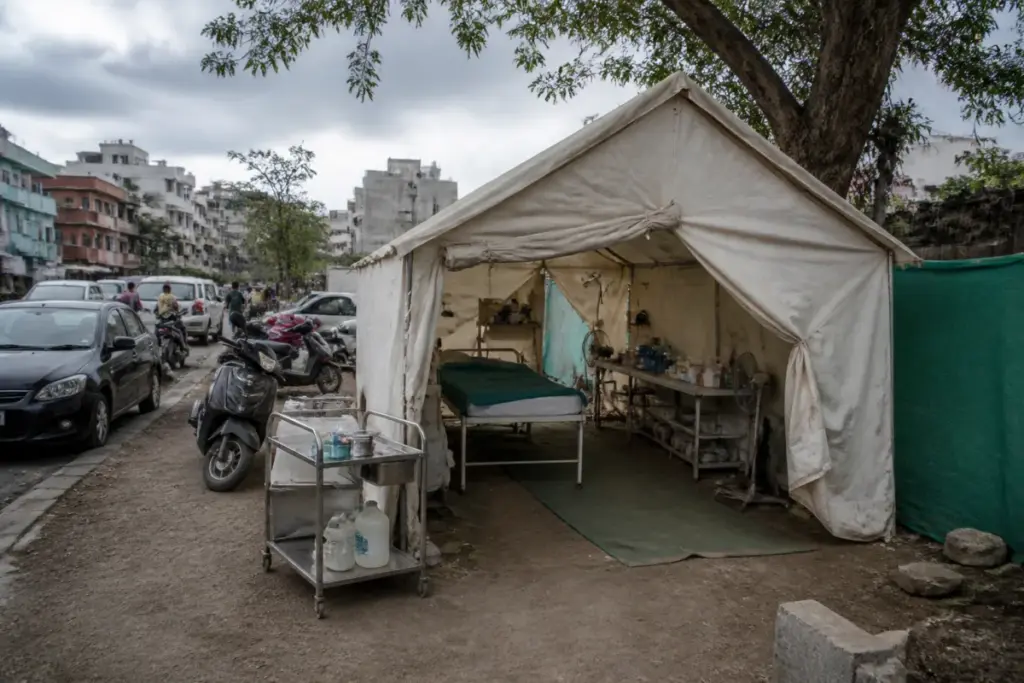
The Pune report describes roadside tents, parked cars and makeshift premises allegedly offering Ayurvedic, naturopathic and Unani treatments for conditions including infertility, arthritis, kidney stones and piles. However, it does not provide a verified list of such establishments, inspection figures, registration records, closure notices or statements from the Pune civic administration. The existence, number and operating status of these alleged clinics therefore require independent confirmation before they can be treated as an established citywide pattern.
The distinction matters because the Fursungi incident, if supported by official records, would establish an alleged illegal practice and a police response. It would not by itself prove that unqualified practitioners are operating across Pune or that civic officials knowingly ignored them. Establishing those wider claims would require evidence such as inspection data, complaints received, enforcement action, prosecutions, professional-registration checks and information on the authorities responsible for each category of violation.
The supplied article also refers to an 18-year-old in Jabalpur who allegedly died after receiving multiple injections and an intravenous drip at a facility linked to an unqualified practitioner. It says authorities sealed the hospital. The account is presented as a reported case and contains serious allegations, but the material does not provide the hospital-sealing order, police case details, medical findings or a statement from the Madhya Pradesh authorities. The Jabalpur incident should therefore be treated as an attributed allegation rather than an independently established account in this article.
Together, the two cases point to the vulnerability of patients seeking low-cost or easily accessible treatment. The supplied report says that people who are poor, anxious or unable to afford formal hospital care may be more likely to respond to promises of quick, cheap or natural cures. That is a plausible public-health concern, but the article provides no survey, patient data or official assessment quantifying how affordability, distance or distrust of formal healthcare influence patients’ choices in Pune.
For city administrations, the enforcement question is not limited to identifying a person who claims to be a doctor. Authorities must determine whether the individual is registered to practise, what form of treatment is being offered, whether the premises are authorised, whether medicines or invasive procedures are being used, and which agency has jurisdiction. A response that addresses only one part of the problem may leave the operation able to reopen under another name or at another location. The supplied material, however, does not establish how Pune currently divides these responsibilities or whether a joint enforcement mechanism exists.
The article calls for surprise inspections, registration checks, closure of illegal clinics and prosecution that deters repeat violations. It also says officials who ignore such operations should be held accountable. These are recommendations made by the source article, not announced measures from the Pune civic administration or health authorities. No official enforcement plan, inspection schedule, prosecution data or accountability mechanism is included in the supplied material.
The absence of such information is itself important for reporting. A police arrest can provide an immediate response to a complaint, but it does not reveal whether the city has a preventive system for detecting unauthorised medical activity. To assess that system, readers would need to know how complaints are recorded, how quickly inspections follow them, how practitioner credentials are checked and what happens after a premises is sealed. They would also need clarity on whether patients can verify registration through an accessible official database and whether enforcement outcomes are publicly reported.
The Pune case also raises a question about the boundary between traditional systems of medicine and unauthorised medical practice. The report mentions services described as Ayurvedic, naturopathic and Unani, but it does not establish whether the accused held any recognised qualification in one of these systems or whether the alleged treatment fell within the permitted scope of such practice. That distinction should be determined through registration records, the relevant professional rules and the investigating authority’s findings, rather than inferred from the description of the treatment alone.
For patients, the report advises checking a practitioner’s registration number with the relevant medical council before accepting treatment. That precaution may reduce risk, but the supplied article does not identify the official verification portals, explain which council applies to different systems of medicine or state what patients should do when a practitioner refuses to provide credentials. A useful public-health response would require clear, accessible information, but no such government communication is cited here.
The immediate verified development available in the supplied material is the reported arrest in Fursungi. The broader claim that illegal clinics are widespread in Pune, that officials routinely overlook them or that similar operators are active across the city remains to be established through primary records and official responses. The next significant milestones are the police investigation, any charges or court proceedings, confirmation from the health and civic authorities, and evidence showing whether the alleged practice was isolated or part of a wider enforcement problem.


