

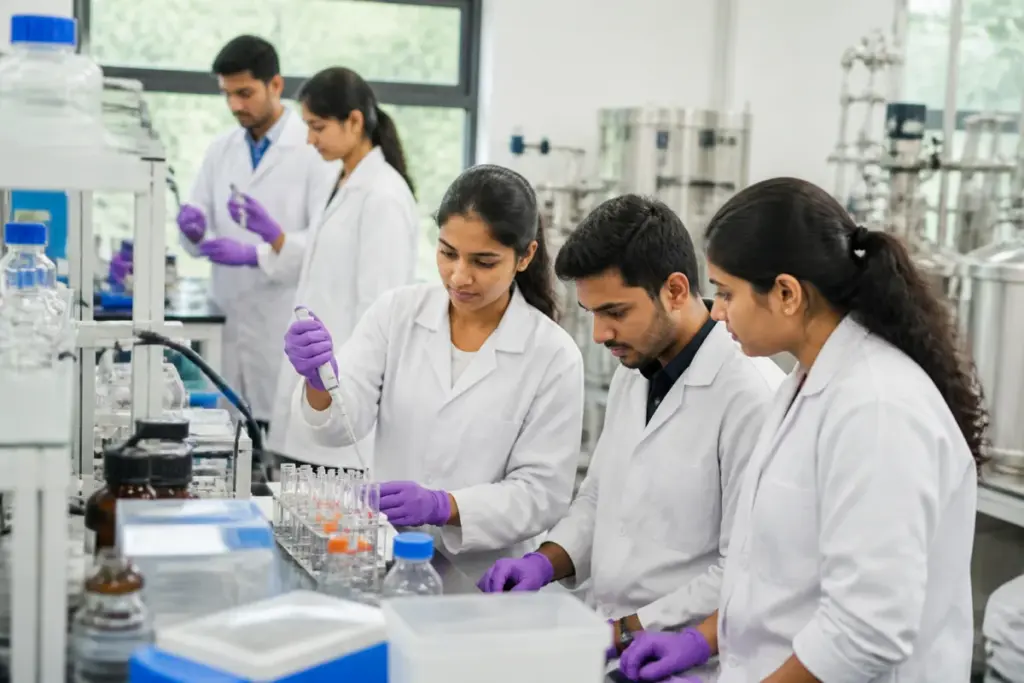
IIT Madras has launched UDYOG, an industry-oriented biotechnology finishing school that aims to move graduates beyond classroom learning and towards practical work in biotechnology and biomanufacturing. The programme is significant not because it is another academic course, but because it brings into focus a persistent institutional question: how can higher education prepare students for sectors in which laboratory practice, pilot-scale operations and industry exposure are as important as formal qualifications?
The programme was inaugurated by IIT Madras Director V. Kamakoti and will be delivered through SynBioME and the IIT Madras-TICEL Biofoundry. It is intended for pre-final and final-year BTech, MTech and MSc students in biotechnology and allied disciplines from across India. The first batch is scheduled to begin on January 18, 2027, while early-bird registration is due to close on December 15, 2026.
UDYOG, or Upskilling and Development for YOung Graduates, will combine online courses with intensive laboratory training, pilot-scale exposure and industry internships. That combination is the central feature of the initiative. Rather than treating employability as a matter of adding another certificate, the programme is designed around the practical environments in which biotechnological processes are developed, tested and transferred.
The distinction matters for the way technical education connects to the wider urban economy. Biotechnology and biomanufacturing depend on specialised laboratories, trained personnel, pilot facilities, institutional partnerships and companies capable of absorbing skilled graduates. The source material does not establish the size of that sector or quantify the shortage of trained workers. It does, however, identify the gap between academic learning and industry requirements as the problem UDYOG is intended to address.
That gap is often created by the different operating conditions of universities and industry. Academic programmes generally organise learning around courses, examinations and research work. Industry, by contrast, requires familiarity with processes, equipment, quality expectations and production-oriented environments. UDYOG’s proposed mix of laboratory training, pilot-scale exposure and internships suggests an attempt to place students closer to the latter environment before they complete their degrees.
The institutional design is also important. The programme is being launched through SynBioME and the IIT Madras-TICEL Biofoundry rather than as a conventional classroom-only intervention. The involvement of a biofoundry gives the initiative a practical infrastructure base, at least as described in the announcement. A biofoundry can serve as a bridge between laboratory experimentation and more applied biomanufacturing work, although the supplied information does not specify the equipment, facilities, industrial partners or projects that students will access.
This lack of detail is not a minor issue when assessing the likely value of a finishing school. The programme’s stated components are clear, but their quality will depend on how much laboratory time students receive, whether pilot-scale work is genuinely hands-on, what the internships involve and how closely the curriculum reflects the needs of participating companies. None of those outcomes can be established from the launch announcement. At this stage, UDYOG is best understood as an institutional response to a recognised skills problem, not as proof that the problem has already been solved.
The programme is open to students in BTech, MTech and MSc courses in biotechnology and allied disciplines. That target group indicates that the initiative is aimed at the transition between higher education and employment. Pre-final and final-year students are close enough to graduation to benefit from work-oriented exposure, while still having time to apply the learning within their degree programmes. The national eligibility frame also means that the initiative is not restricted to students already enrolled at IIT Madras.
For students outside major research institutions, access to specialised training can be particularly important. The announcement does not provide a breakdown of participating colleges, locations or fees, so it is not possible to assess how accessible the programme will be across regions or income groups. The online component may allow wider participation, but laboratory and pilot-scale training require physical infrastructure. The eventual reach of UDYOG will therefore depend on how the programme combines digital instruction with in-person capacity.
The programme also reflects the changing language of technical education. In his remarks, Kamakoti linked AI with “Academia-Industry” and argued that every discipline of science and engineering must engage with AI to remain relevant to the modern world. The statement places UDYOG within a broader effort to connect academic institutions with contemporary technological and industrial requirements. The announcement does not explain how AI will be integrated into the finishing school’s curriculum, so its precise role remains unspecified.
That ambiguity is important. AI can refer to different forms of work in biotechnology, from data analysis and process optimisation to modelling, automation and the management of laboratory information. Without details of the modules, teaching methods or tools involved, it would be premature to conclude that UDYOG is an AI programme. What can be said is that its launch is being presented as part of a wider attempt to make scientific and engineering education more closely aligned with a changing industrial environment.
The institutional responsibility is divided across several actors. IIT Madras is the academic anchor and the institution whose director inaugurated the programme. SynBioME and the IIT Madras-TICEL Biofoundry are the platforms through which the initiative is being launched. Industry enters through the programme’s stated internship and application orientation. Students are the immediate participants, while biotechnology and biomanufacturing companies are the intended beneficiaries of a more practically trained talent pool.
This structure highlights a broader challenge in skills policy: no single institution controls the entire transition from education to employment. Universities can teach concepts and provide laboratories. Industry can define workplace requirements and offer internships. Applied facilities can create a space between academic research and commercial production. A finishing school attempts to connect these functions, but its effectiveness will depend on coordination among them.
The available numbers are limited but useful. The programme is aimed at three broad qualification groups—BTech, MTech and MSc students—and is open to candidates across India. It has two stated near-term milestones: early-bird registration by December 15, 2026, and the start of the first batch on January 18, 2027. The announcement does not state the number of seats, duration, fee structure, faculty strength, internship partners or expected placement outcomes. These are the indicators that will eventually determine the programme’s scale and performance.
The absence of those figures also limits comparisons. There is no information in the supplied material about similar finishing schools, existing biotechnology training capacity, employer demand or the number of graduates expected to participate. It is therefore not possible to measure UDYOG against a national benchmark or to establish whether it represents a large intervention or a limited pilot. The initiative’s importance lies, for now, in the model it is attempting to test: combining academic instruction with practical laboratory, pilot and industry experience.
For cities and regional economies, the relevance of such a model extends beyond campus boundaries. Biotechnology and biomanufacturing require concentrated ecosystems of research institutions, specialised infrastructure, companies and skilled workers. The source material does not identify the locations where participating students will work or the industries that will host them. It does show, however, that IIT Madras is using its institutional facilities and partnerships to address a workforce transition that cannot be managed through classroom instruction alone.
The next stage will reveal whether the launch becomes a durable training pathway or remains a one-off programme. The key evidence will be the number and diversity of students enrolled, the actual laboratory and pilot-scale exposure provided, the nature of industry internships, and whether graduates move into relevant employment or further applied research. Those outcomes are not yet available and should not be inferred from the announcement.
UDYOG’s first batch is scheduled to commence on January 18, 2027, with early-bird registration closing on December 15, 2026. Until then, the programme establishes an institutional commitment by IIT Madras to narrow the distance between biotechnology degrees and workplace practice. Its larger test will be whether that commitment can be translated into measurable access, training quality and industry outcomes.


