

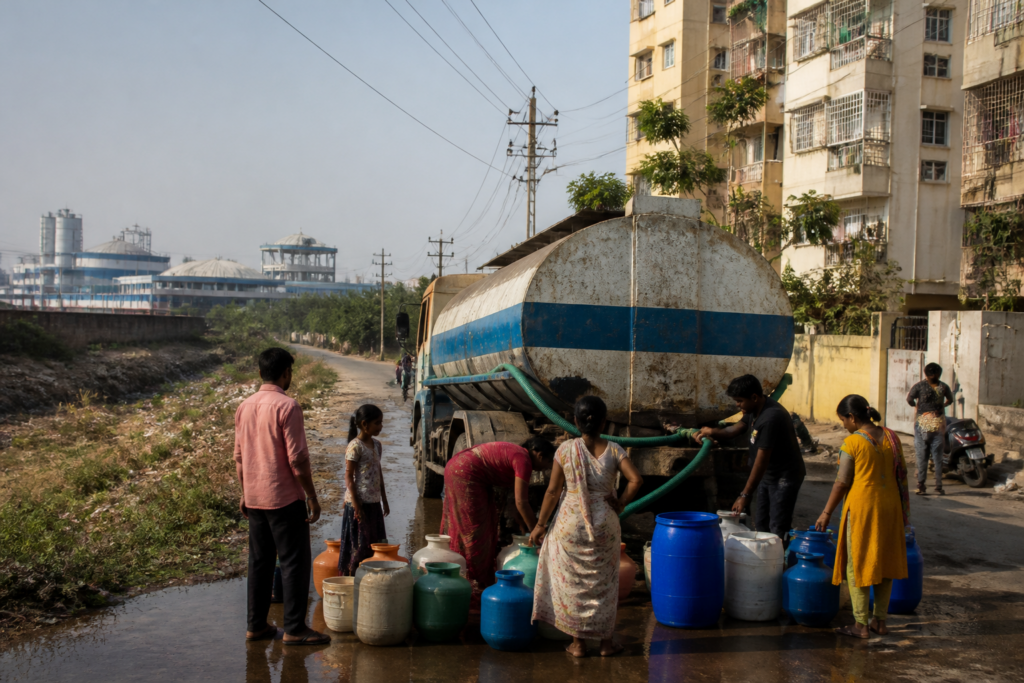
Hyderabad’s water crisis is becoming visible in the numbers emerging from the city’s own water and power agencies. Water tanker bookings have risen from the usual 3,500 for this period to about 7,000, groundwater levels have fallen by more than five metres compared with last year, and officials say the water available from the Manjeera and Singur reservoirs may last only until December if there are no inflows.
The figures were presented at a review meeting convened by Government Special Chief Secretary Jayesh Ranjan at the Hyderabad Collectorate. The meeting brought together the Hyderabad district administration, the Hyderabad Metropolitan Water Supply and Sewerage Board (HMWSSB), Telangana Southern Power Distribution Company Limited, the Greater Hyderabad Municipal Corporation and other departments to plan for the effects of El Niño and adverse weather conditions.
The immediate response is a conservation campaign. Ranjan has asked officials to ensure that every household reduces water consumption by at least 20 per cent. The administration also plans awareness programmes through different media and has warned that illegal motors fitted to HMWSSB pipelines will be identified and removed, with fines and penalties imposed where necessary. HYDRAA services will be used to identify violations, including illegal water extraction and misuse of resources.
These measures show that Hyderabad’s water challenge is no longer being treated only as a problem of source augmentation. It is also being framed as a problem of demand, distribution and enforcement. The city is being asked to consume less at the same time as its agencies search for alternative sources and attempt to shift non-drinking uses away from treated drinking water.
That distinction is central to understanding the city’s resource position. HMWSSB Managing Director K Ashok Reddy said the absence of inflows into the Manjeera and Singur reservoirs this year had made the currently available water sufficient only until December. Plans are being prepared to supply water through alternative sources, including additional water from the Godavari Drinking Water Scheme. Officials are also examining the possibility of drawing more Krishna water and adding filter beds at Himayat Sagar and Osman Sagar.
The source-side options are significant because they involve expensive, large-scale infrastructure and inter-system transfers. But the meeting’s details also indicate that Hyderabad is trying to build a parallel system for non-potable water. Treated sewage water discharged into the Musi River is expected to be made available for industrial use, data centres, gardening, landscaping and the maintenance of central medians. Filling stations at sewage treatment plants would allow tankers to collect this water for uses that do not require drinking-water quality.
HMWSSB has identified 13 treated-water filling stations within its jurisdiction, of which three or four are currently operational. The stated target is to make all 13 operational by November 1. Another 20 filling stations are planned over the following 15 days. A mobile application called ‘Dial a Green Tanker’ is also expected to enable online bookings for treated water.
The proposed system could change how Hyderabad manages demand from construction and landscaping, two activities that can consume substantial quantities of water but do not require potable supplies. Officials said steps would be taken to ensure that 90 per cent of the water required for construction activities comes from treated water available nearby. The use of treated water for landscaping is also expected to become mandatory, including in government institutions.
However, the evidence supplied in the review meeting also reveals a gap between the city’s planned reuse network and the scale of current stress. Only three or four of the 13 identified stations are operational, while tanker demand has already doubled. The plan for 20 additional stations indicates an effort to close that gap quickly, but the available information does not establish their precise locations, capacities, quality-monitoring arrangements or operating costs.
The tanker figures provide a ground-level indicator of this pressure. Reddy said bookings had risen because of reduced rainfall and declining groundwater levels. About 7,000 bookings are now being recorded against a normal figure of roughly 3,500 for the month. Tankers therefore function not simply as an emergency service but as a measure of how far the formal network and local sources are failing to meet demand in parts of the city.
Groundwater adds another layer to the problem. Officials said levels had fallen by more than five metres compared with the previous year. The government has taken up 22,000 groundwater recharge structures this year and is formulating a plan to provide recharge facilities to every household over the next five years. The proposal recognises that groundwater depletion cannot be addressed only through tanker supply or new surface-water allocations.
Yet recharge infrastructure will have to operate within the city’s built environment. The supplied report does not specify the performance of the 22,000 structures, their distribution across Hyderabad, or the volume of water they are expected to restore. It also does not indicate how household-level recharge facilities will be financed, enforced or maintained. Those details will determine whether recharge becomes a functioning urban utility or remains a construction target.
The electricity discussion at the meeting points to a connected pressure. Telangana’s electricity demand has reached a new peak of 20,018 MW, according to Telangana Southern Power Distribution Company Limited Managing Director Jitesh Patil. Demand is expected to increase further during the summer months, particularly in March and April. Water supply, groundwater extraction, pumping, treatment and cooling all depend on electricity, making the two conservation agendas closely linked even though they are managed by different agencies.
Patil asked government offices to maintain air-conditioner temperatures at 25 degrees Celsius and reduce electricity use during evening hours. Residents were advised to inspect household wiring and exercise caution when using electric cookers, induction stoves and air-conditioners at the same time. Rooftop solar installations are being encouraged, and consumers were advised to plan electricity use around daytime solar availability.
The proposed response is therefore based on several layers: conserve household water, prevent illegal extraction, expand alternative supplies, reuse treated sewage, recharge groundwater, reduce electricity demand and encourage distributed solar generation. This is broader than a seasonal advisory. It is an attempt to coordinate municipal administration, water supply, power distribution, urban development and enforcement around a common resource constraint.
The institutional structure matters because Hyderabad’s water demand does not sit within one department. HMWSSB controls major elements of water supply and sewage management. The district administration coordinates local government action. GHMC has responsibilities affecting roads, public spaces, landscaping and civic operations. HYDRAA is being brought into enforcement against violations. Power distribution authorities must manage a parallel demand peak. The meeting’s multi-agency composition reflects the fact that a water shortage quickly becomes a governance problem.
The construction sector is an important test of this framework. The proposed 90 per cent treated-water requirement would shift construction demand away from potable supplies, but implementation will depend on reliable access to filling stations and tankers. It will also depend on how compliance is checked at sites and whether treated water is available at a practical distance and price. The report records the target, but not the enforcement mechanism or the timetable for making it binding.
The same issue applies to landscaping. Making treated water mandatory in government institutions could establish an early compliance benchmark. But the policy will have wider significance only if private developments, commercial premises and other large users are brought into a transparent system of monitoring. The supplied material does not specify the scope of the proposed mandate or the penalties for non-compliance.
Hyderabad’s immediate water position is also shaped by its dependence on rainfall and reservoir inflows. The report does not provide a longer rainfall series or a citywide water-demand figure, so it cannot establish the full scale or duration of the current deficit. It does, however, provide three concrete signals: tanker bookings have doubled, groundwater has declined by more than five metres year-on-year, and the water available in two reservoirs may last only until December without inflows.
Together, these indicators show why the city is being pushed towards demand management and reuse. Surface-water projects can add capacity, but they require source availability, transmission systems, treatment infrastructure and energy. Groundwater recharge can improve local resilience, but it does not immediately replace a depleted aquifer. Treated-water networks can protect drinking-water supplies, but they require treatment plants, filling stations, tankers, quality controls and users willing or required to shift from potable water.
The electricity peak adds urgency to that transition. A city that expands pumping and treatment without managing power demand could transfer pressure from one utility to another. Conversely, daytime solar generation and more efficient consumption could reduce some stress, although the meeting record does not quantify the potential contribution of rooftop solar or establish how many households are expected to adopt it.
The larger urban question is whether Hyderabad can move from crisis response to a permanent separation of water uses. The current measures point in that direction: drinking water for essential consumption, treated sewage water for construction and landscaping, groundwater recharge for local resilience, and conservation to restrain demand. The approach is institutionally ambitious, but its success will be measured through operations rather than announcements.
The next milestones are clear in the information available. HMWSSB aims to make all 13 identified treated-water filling stations operational by November 1 and plans another 20 stations shortly afterwards. The administration will begin wider conservation messaging, action against illegal pipeline motors and preparations for alternative water supplies. What remains to be established is whether these measures can reduce tanker dependence, slow groundwater depletion and extend the city’s available water beyond the December warning point.


