

Hyderabad’s water shortage is no longer limited to a question of seasonal supply. A review meeting held at the Hyderabad Collectorate on Friday brought together senior officials from the district administration, water utility, electricity distribution company, Greater Hyderabad Municipal Corporation and other departments to plan for declining rainfall, falling groundwater levels and rising resource demand. The measures discussed reveal a city attempting to manage immediate scarcity while also building a larger system for treated-water reuse and groundwater recharge.
Government Special Chief Secretary Jayesh Ranjan asked officials to conserve water, protect groundwater and reduce electricity consumption in response to the impact of El Niño and adverse weather conditions. He said Hyderabad’s high drinking-water requirements and electricity consumption made advance planning necessary to prevent difficulties in the coming months. The state government has appointed 10 senior officers as special officers for the 10 erstwhile undivided districts and has initiated measures to address El Niño conditions, according to the report.
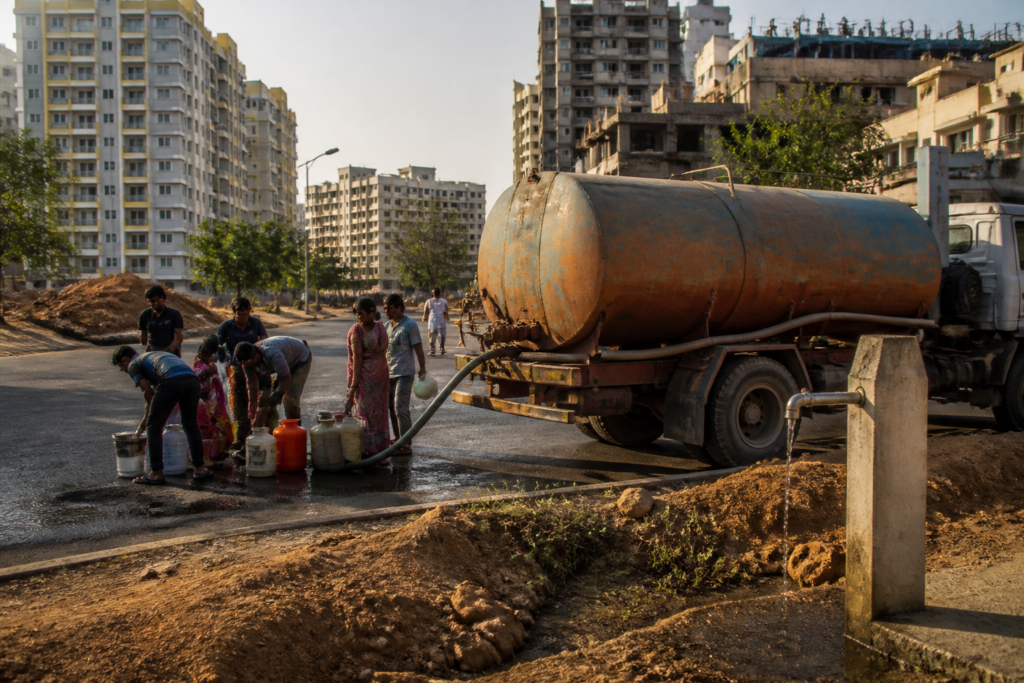
The immediate pressure is visible in the demand for private and utility-supplied tankers. K Ashok Reddy, managing director of the Hyderabad Metropolitan Water Supply and Sewerage Board, said bookings had increased to approximately 7,000 during the month, compared with the usual figure of around 3,500. He attributed the increase to reduced rainfall and declining groundwater levels. Reddy also said groundwater levels had fallen by more than five metres compared with the previous year.
That change matters because groundwater is not merely a supplementary source for Hyderabad. It supports households, construction activity, institutions and local supply arrangements in areas where piped water is inadequate or irregular. A decline of more than five metres, as reported at the meeting, indicates that the city is drawing on a resource whose replenishment is not keeping pace with demand. The current tanker figures show how this pressure reaches residents: when groundwater availability falls, dependence on purchased water rises quickly.
The reservoir position adds another layer of vulnerability. Reddy said there had been no inflows into the Manjeera and Singur reservoirs this year and that the water currently available would be sufficient only until December. Plans are therefore being prepared to supply water through alternative sources. These include making additional water available through the Godavari Drinking Water Scheme, examining the possibility of drawing more water from Krishna waters and considering additional filter beds at Himayat Sagar and Osman Sagar.
The reported alternatives are not simply a list of new sources. They illustrate the institutional complexity of keeping a large city supplied. Hyderabad’s water security depends on reservoirs, inter-basin or regional supply systems, treatment capacity, groundwater, tanker logistics and demand management working together. When rainfall and reservoir inflows weaken, the utility must compensate through a combination of new supply, stricter consumption controls and more efficient allocation of non-potable water.
The proposed response places particular emphasis on separating drinking-water demand from uses that do not require potable water. Ranjan said treated sewage water discharged into the Musi River would soon be used for industrial activity, data centres, gardening, landscaping and maintenance of central medians. Filling stations at sewage treatment plants are planned to make treated water available for these purposes.
Of the 13 treated-water filling stations identified under the HMWSSB jurisdiction, three to four were reported to be operational. The stated target is to make all 13 operational by November 1, with another 20 filling stations to be established over the following 15 days. The report does not establish whether these targets will be met, but the proposed network indicates an attempt to create a formal market and distribution system for treated water rather than leaving reuse dependent on individual projects.
This is especially important for construction, one of the largest non-drinking uses of water in a rapidly developing city. Reddy said measures would be taken to ensure that 90 per cent of the water required for construction activities was sourced from treated water available nearby. The authorities also plan to make treated water mandatory for landscaping, including in government institutions. If implemented, these measures would shift treated sewage from being an environmental management concern to becoming part of Hyderabad’s construction and public-realm infrastructure.
The proposed ‘Dial a Green Tanker’ mobile application is intended to support that shift by allowing online booking of treated water through tankers. Its effectiveness will depend on the availability, quality, location and reliability of treated-water supplies, but the proposal addresses a practical problem: users need a convenient way to obtain non-potable water if authorities expect them to stop using drinking water for construction, landscaping and similar activities.
Hyderabad water shortage pressures are also being addressed through demand reduction. Ranjan said awareness programmes would be conducted through various media, with the objective of ensuring that every household reduces water consumption by at least 20 per cent. The report does not specify how household consumption will be measured or enforced. That distinction is significant. Public appeals can create awareness, but durable reductions generally require information, metering, leakage control, pricing or regulation, and the input does not provide details on which of these mechanisms will be used.
The administration also plans enforcement against illegal water extraction from pipelines. Ranjan said people illegally installing motors on HMWSSB pipelines to draw water would be identified, with the motors removed and fines and penalties imposed where necessary. HYDRAA services would be used to identify violations, including illegal extraction of water and misuse of resources. This places water conservation within a wider enforcement framework involving the water utility, municipal administration and the Hyderabad Disaster Response and Asset Protection Agency.
The focus on illegal motors reflects an unevenness problem within urban water distribution. Where residents use unauthorised equipment to increase their draw from a pipeline, the resulting pressure can affect surrounding households. However, the report does not provide figures on the number of illegal motors, the locations of violations or the penalties imposed so far. Those details would be needed to assess the scale of the problem and the likely effect of enforcement on citywide supply.
Groundwater recharge is the longer-term component of the response. Ranjan said 22,000 groundwater recharge structures had been taken up during the year and that a plan was being formulated to provide recharge facilities to every household over the next five years. The announcement connects household-level infrastructure with city-level water security, but the supplied information does not specify the type, location or performance of the structures, nor how many households would be covered under the proposed plan.
The electricity measures discussed at the same meeting show that Hyderabad’s resource stress is not confined to water. TGSPDCL managing director Jitesh Patil said state electricity demand had reached a new peak of 20,018 MW and could rise further during the summer months, particularly in March and April. Government offices were advised to set air-conditioners at 25 degrees Celsius and reduce electricity consumption during evening hours.
Patil also advised households to inspect electrical wiring and exercise caution when using electric cookers, induction stoves and air-conditioners simultaneously. He urged residents to use electricity only as required and encouraged rooftop solar installations. These measures link resource conservation with safety and peak-demand management, although the report does not provide a city-specific electricity-demand figure or details of the rooftop-solar programme.
The combined water and electricity agenda points to a larger urban-management challenge. Hyderabad’s demand is shaped not only by its resident population but also by construction, commercial activity, data centres, landscaping, institutional campuses and expanding infrastructure. The review meeting’s proposed responses show that the city is trying to allocate different grades of water to different uses while asking households and offices to reduce consumption and utilities to prepare for higher electricity demand.
The evidence supplied by the report confirms immediate pressure: tanker bookings are approximately twice the usual level, groundwater has declined by more than five metres compared with the previous year, reservoir inflows are absent at Manjeera and Singur, and the state electricity system has reached a 20,018 MW peak. It also records a set of planned interventions, including alternative water sources, treated-water filling stations, construction reuse, recharge structures, enforcement against illegal extraction and household conservation.
What remains uncertain is implementation. The reported measures have deadlines and targets, but the source does not establish whether the treated-water stations, additional supply arrangements, household reduction target or recharge plan have achieved measurable results. The next important developments will therefore be operational: whether all 13 identified filling stations become functional by November 1, whether the additional 20 stations are established within the stated timeframe and whether treated water begins replacing potable water in construction and landscaping at the proposed scale.


