

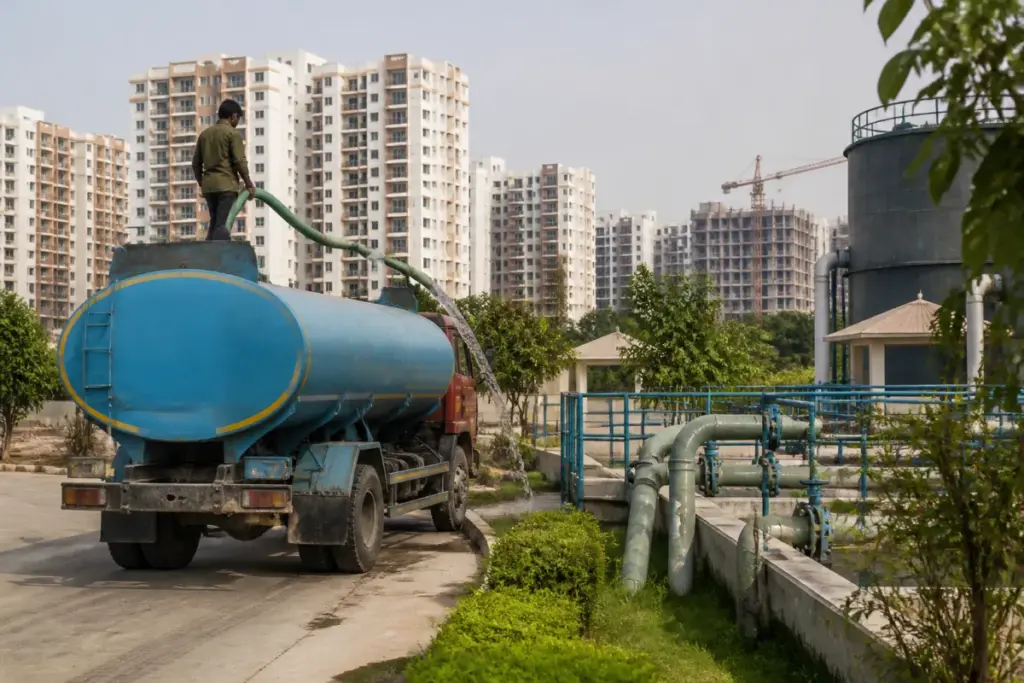
Hyderabad’s water board plans to source treated wastewater from sewage treatment plants in gated communities and apartment complexes for construction, landscaping and other non-potable uses, as the city prepares for possible water stress next summer.
The Hyderabad Metropolitan Water Supply and Sewerage Board (HMWSSB) said it would bring private Sewage Treatment Plants (STPs) into a proposed ‘Dial-a-Green Tanker’ service. The system is intended to supply treated water to construction sites, industrial units, landscaped areas, medians and other locations where drinking water is not required.
HMWSSB plans to launch the service by November 1. A dedicated website is expected to show nearby treated-water sources, the distance to each source, tanker-booking options and vehicle-tracking facilities. The platform will also provide other information related to the movement and use of the treated water, according to the Board.
The first-phase target is 100 million litres per day (MLD) of treated water. At present, 51 private STPs have registered with the initiative and can collectively provide 1.5 MLD, HMWSSB Managing Director Ashok Reddy said. The gap between the initial registered capacity and the planned target means that wider participation from private STPs will be central to the programme’s expansion.
The Board’s plan is part of preparations to reduce pressure on drinking-water sources and groundwater levels before the next summer. HMWSSB also cited concerns over stress on the Singur and Manjeera reservoirs and the possibility of further rainfall shortfall linked to El Niño weather conditions.
Mr. Reddy said the eight months before the onset of the monsoon would be crucial. On October 17, he held a meeting with the Confederation of Real Estate Developers’ Associations of India, the National Real Estate Development Council, the Telangana Builders Federation and other builders’ associations to discuss the use of treated water at construction sites and its transportation.
The cost of using tankers emerged as one issue during the discussions. Officials also considered connecting STPs directly to nearby users instead of relying only on tanker transport. The Board cited the Botanical Garden in Gachibowli, which already receives treated water through a pipeline, as an example for exploring similar connections to parks, golf courses, construction sites and other locations.
The proposal places private residential developments within a wider urban water-management system. Gated communities and apartment complexes that operate STPs would become potential suppliers of treated water, while construction sites and public or landscaped spaces would become users. The effectiveness of the arrangement will depend on registration, treatment capacity, transport costs and the availability of pipeline links.
HMWSSB said it had instructed officials to examine these connections and other implementation aspects. The planned November 1 launch is the next stated milestone for the Dial-a-Green Tanker service.


