

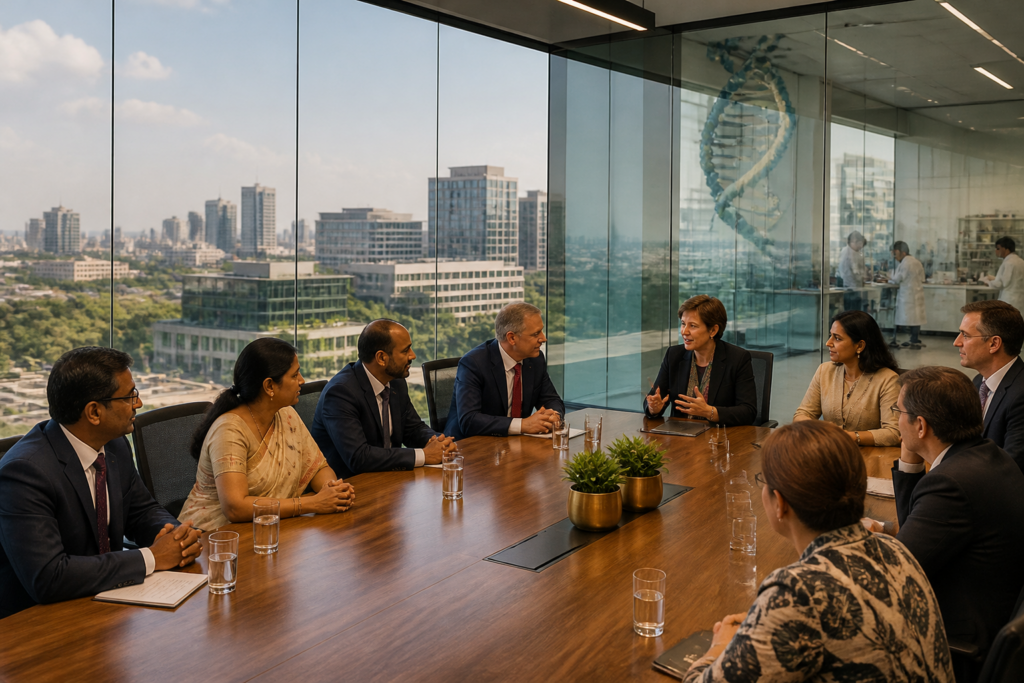
Hyderabad’s three-day engagement with Liverpool has produced a network of agreements spanning government, healthcare, life sciences, startups, education, skills and sports. The immediate event was a delegation visit, but its larger significance lies in the attempt to connect two urban ecosystems through institutions rather than a single investment announcement.
The Telangana government and Liverpool City Council signed a memorandum of understanding establishing a framework for long-term collaboration in trade, investment, innovation, entrepreneurship, skills, tourism, culture and sports. Separately, T-Hub and Knowledge Quarter Liverpool/Sciontec signed a Letter of Intent for a Hyderabad–Liverpool Innovation Bridge. KIMS and NHS University Hospitals Liverpool Group also advanced an agreement covering research, clinical collaboration, education, training and workforce development.
Taken together, the arrangements point to a partnership model built around repeated institutional exchange. Instead of limiting cooperation to government-to-government engagement, the agreements bring in a city council, an innovation hub, a knowledge-economy platform, a private healthcare institution and an NHS-linked hospital group. The proposed links therefore cover several layers of an urban economy: public administration, research, entrepreneurship, clinical practice, education and employment.
That structure matters for Hyderabad because the city’s global economic identity increasingly rests on the interaction between specialised sectors. The delegation visited Genome Valley and met leading industry and research organisations to explore opportunities in biopharma, vaccines, medical technology, clinical research and workforce development. These are fields in which research capacity, hospital networks, trained professionals, companies and regulatory systems need to work together for collaboration to produce practical outcomes.
The supplied account does not specify the value of any investment, the number of jobs expected, the projects to be funded or a timetable for the agreements. It also does not establish whether the memorandums will lead to particular companies entering either market. The significance of the visit must therefore be understood through the institutional connections announced, rather than through an investment figure or a confirmed construction project.
The proposed Innovation Bridge is the clearest example of this approach. T-Hub and Knowledge Quarter Liverpool/Sciontec intend to connect startups, enable market access and foster business partnerships. In practical terms, the arrangement is designed to address a problem common to innovation ecosystems: a startup may have a product and technical capacity but still lack access to customers, partners, research institutions or international networks.
The announcement does not define the bridge’s operating model, selection criteria, funding arrangements or measurable targets. It does, however, identify the functions the partners want it to serve. Market access and business partnerships suggest that the initiative is intended to move beyond promotional exchanges and support commercial and institutional connections. Whether it succeeds will depend on how those broad objectives are translated into programmes and participating organisations.
The healthcare agreement adds another layer to the partnership. KIMS and NHS University Hospitals Liverpool Group advanced cooperation in research, clinical collaboration, education, training and workforce development. This places hospitals at the centre of the relationship, rather than treating healthcare only as a business or investment sector. Research collaboration can connect clinical needs with scientific work, while training and workforce development address the human capacity required to sustain advanced healthcare systems.
Again, the supplied report does not provide details about specific research studies, specialties, training numbers or patient-care arrangements. It records the areas of intended cooperation. That distinction is important: an agreement to explore collaboration is an institutional commitment, but it is not evidence that a clinical programme or research project has already begun.
Genome Valley provided the delegation with a direct view of Hyderabad’s life-sciences base. The visit covered biopharma, vaccines, medical technology and clinical research, indicating that the partnership is being positioned around the wider ecosystem rather than one company or one facility. For the city, this creates a potential link between research organisations, manufacturing and healthcare delivery, although the report does not identify individual projects or participating companies.
The partnership also extends beyond the knowledge economy. Delegation engagements with the LFC Foundation, the Sports Authority of Telangana, the FIFA–AIFF Telangana Talent Academy at Gachibowli, football clubs, coaches, the Centre for Spine and Sports Health and the Pullela Gopichand Badminton Academy covered grassroots sports, sports medicine, athlete development and high-performance sports.
This is relevant to the urban system because sports institutions operate across several public and private domains. They involve training facilities, schools and academies, healthcare support, coaching networks and pathways for young athletes. The inclusion of sports in the city partnership broadens the relationship beyond trade and investment. It also connects international cooperation to facilities and programmes that function at the city level, particularly in Gachibowli and other parts of Hyderabad’s institutional landscape.
The government-to-government memorandum provides the administrative framework for these sectoral links. Telangana Chief Minister A. Revanth Reddy reiterated the state’s commitment to attracting investment and strengthening global research and innovation partnerships. Jayesh Ranjan, Special Chief Secretary, described the strengths of the two regions as complementary and pointed to the potential for institutional partnerships.
The reference to complementary strengths is reflected in the range of organisations involved. Hyderabad contributes a concentration of life-sciences, healthcare, startup and sports institutions, while the Liverpool side brings city-level, knowledge-sector, NHS and football-related connections. The report does not set out a formal division of responsibilities, but the agreements indicate an attempt to match institutions with similar or complementary functions.
The visit also builds on the Chief Minister’s UK visit in August 2026. That sequence suggests the Hyderabad engagement is part of a continuing international partnership effort rather than an isolated delegation programme. However, the supplied material does not state which commitments from the earlier visit have advanced, nor does it provide a review mechanism for the new arrangements.
That implementation question is central. Memorandums of understanding and letters of intent can create a platform for cooperation, but their urban and economic value depends on what follows: named projects, responsible institutions, funding, milestones and public reporting. In this case, the announced areas are broad. They include trade, investment, innovation, entrepreneurship, skills, tourism, culture, sports, healthcare and research. The next stage will determine whether the partnership remains a framework or develops into operational programmes.
For Hyderabad, the opportunity is not limited to attracting external capital. International institutional partnerships can also help the city connect education and training to expanding sectors, improve access to research networks, and give startups routes into new markets. The KIMS–NHS engagement and the proposed Innovation Bridge address these links directly, while the Genome Valley visit anchors the discussion in the city’s existing life-sciences ecosystem.
The broader urban question is how a city converts a strong concentration of specialised institutions into wider economic and social capacity. The report confirms that Hyderabad is seeking international links across research, healthcare, enterprise, skills and sports. It does not yet show the scale of outcomes, the distribution of benefits or the mechanisms that will make the collaboration durable.
The immediate facts are clear: Telangana and Liverpool City Council have established a cooperation framework; T-Hub and Knowledge Quarter Liverpool/Sciontec have signed a Letter of Intent; and KIMS and NHS University Hospitals Liverpool Group have advanced a healthcare-focused agreement. The next developments to monitor are the agreements’ implementation details, the launch of the Innovation Bridge, concrete research or training programmes, and any investment or employment outcomes publicly announced by the participating institutions.


