

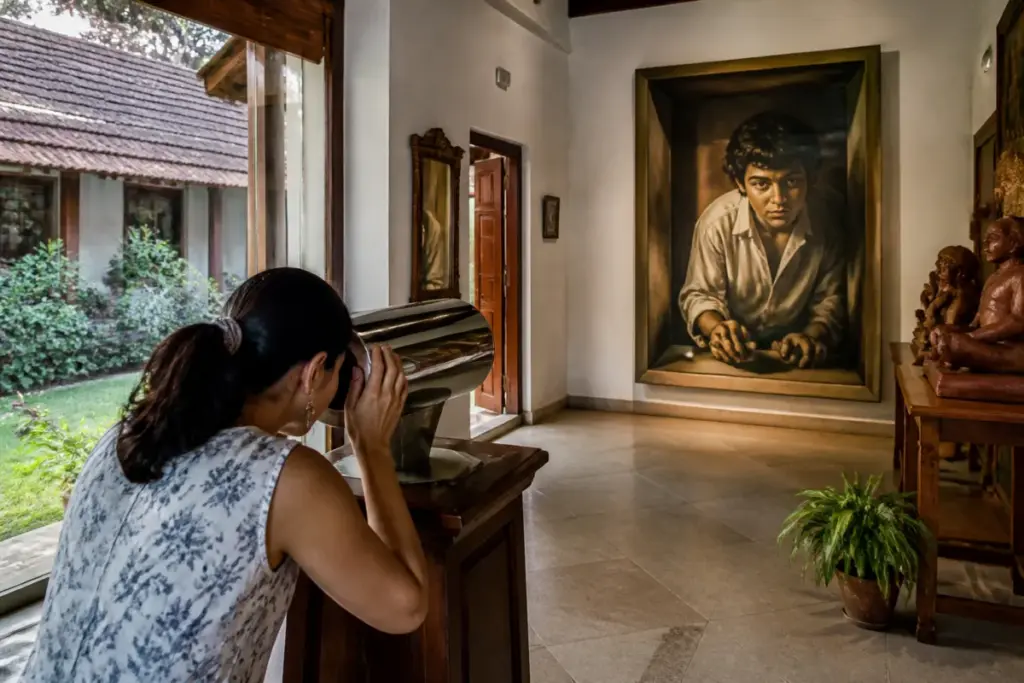
The Miller Museum of Anamorphic Art in Bengaluru’s Cooke Town is more than a gallery of distorted paintings. It is an example of how a private family property can be transformed into a public cultural space, preserving the work of an artist whose career moved between Bengaluru, Kuwait, the United States and international exhibition circuits.
The museum presents the work of Shereen Miller, a Bengaluru-born artist who revived anamorphic art through decades of experimentation and exhibitions. The form depends on distortion, geometry and a reflective surface: an image that appears twisted on a flat canvas resolves into a recognisable figure or landscape when viewed through a steel cylinder. The visitor is therefore not only looking at an artwork but also completing the process through movement, reflection and perspective.
That interaction gives the museum a distinctive urban role. Unlike a conventional display in which a visitor stands before a finished object, anamorphic art makes the gallery dependent on spatial arrangement. The artwork, the reflective cylinder and the visitor’s position must work together. The architecture of the museum becomes part of the viewing experience, even when the central attraction remains the artist’s work.
The museum was designed in an old family property by Shereen Miller and her daughter, Cheryl Anita Miller, beginning in 2022. Shereen died in 2023, and the museum now functions both as an exhibition space and as a record of her artistic life. Cheryl Miller described it as “a love letter from a mother and daughter to Bengaluru”. That description points to the institution’s unusual origin: it was not established first as a large public cultural project, but developed from a family relationship, an inherited property and a decision to make a personal archive accessible to visitors.
This model places private stewardship at the centre of cultural infrastructure. The museum’s existence depends on the family’s ability to maintain the building, preserve the collection and operate scheduled visits. The supplied account does not establish the museum’s ownership structure, operating costs, visitor numbers or long-term funding arrangements. But it does show how a relatively small cultural institution can emerge outside the conventional framework of a state museum or a large commercial gallery.
That distinction matters for Bengaluru, a city whose cultural identity is often represented through major institutions, established neighbourhoods and large public events. The Miller Museum offers a different scale of cultural experience. Its importance lies not in the size of its collection but in the specificity of the work, the intimacy of the setting and the direct connection between the artist’s biography and the building in which the collection is presented.
Shereen Miller was born in Bengaluru’s Benson Town in 1941. Her daughter’s account describes the social resistance she faced when she chose art as a career. Miller later explored art in Kuwait, where her American husband, Paul, worked in the oil industry. During a visit to the United States, she encountered information about an exhibition of historical anamorphic works assembled by two Dutch men. She then began working out the technique without books, images or a manual, according to Cheryl Miller.
The account is significant because it presents artistic practice as a process of reconstruction rather than simple inheritance. Miller did not merely reproduce a readily available method. She tried to recover the logic of anamorphic art through determination and experimentation. The museum consequently preserves both the objects and the story of how the artist developed her practice.
Its collection extends beyond anamorphic works. It includes conventional artworks and sculptures, including pieces made from teakwood. Some of these works create the impression of three-dimensionality despite being made on a two-dimensional surface. Another sculpture appears abstract until a closer look reveals a crystal sphere containing Miller’s birth date and face.
These details give the museum an archival function. Its collection documents an artist’s evolution across different media rather than presenting a single signature technique in isolation. The museum also includes archived press coverage recording Miller’s international recognition. The reported visitors to her work included the Oba of Benin, members of Kuwaiti royalty and American presidents. Two of her pieces are housed in the presidential libraries of Ronald Reagan and George H. W. Bush, according to the report.
The museum’s design extends this idea of a collection as an experience. Cheryl Miller said the space engages all five senses by connecting the gardens to the gallery. Visitors hear music, encounter the scent of sandalwood and jasmine, see the artworks, touch nature and receive complimentary coffee. This approach changes the relationship between the building and the collection. The garden is not simply an external landscape around the gallery; it forms part of the museum’s interpretation of the work.
For visitors, that creates a more layered cultural itinerary than a room-by-room display. The experience is built through sight, sound, smell, touch and taste, while the anamorphic artworks require observation from a particular position. The museum therefore turns movement through the property into part of the exhibition. Its spatial design is not separate from its curatorial purpose.
The museum also raises a practical question about access. It is open on Fridays and weekends from 11 am to 6 pm. Entry costs Rs 250, while students with identification pay Rs 200. Children aged six years or younger enter free. These details make the institution’s public character concrete: it has defined visiting hours, a published ticket structure and provisions for at least one category of younger visitors.
At the same time, the schedule limits access to the end of the working week and weekends. The supplied report does not provide information on weekday demand, school visits, accessibility facilities, group bookings or public transport connections. Those omissions do not diminish the museum’s significance, but they show the information still needed to understand how effectively a privately run cultural space serves the wider city.
The museum’s location in Cooke Town is also relevant to its identity. The space is tied to an established Bengaluru neighbourhood and to the family property in which the collection is displayed. Rather than separating the museum from the city around it, the building connects personal history, neighbourhood geography and public visitation. The reported transformation beginning in 2022 demonstrates how an existing property can acquire a new civic and cultural function without being described as a conventional redevelopment project.
There is also a preservation question at the centre of the museum. Anamorphic art is presented in the report as a dying form that Shereen Miller helped revive and take across the world. The museum’s role is therefore not limited to displaying rare or unusual objects. It keeps a specialised method visible to visitors who may otherwise encounter neither the technique nor the planning behind it. The steel cylinder, distorted canvas and carefully controlled viewpoint make the process understandable through direct experience.
This is where the museum’s public value extends beyond biography. A visitor can learn that artistic innovation may depend on geometry, spatial perception and repeated experimentation. The collection turns an unfamiliar technique into something that can be observed physically. In doing so, the museum provides a form of informal education alongside commemoration.
The institution’s limits are equally clear from the available evidence. There is no information in the supplied material on annual visitor numbers, conservation protocols, staffing beyond the custodian, institutional partnerships or plans for expansion. Nor does the report establish whether the museum receives public funding. Its current operation is documented through its opening hours, ticket prices, collection and family stewardship, but its long-term administrative model remains unspecified.
That uncertainty is important because small museums often depend on the continuity of individual custodians. In this case, Cheryl Miller is identified as the museum’s custodian and as a collaborator in its creation. The story of the museum is therefore inseparable from the family that maintains it. Whether the institution can continue to preserve the collection, sustain visitor access and communicate the technique to new audiences will depend on arrangements that are not detailed in the report.
The Miller Museum nevertheless shows how cultural infrastructure can operate at a human scale. It does not need to compete with a major museum in collection size to provide a distinctive public experience. Its strength comes from the combination of a rare artistic practice, a documented personal history, a property adapted for exhibition and a ticketed system that allows visitors to enter the space.
The larger urban question is how many such cultural spaces remain undocumented or difficult to find. The report identifies the museum as one of the younger institutions of its kind in Bengaluru, but it does not establish a complete inventory of comparable spaces. What it does establish is a particular model: a family-led museum that converts memory and privately held work into a scheduled public encounter.
For Bengaluru, that model adds another layer to the meaning of the built environment. A building can retain traces of family history while acquiring a new role as a gallery, garden and archive. In the Miller Museum, the architecture is not only a container for art. It is part of the story of how the art was preserved, how visitors encounter it and how a daughter continues her mother’s work.
The evidence confirms the museum’s cultural distinctiveness, its public visiting arrangements and the central role of Shereen and Cheryl Miller in creating it. What remains unclear is the institution’s scale, funding and future operating framework. For now, the museum’s significance lies in making a specialised artistic practice accessible in Bengaluru through a space where collection, memory, landscape and visitor movement are deliberately connected.


