

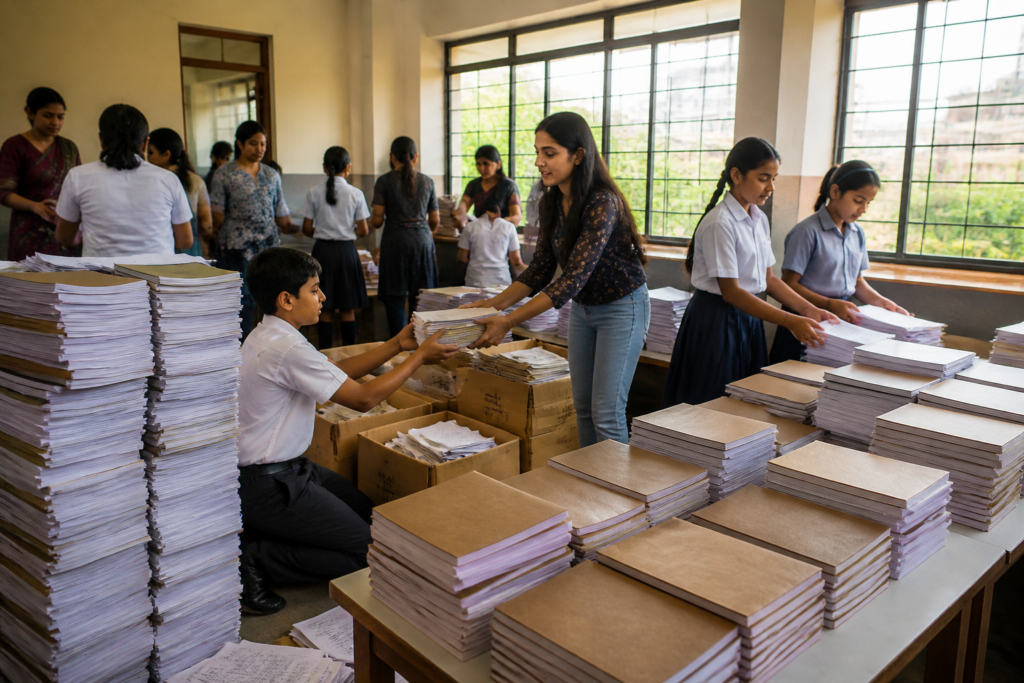
Made@gain began with a simple observation in a Bengaluru classroom: most school notebooks still had unused pages when the academic year ended. Two years later, the student-led initiative has collected more than 20,000 kilograms of used stationery and converted it into around 12,000 notebooks, linking waste recovery with access to educational materials.
The initiative was started by Samaira Garg, a 16-year-old Class 11 student at The International School Bangalore. She initially reused pages from her own notebooks and taped them together to make roughly 20 notebooks of 60 to 100 pages each. The result was useful but informal. Her next question was whether an industrial process could turn discarded pages into new notebooks that looked and functioned like commercially produced stationery.
That question brought her to Rescript, a Bengaluru-based company that works with reprocessed paper and uses both pre-consumer and post-consumer waste. Rescript co-founder Ashutosh Ananth helped examine whether the collected material could be processed into new notebooks. The partnership shifted the initiative from an individual act of reuse to a collection-and-manufacturing model.
The first collection drive generated 2,000 kilograms of paper and produced 1,000 notebooks. Made@gain was formally established in February 2025. Since then, the initiative has distributed around 8,000 notebooks to students in 10 schools, children from the Soliga tribal community at BR Hills and children of migrant construction workers. The remaining notebooks form part of the initiative’s continuing distribution and collection effort, according to the information provided by Made@gain and reported by The Hindu.
The numbers show the importance of organising waste at the point where it is generated. Made@gain’s collection network now includes five schools, 10 corporates, six communities and about 800 individual donors. The initiative has also begun working with apartment communities and corporate offices, extending the model beyond its original school-based setting.
This is the central urban lesson in the initiative: paper waste is not only a disposal problem. It is also a material stream that can be collected, processed and returned to communities in a different form. The value of that process depends on coordination between the places where paper is discarded, the organisations that can process it and the institutions that can distribute the final product.
Schools are particularly important in this chain because they generate concentrated quantities of paper at predictable points in the academic calendar. Meenu Bhattacharya, principal of National Public School-East, said the school produces substantial paper waste, especially at the end of the academic year. In the absence of a workable recycling plan, that material can simply be discarded. Made@gain’s proposal provided a defined route for collection and processing.
At NPS-East, the initiative was introduced through the school’s Social Empowerment through Work Education and Action programme. Older students explained the model to younger classes, and the school contributed a sizeable quantity of paper. The arrangement made recycling part of school activity rather than treating it as a separate environmental campaign.
That institutional connection also changes how sustainability is understood. Students are not only asked to learn about recycling as an abstract concept; they participate in collection, communication and distribution. Made@gain has created an ambassador programme in which students lead collection drives in their schools. The programme gives them practical roles in sustainability, leadership and responsible consumption, while also helping the initiative expand its collection network.
The model depends on an often overlooked part of urban waste management: the quality and destination of separated material. Ashutosh Ananth said paper placed in dustbins can still end up in landfills despite efforts to segregate waste. Made@gain’s approach is to create a direct channel through which paper can be handed to the initiative, a waste collector or an aggregator working with paper. That channel is significant because segregation has limited value if the separated material does not reach a facility or organisation capable of using it.
The environmental figures cited by Rescript indicate the reported scale of the material benefit. The company estimates that the notebooks have saved approximately 46,200 litres of water, prevented 1,368 kilograms of carbon dioxide emissions and required no trees to be cut. These figures are claims attributed to the company in the supplied report; the material does not provide an independent assessment or the methodology used to calculate them. Even so, they show how Made@gain frames paper recovery as a resource-efficiency intervention rather than only a charitable activity.
The initiative therefore combines two forms of value. The first is direct: notebooks are distributed to students who may not otherwise receive new stationery. The second is systemic: paper that might have been discarded is collected and directed into a manufacturing process. The connection between the two is what gives the project its wider urban relevance.
Access to stationery can appear minor when viewed against larger questions of education infrastructure, but the experience of the beneficiaries described in the report shows why basic materials matter. During visits to schools serving children from the Soliga tribal community at BR Hills, Samaira said she recognised that a new notebook, often taken for granted by students in more privileged settings, could have greater significance for children accustomed to using hand-me-downs.
The distribution model also includes children of migrant construction workers, a group whose access to stable educational resources can be affected by mobility and household income. The source does not provide numbers for these beneficiaries, but their inclusion indicates that the initiative is directing recovered material towards groups that may face practical barriers in obtaining stationery.
Made@gain’s work also demonstrates how private and civic institutions can be connected through a relatively small operational system. Schools and offices supply paper. Rescript processes it. Donors and communities support collections. Beneficiary schools and groups receive the notebooks. The project’s effectiveness depends less on a single donation than on maintaining each link in this chain.
The initiative has added a personalisation option priced at ₹18 per notebook. This includes the cover design, contributor branding and the Thinking Circular concept on the back cover. Such an option may help schools, companies and communities identify with the notebooks they help produce, while also connecting institutional participation with the finished product. The supplied material does not establish how much of Made@gain’s funding comes from this service or whether it covers processing costs.
Its expansion also raises practical questions that remain unanswered in the available evidence. The report does not specify the total operating cost, the processing capacity available through Rescript, the proportion of collected paper that is suitable for recycling or the arrangements used to transport material from different collection points. It also does not provide an independent audit of the environmental savings. These details would be necessary to assess how easily the model could be replicated at a larger scale.
What the available evidence does establish is that a student-led idea has developed into a functioning network involving schools, companies, communities and individual donors. The initiative has recovered a measurable quantity of paper, produced new notebooks and distributed them to students across different locations and social groups. It has also created a practical setting in which environmental education is connected to procurement, collection, manufacturing and distribution.
For Bengaluru, the larger question is how many other waste streams could be made useful if institutions had clear collection routes and reliable processing partners. Made@gain does not replace municipal waste systems, and the supplied material does not claim that it does. Instead, it operates within a defined material category and shows how focused networks can prevent at least some recyclable material from being treated as general waste.
The initiative’s next phase will depend on whether its school, apartment and corporate networks can continue expanding while maintaining the quality of collection and the flow of notebooks to beneficiaries. The report says additional schools have approached Made@gain and that efforts are under way to involve other branches of National Public School. Those developments will indicate whether the model remains a small, high-impact initiative or becomes a broader institutional practice in Bengaluru’s schools and communities.


