

The dispute over Gurugram’s dog sterilisation contracts is not only a question of whether one NGO met the requirements for two facilities. It exposes a more consequential weakness in how urban local bodies verify, monitor and enforce animal birth control contracts before services begin. The Animal Welfare Board of India (AWBI) has asked the Municipal Corporation of Gurugram (MCG) to cancel contracts awarded to Jabalpur-based Maa Baglamukhi Sewa Samiti after rejecting the organisation’s applications for project recognition at two Gurugram centres.
The AWBI’s position, placed before the Punjab and Haryana High Court in a counter-affidavit filed on October 8, is that the NGO did not possess the mandatory project recognition required to operate Animal Birth Control (ABC) centres in Gurugram. The Board had written to the MCG on October 5 seeking immediate cancellation of the contracts. The municipal corporation, however, has said it issued a notice to the agency and will decide the next step after receiving its reply.
That sequence matters because the ABC system is designed around a chain of institutional approvals. A municipal body awards the work, an implementing organisation operates the facility, state authorities may inspect or recommend it, and the AWBI grants project recognition after examining compliance. The Gurugram case shows what can happen when those stages are treated as interchangeable or when a bid-stage approval is allowed to run ahead of the final operational clearance.
The recognition question is at the centre of the dispute. According to the AWBI affidavit, Maa Baglamukhi Sewa Samiti was granted ABC Project Recognition on February 23, 2024, but only for its centre at Kathonda Gram within the jurisdiction of the Jabalpur Municipal Corporation in Madhya Pradesh. The Board stated that recognition for that project could not be treated as recognition to operate ABC centres in Gurugram. It also clarified that submitting an application, or having an application pending, does not itself amount to project recognition. The formal approval follows inspection and issuance of a certificate.
The MCG has presented a different account of the eligibility process. In an earlier affidavit dated September 29, MCG Commissioner Pradeep Dahiya defended the award, stating that the NGO had a valid general AWBI registration when it submitted its bid and had applied for project recognition within the six-month period permitted under Rule 5 of the ABC Rules. The civic body also relied on a June 2026 inspection by a state committee, which was forwarded by the Haryana Animal Husbandry and Dairying Department on July 2 and reportedly found the facilities satisfactory while recommending them for recognition.
The difference between these positions points to a structural administrative problem: a general registration, a state inspection recommendation and a project-specific recognition certificate perform different functions, but the contracting process appears to have brought them into the same eligibility conversation. The AWBI’s intervention suggests that the final authority responsible for project recognition did not consider the available material sufficient to permit operations at the Gurugram sites.
The two applications submitted by the NGO in 2026 concerned separate facilities, one at Baliyawas village and another near a dairy in Sector 90. The AWBI’s ABC Project Recognition Committee deferred the Baliyawas application after reviewing the initial material. It noted that photographs of the operation theatre and kennels were unclear, directed verification of pending complaints and ordered a fresh inspection by a three-member central team.
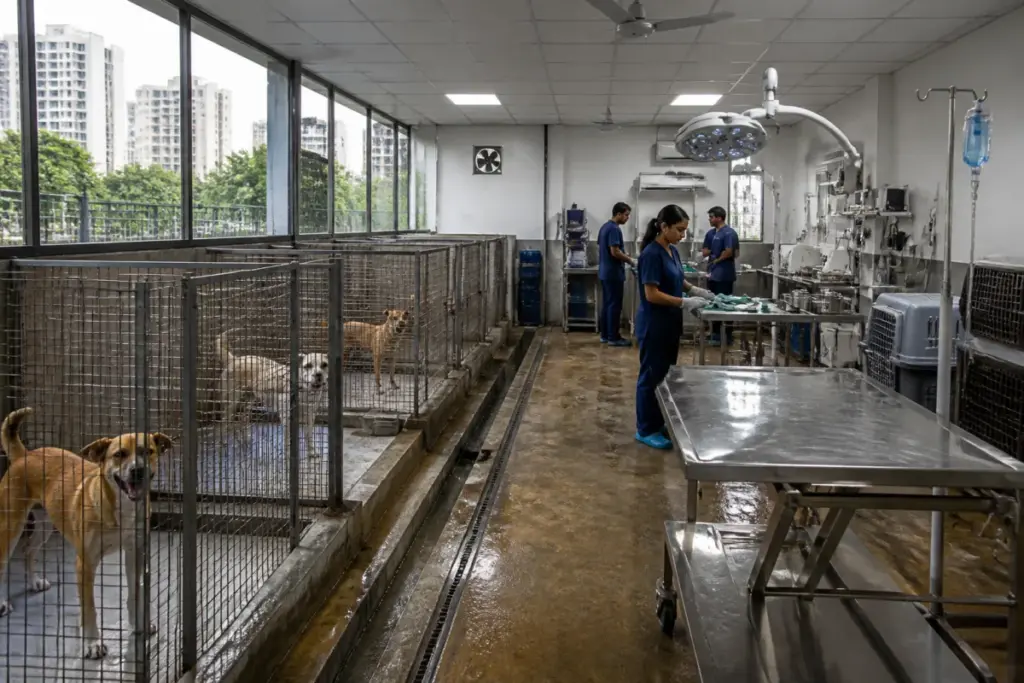
After the joint re-inspection of the Baliyawas facility on August 1, the committee rejected the application on September 9, listing 16 alleged major deficiencies. The AWBI affidavit cited concerns about unverified or under-qualified staff, missing records and vehicles, rusted kennels, the absence of emergency medicines in the operation theatre, inadequate pain-management procedures, and insufficient water supply and drainage. It also recorded that two stray dogs at the facility were heavily infested with ticks.
The Sector 90 application was rejected on the same day after the committee reviewed the state department’s inspection material. The concerns recorded there included surgical instruments that appeared rusted and unsuitable, no water in the operation theatre, poor hygiene and sanitation, and the failure to provide clear colour photographs of the operation theatre, refrigerator and dog-catching van.
These findings are significant because an ABC programme is not merely a numerical sterilisation exercise. Its delivery depends on a chain of physical and operational safeguards: suitable surgical infrastructure, trained personnel, animal-catching equipment, records, post-operative care, medicines, sanitation and reliable water and drainage. Weakness at any one point affects the welfare of animals brought into the system and the credibility of the municipal programme that funds it.
The case also illustrates why project recognition is location-specific. A facility that has been recognised for work in Jabalpur cannot automatically be assumed to meet the operational conditions of a Gurugram centre. The geography changes the municipal responsibility, the facility being inspected, the staff and equipment deployed, and the records that must be maintained. The AWBI’s position treats recognition as a project-level authorisation rather than as a transferable credential held by an organisation.
That distinction has direct implications for public procurement. A municipal contract can create an expectation that services will proceed, but the contract cannot substitute for a mandatory regulatory clearance. If a civic body relies on a general registration or a recommendation while the project-specific recognition remains pending, the city risks entering an operational arrangement whose regulatory foundation is unsettled. The Gurugram dispute shows the cost of resolving that question after work orders have already been issued.
The public-interest litigation was filed by Gurugram-based NGO Kaali Welfare Foundation through its founder-director Chetna Joshi. The petition challenged work orders issued by the MCG on November 28, 2025, awarding two-year ABC contracts to Maa Baglamukhi Sewa Samiti. The court record therefore brings together competing institutional interpretations: the petitioner’s challenge to eligibility, the MCG’s defence of its procurement process, the AWBI’s findings on project recognition and infrastructure, and the contractor’s explanation.
The NGO has disputed the AWBI’s conclusions. Its vice-president, Pankaj Shukla, told The Indian Express that the organisation had received clearances from the State Animal Husbandry department, which had found its facilities satisfactory and recommended project recognition. He said the AWBI rejected the applications because some photographs required under the format were missing, and that the organisation was in contact with the Board and civic officials. The MCG’s Joint Commissioner Preetpal Singh said the civic body had issued a notice and would follow due process before deciding on further action or cancellation.
The evidence currently establishes that the AWBI rejected the two project-recognition applications, identified multiple deficiencies and asked the MCG to cancel the contracts. It does not establish the final fate of the contracts, the volume of sterilisation work completed under them, or whether the cited deficiencies have since been rectified. Those questions remain important because cancellation, suspension, correction and continuation under conditions would have different consequences for municipal service delivery.
For Gurugram, the larger urban question is whether animal birth control is being managed as a compliance-led public service or primarily as a procurement transaction. The answer depends on when facilities are inspected, which authority’s clearance controls the process, how records are audited and what happens when a contractor fails to meet the required standard. The current dispute indicates that these safeguards were contested only after the contracts had been awarded and the matter had reached the High Court.
The next formal step is the MCG’s consideration of the NGO’s reply to its notice. The High Court proceedings will also determine how the competing claims over eligibility, inspection and project recognition are treated. Until those steps are completed, the record supports a clear conclusion about the governance gap but not a final conclusion about the contracts’ outcome or the extent of work already carried out in Gurugram.


