

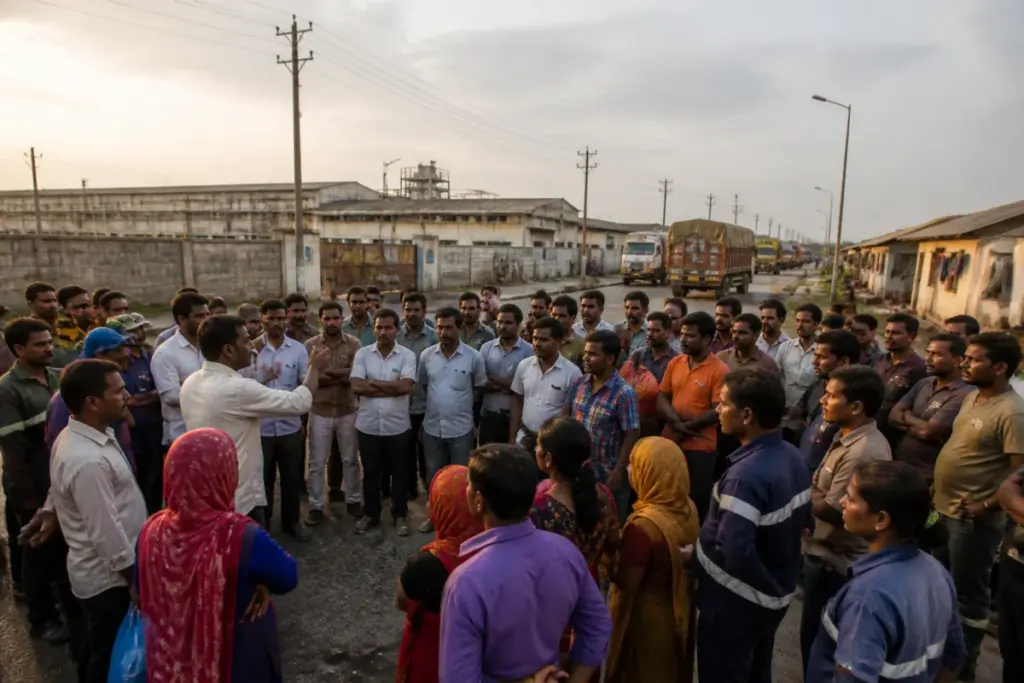
Workers’ organisations in Gujarat have warned of a statewide agitation before Diwali if the government does not address complaints about low wages, long working hours and the expansion of contractual employment, according to a report by Gujarat Samachar. The report says anganwadi workers, ASHA workers, industrial labourers and other worker groups have raised the threat of protest over what they describe as economic exploitation and inadequate legal protection.
The reported dispute sits at the intersection of employment security, public service delivery and the urban economy. Gujarat’s industrial areas depend heavily on contract and migrant labour, while anganwadi and ASHA workers perform frontline childcare, nutrition and public-health functions. Any prolonged protest could therefore affect both industrial activity and essential services, although the source report does not provide a confirmed strike date, formal notice or government response.
According to Gujarat Samachar, workers’ organisations have alleged that many labourers are being made to work for as long as 12 hours while receiving less than the full wages applicable to eight hours of work. The report also says workers are facing higher living costs, electricity cuts, gas shortages and an economic slowdown that have affected employment. These claims are presented as statements by workers and labour organisations and require confirmation from the relevant departments, employers and unions.
The report identifies several groups at the centre of the concerns. It cites 1,20,540 anganwadi workers, 47,817 helpers and 44,000 ASHA workers and facilitators as receiving what it describes as very low remuneration. These workers are not only part of the state’s labour system but also support services that reach households, children and communities. The report does not specify the current remuneration structure, the distinction between wages, honorariums and incentives, or whether the figures refer to sanctioned strength or personnel currently working.
It also describes a substantial role for contract, outsourced and ad hoc employees in the state administration. The report says the number of fixed-pay employees rose from around two lakh in 2018 to 3.50 lakh in 2025. It further states that government contract, outsourcing and ad hoc employees increased from six lakh in 2022 to 6.50 lakh in 2025, while the number of permanent government employees fell by about 30 per cent. These figures are not accompanied in the supplied material by the name of a government report, department, budget document or employment database, making independent verification necessary.
The report separately refers to 47,762 registered factories employing 24 lakh people and says the number of unregistered factories is considerably higher. It also estimates that 30 to 40 lakh migrant workers are employed in industrial estates under difficult conditions. The scale of these claims has major implications for housing, transport, workplace safety, access to public services and the ability of local administrations to plan for temporary and circular migrant populations. However, the source does not identify the administrative or statistical basis for these estimates.
There is also a material inconsistency in the reported totals. The opening summary refers to more than 2.70 lakh workers and labourers, while the article later states that 1 crore 18 lakh 9 thousand 61 workers are employed in the unorganised sector. It subsequently refers to approximately 2.50 crore workers and their families. These numbers may relate to different categories, but the supplied report does not explain the distinctions. The inconsistency affects the central scale of the story and must be resolved through the underlying official data or direct clarification from the source.
The report says the number of agricultural labourers has risen to 75 lakh and links the wider employment situation to power shortages, gas scarcity and economic difficulties. It also says migrant workers are returning to their home states after losing jobs or facing insecure employment. No migration data, industrial production figures, power-supply records or worker surveys are provided in the supplied material to establish the extent of these trends.
The dispute also highlights the administrative complexity of labour protection. Responsibility is divided among labour departments, employers, contractors, local administrations and, in the case of anganwadi and ASHA workers, departments responsible for women and child development and public health. Enforcement of working-hour rules, minimum wages, social-security provisions and workplace protections can become difficult when workers are hired through contractors or classified outside regular government employment.
For cities and industrial regions, the issue extends beyond wages. Migrant workers who lose employment may leave without access to formal rental housing, public transport or social protection in the destination city. Workers who remain may experience longer commutes, overcrowded accommodation and limited bargaining power. Frontline workers such as anganwadi and ASHA personnel also connect labour conditions to the functioning of neighbourhood-level public services.
The report says trade unions and worker organisations have given the government time until Diwali to address their demands and have warned that failure to act could lead to a larger state-wide agitation. It does not identify the unions involved, list the formal demands, state whether a written memorandum has been submitted or record a response from the Gujarat government. Those details are necessary to establish the status and likely scope of any proposed action.
The available evidence therefore confirms that a reported labour dispute is developing around wages, working hours, employment status and the treatment of contract and frontline workers. It does not yet establish the accuracy of the workforce totals, the legal findings implied by the allegations or whether a statewide strike has been formally called. Verification of the cited statistics, the unions’ demands and the government’s response should precede publication as a confirmed account of the scale of the crisis.


