

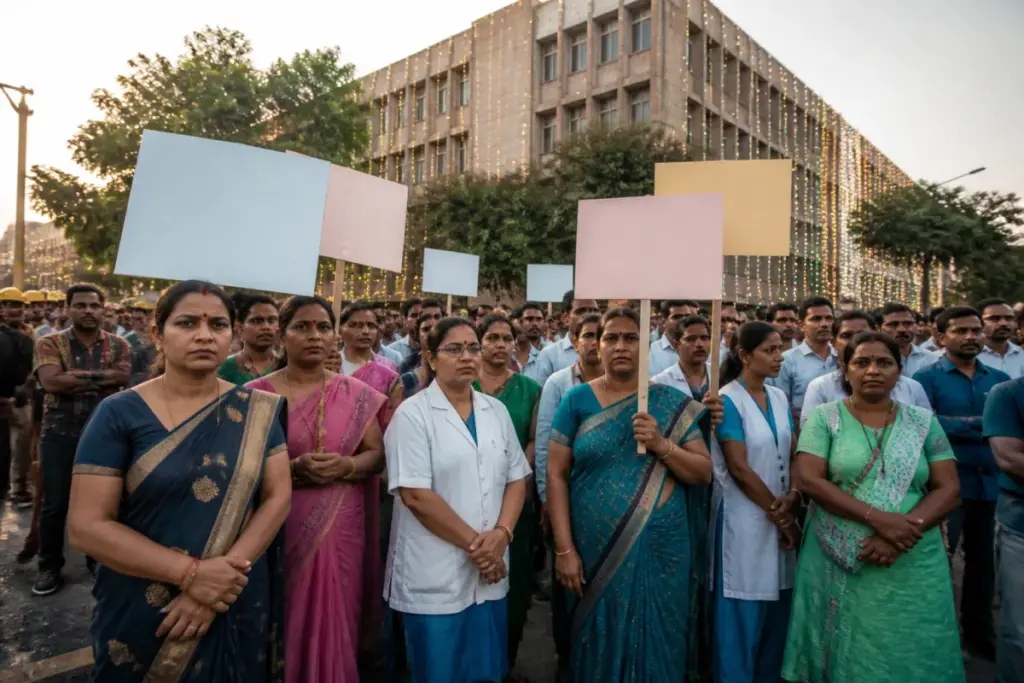
Gujarat workers and employee organisations have warned of a statewide agitation before Diwali if the government does not address complaints over low wages, long working hours, contract employment and rising living costs. The warning involves anganwadi workers, ASHA workers, industrial labourers and other sections of the workforce across the state.
The threat was reported by Gujarat Samachar, which said workers’ organisations had accused the government of failing to resolve issues linked to economic exploitation and inadequate remuneration. The report said workers were demanding action before the festival, warning that the protest could intensify if no settlement is reached.
Among the groups cited are 1,20,540 anganwadi workers, 47,817 helpers and around 44,000 ASHA workers and facilitators. The report said these workers continue to perform public-facing duties for extended hours while receiving what their organisations describe as inadequate pay. It also said fixed-pay employment in the state had increased from around two lakh positions in 2018 to approximately 3.50 lakh by 2025.
The report further pointed to the expanding role of contract, outsourced and ad-hoc employment in government-linked work. It cited an increase in such employees from six lakh in 2022 to 6.50 lakh in 2025, while claiming that the number of permanent government employees had declined by about 30%. These figures were presented in the report as evidence of a wider shift towards less secure employment.
Industrial and informal-sector workers were also cited in the warning. Gujarat Samachar reported that the state has 47,762 registered factories employing around 24 lakh people, while industrial estates are home to an estimated 30–40 lakh migrant workers. The report said workers’ organisations had raised concerns about electricity shortages, gas constraints, economic uncertainty and job losses, with some migrant workers returning to their home states.
The workers’ central complaint is that people are being made to work for as many as 12 hours while not receiving the full wages applicable even for eight hours of work. The report said labour groups believe minimum-wage protections are not being implemented adequately amid inflation and rising household costs.
The dispute also highlights the dependence of urban services and industrial production on workers whose employment is often informal, outsourced or tied to short-term arrangements. Anganwadi and ASHA workers support essential community and public-health functions, while migrant labourers remain critical to industrial estates and construction-linked economies. Any statewide mobilisation could therefore affect both public services and industrial operations, although the supplied report does not provide details of a formal strike date, named unions or a government response.
Worker organisations have said they will intensify their movement if the government does not resolve the issues before Diwali. The next step, according to the report, is a statewide protest if the deadline passes without an agreement.


