

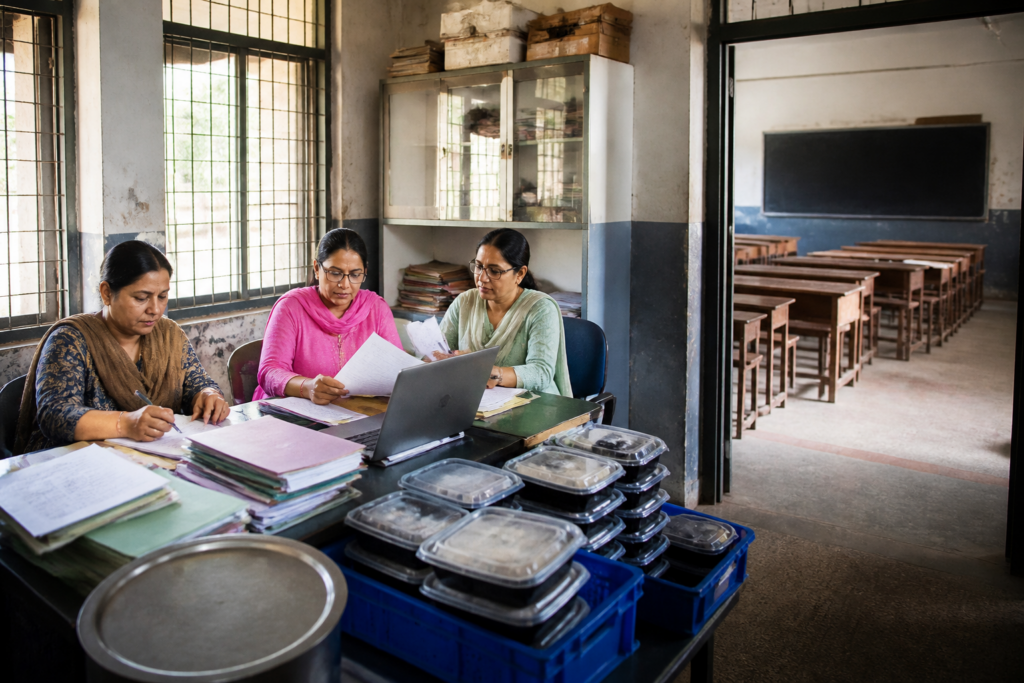
Primary-school teachers in Gujarat have reportedly been appointed nodal officers for the Shramik Annapurna Yojana, adding responsibility for monitoring meal distribution centres to an expanding list of administrative duties traditionally handled outside the classroom.
Gujarat Samachar reported on October 16 that the state government has assigned teachers responsibility for the operation of food distribution centres run under the Labour Welfare Board’s Shramik Annapurna Yojana. The report said the decision has triggered concern within the education sector because teachers are already handling data entry, portal updates, surveys, reporting and other government-related administrative work.
Under the reported arrangement, teachers are expected to monitor whether workers receive meals through the scheme. The report did not provide the text of the government order, the number of teachers affected, the locations of the food centres or the duration of the assignment. It also did not specify whether additional staff or administrative support would be provided.
The latest responsibility comes alongside duties that Gujarat Samachar said have already been assigned to school principals and teachers. These include submitting bills, preparing reports for government schemes, updating online records, supporting election-related work, assisting with voter-list revision and participating in census-related activities.
The issue is significant for government schools because teachers are a frontline resource whose availability directly affects classroom functioning. Gujarat Samachar reported that schools are already facing a shortage of teachers, while additional non-teaching assignments require time away from lessons, preparation and direct interaction with students.
The report linked the assignment to a wider concern over the administrative burden placed on government-school staff. It said that teachers are increasingly required to manage online processes, paperwork and implementation-related tasks in addition to their teaching responsibilities. The result, according to the report, is a conflict between classroom instruction and the delivery or monitoring of government schemes.
The Shramik Annapurna Yojana is administered through the Labour Welfare Board and involves food distribution centres for workers. Assigning school teachers as nodal officers places an education department workforce in a coordinating role for a labour-welfare programme. The available report does not clarify the formal chain of responsibility between the education authorities, the Labour Welfare Board and the officers managing the centres.
That institutional detail will determine how the new arrangement works in practice. If teachers are expected only to record information or coordinate with existing staff, the time burden may be different from a system in which they must regularly inspect centres, verify beneficiaries, monitor meals and submit compliance reports. The supplied report does not establish the operational requirements or whether workload limits have been set.
The report also did not include a response from the Gujarat government, the Labour Welfare Board or education officials to the concerns raised. The next formal communication on the assignment would need to clarify the scope of the nodal officer role, the reporting process, the frequency of inspections and the arrangements for maintaining classroom teaching while the scheme is monitored.


