

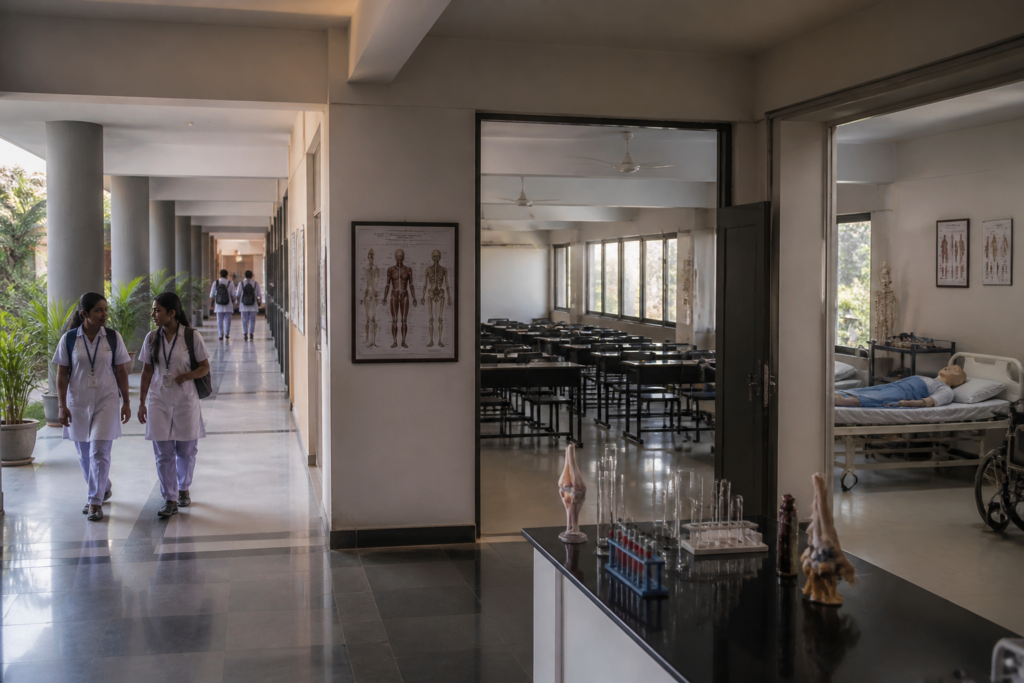
Gujarat nursing admissions have produced a stark mismatch between the number of approved seats and student demand, with 36,252 seats remaining vacant across paramedical courses after three rounds. The figures reported by Nav Gujarat Samay indicate that only 16,954 of 53,206 seats across 1,095 colleges have been filled, raising questions about how new institutions are being approved and monitored.
The report concerns admissions to BSc Nursing, physiotherapy, General Nursing and Midwifery, Auxiliary Nurse Midwifery, orthotics and prosthetics, and Bachelor of Audiology and Speech-Language Pathology courses. After three rounds, only about one-third of the available seats had been filled, leaving roughly two-thirds vacant. The scale of the shortfall is significant because these courses are linked to the healthcare workforce, professional training capacity and the availability of qualified personnel for hospitals and community health services.
The immediate administrative response is divided between government and self-financed colleges. The admission authority has announced another round for 444 vacant seats in government colleges. Students seeking these seats can fill their choices between 13 and 16 October, according to the report. The government-college vacancies include 98 physiotherapy seats, 46 BSc Nursing seats, 133 GNM seats, 145 ANM seats, seven BASLP seats and 15 seats in Bachelor of Orthotics and Prosthetics courses.
Self-financed colleges will receive responsibility for filling their remaining seats directly until 30 October, which is the reported final date for completing admissions to these courses. The colleges must follow admission rules and enrol admitted students with the relevant councils and universities. This changes the operational model from centralised allocation to institution-led admissions for a large share of the vacant capacity.
That shift may help colleges use some of their unused capacity before the deadline, but it also makes oversight important. The supplied report does not establish how many of the 36,252 vacant seats can realistically be filled through direct admissions, whether students are concentrated in particular districts or courses, or what minimum infrastructure and faculty standards will be applied during the process. Those details would be necessary to assess whether the measure is only an administrative adjustment or part of a broader correction to the sector.
The data points to a supply problem that extends beyond one admission cycle. The report says 1,015 colleges received only a small number of students. It identifies 70 colleges with between 21 and 25 admissions and 133 colleges with between six and 10 admissions. It also states that more than 100 additional institutions have applied for approval to offer nursing and related courses, even though many existing colleges have struggled to attract students.
This creates a clear planning question: how is capacity being assessed before new colleges are approved? If institutions continue to be added while existing colleges operate with very low enrolment, the system may accumulate buildings, seats and administrative approvals without creating a proportionate increase in high-quality training. The report does not provide the approval criteria, inspection records, district-wise demand estimates or course-level employment data needed to determine why this expansion has continued.
The institutional structure is also visible in the admission arrangements. The central admission process retains responsibility for the 444 vacant government-college seats, while self-financed colleges are permitted to fill their own vacancies within the prescribed rules. Enrolment with the relevant council and university is intended to provide a formal record of students admitted through the institution-led process. The effectiveness of that safeguard will depend on how quickly enrolments are recorded and whether regulators verify compliance with faculty, laboratory, clinical training and infrastructure requirements.
The reported numbers also show why total seat capacity alone is an incomplete measure of healthcare education capacity. Gujarat has 53,206 sanctioned seats across the listed courses, but the number of students actually entering training is much lower. A vacant seat may reflect limited student demand, high fees, location, weak institutional reputation, inadequate information, course preferences or a mismatch between the curriculum and employment expectations. The supplied material does not distinguish among these causes.
The difference between government and self-financed institutions is another unresolved part of the picture. Only 444 vacant seats are reported in government colleges, compared with the much larger pool of vacancies assigned to self-financed colleges. This may indicate stronger demand for government institutions, lower fees, better perceived quality, more accessible locations or limited government capacity relative to private supply. The report provides the vacancy count but not the fee structure, geographic distribution or comparative student preferences required to explain the gap.
There is also a data issue that must be resolved before the figures can be treated as publication-ready. The report’s headline and one passage state that 133 colleges received no students, while another passage states that 138 colleges received zero admissions. Since the difference affects the assessment of how widespread the problem is, the figure should be checked against the official admission data or the relevant admission committee’s statement. The report also refers to 1015 colleges receiving only a few students and separately cites 1,095 colleges as the total number of institutions for which seats were offered; the relationship between these two figures is not fully explained in the supplied material.
These inconsistencies do not erase the broader signal. Even using the reported total of 36,252 vacant seats, Gujarat’s paramedical education system appears to have substantially more approved capacity than student demand after three rounds. The immediate deadline-driven response may fill some seats, but it cannot by itself answer whether the state has the right number of colleges, whether they are located where students and healthcare employers need them, or whether inspection systems are keeping pace with expansion.
The next administrative milestones are the government-college choice-filling window from 13 to 16 October and the reported 30 October deadline for completing admissions. Verification is still required for the conflicting zero-admission college count, the final college total, and the official course-wise admission data. Those records will determine whether the reported vacancy crisis reflects a temporary admission-cycle imbalance or a deeper failure to align professional education capacity with demand and regulatory oversight.


