

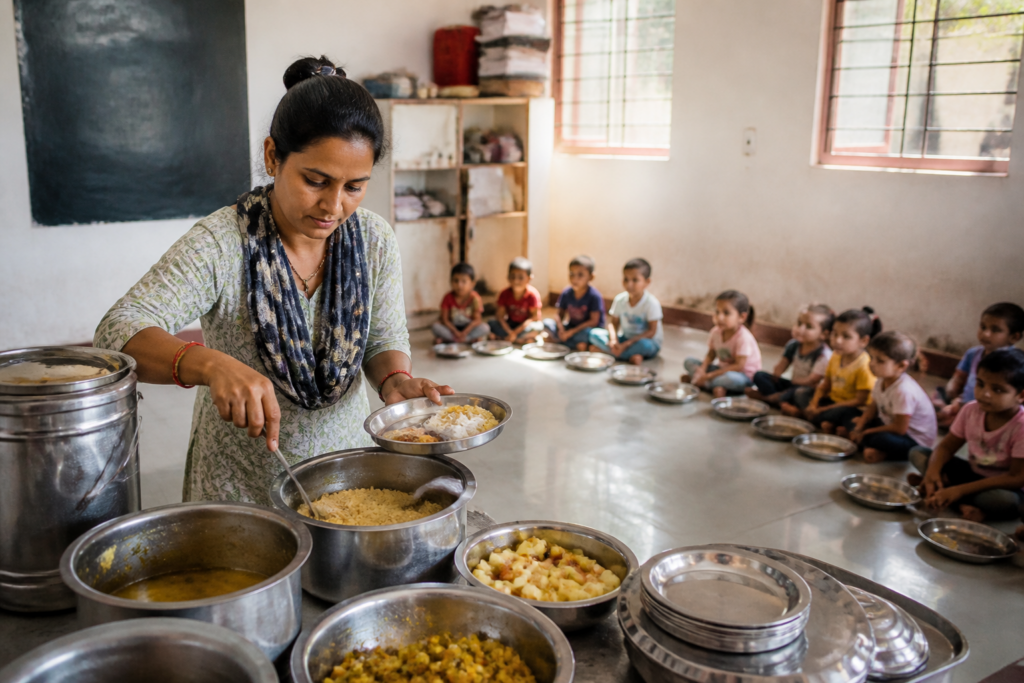
Gujarat’s reported decision to raise the daily food allocation for Anganwadi children from Rs 5.10 to Rs 8.50 has exposed a larger administrative question: whether a fixed per-child budget can realistically support the nutrition standards the programme is expected to deliver.
The report by Gujarat Samachar states that the revised allocation applies to 16.17 lakh children aged between three and six years enrolled in Gujarat’s Anganwadi centres. The reported increase is Rs 3.40 per child per day. The earlier allocation was Rs 5.10, with the Centre and the Gujarat government each contributing 50 per cent, according to the report.
The government is reported to have described the higher amount as a “power pack” increase and said it would support snacks and meals containing pulses, whole gram, green gram, jaggery, vegetables, fruits, peanuts or sesame and spices. The reported allocation also includes a transport component.
The details supplied by the report show how the proposed amount is expected to be distributed: Rs 1.24 for pigeon pea, Rs 0.85 for whole gram, Rs 1.30 for whole green gram, Rs 0.53 for jaggery, Rs 0.83 for green vegetables, Rs 2 for fruit, Rs 0.65 for peanuts or sesame, Rs 0.65 for spices and Rs 0.50 for transport. However, these listed components add up to Rs 8.55, not Rs 8.50. The discrepancy is small in absolute terms but important in a nutrition programme where the entire allocation is divided into tightly prescribed cost heads.
That arithmetic gap also points to the need for clarity on how the allocation is calculated. It is not clear from the supplied report whether the figures have been rounded, whether one component is subject to adjustment, or whether the reported total or one of the individual amounts contains an error. The source does not include the government order, departmental circular or budget document establishing the revised rate.
The central issue is not simply the difference between Rs 5.10 and Rs 8.50. It is whether the revised amount matches the actual procurement and preparation costs faced by Anganwadi centres. The reported cost heads cover both ingredients and transport. That means the same daily allocation must support food procurement, movement of supplies and preparation of meals or snacks. Any increase in prices or transport costs would put pressure on the quantity or variety of food that can be served within the stated amount.
The report specifically identifies pulses, vegetables and fruit as part of the proposed menu. These items do not carry a uniform cost across locations or seasons. The source, however, does not provide procurement dates, approved suppliers, district-wise rates, menu quantities or the number of meals and snacks to be served from the allocation. Without those details, the reported budget cannot by itself establish whether the promised menu is operationally feasible.
The programme’s scale makes the issue a matter of public administration rather than an isolated food-price dispute. A daily change of Rs 3.40 per child, applied to 16.17 lakh children, represents a reported increase of roughly Rs 55 lakh per day before accounting for the number of operating days or the division of costs between governments. That calculation illustrates the size of the policy commitment, but the supplied report does not provide the annual budget impact or clarify whether the revised amount applies on every operating day.
The Centre-state funding arrangement adds another layer of importance. If the earlier allocation was shared equally and the revised amount includes an increase by the state government, the precise funding responsibilities should be set out in the relevant official document. The source report does not establish whether the Centre’s contribution has also changed, whether the state is bearing the full increase, or how the revised allocation will be transferred to centres and implementing agencies.
Anganwadi centres operate at the intersection of nutrition delivery, early childhood care and local administration. The children covered by the reported decision are between three and six years old, a period in which the quality and regularity of meals are directly connected to the public service delivered through the centres. Yet the supplied material contains no information on monitoring arrangements, reporting requirements, food quality checks or action to be taken when the planned menu cannot be delivered within the approved amount.
The comparison in the source report with meals served at political events is presented as criticism of the government’s priorities. That comparison is a political and editorial framing by the source, not a quantified government expenditure comparison supported by a document in the supplied material. The verifiable policy question remains narrower: what amount has been officially approved, what food must be supplied against it, and how will implementation be monitored across Gujarat’s Anganwadi network?
The reported increase may improve the previous allocation, but an increase alone does not demonstrate adequacy. The outcome will depend on the official menu, procurement rules, local prices, transport arrangements, serving frequency and oversight. None of those implementation details is provided in the source material.
The next step is therefore documentary confirmation. Gujarat’s Women and Child Development Department or the relevant state authority would need to publish or clarify the order setting the Rs 8.50 rate, the funding split, the effective date, the menu quantities and the apparent Rs 8.55 arithmetic in the reported cost table. Until those details are confirmed, the report establishes a significant policy claim but not the complete operating framework behind it.


