

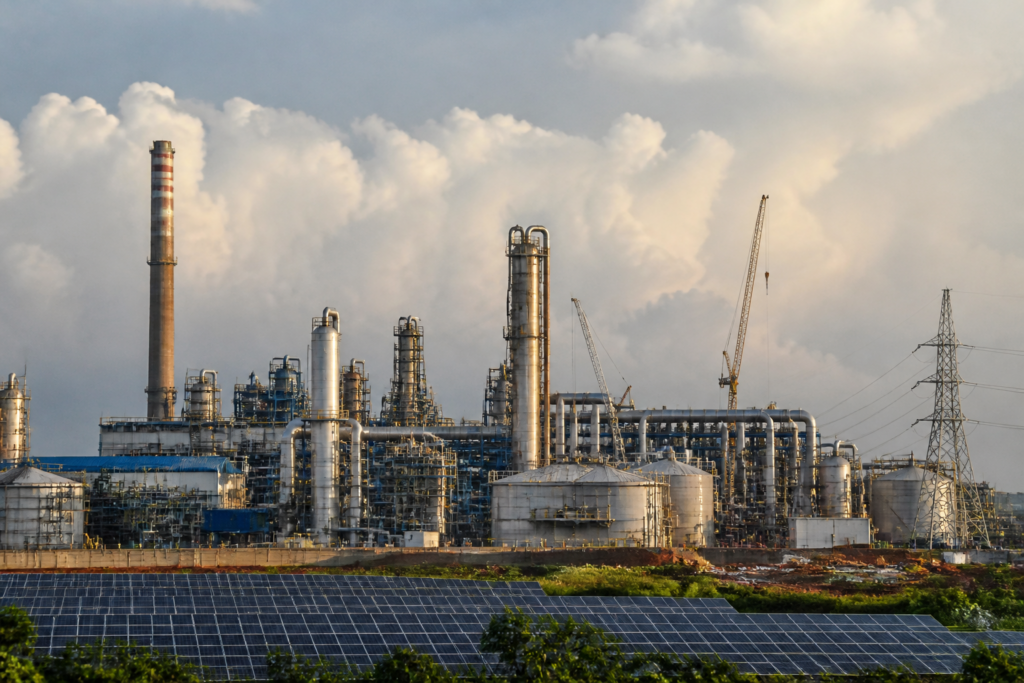
The financing of a large green ammonia plant in Kakinada places Andhra Pradesh at the centre of an industrial transition that is broader than a single project. The Asian Development Bank (ADB) and the government of Japan have signed financing agreements with Hyderabad-based AM Green Ammonia (India) Private Ltd, including a $100 million loan, to support a renewable-powered facility expected to produce about 1.1 million tonnes of green ammonia annually.
The project matters because it combines three forms of infrastructure that are usually discussed separately: an existing industrial site, renewable energy and international development finance. AM Green Ammonia, set up by the founders of Greenko Group, plans to convert a former ammonia and urea facility in Kakinada from natural gas-based production to renewable-powered green ammonia production. The stated objective is to support cleaner fertiliser and industrial supply chains while developing an export industry in India.
That combination makes the project a test of whether industrial decarbonisation can be built through the reuse of existing assets rather than only through entirely new sites. The source report does not provide details of the plant’s original commissioning, its present operating condition, the renewable-energy capacity that will supply it, or the construction schedule. Those omissions are important because the project’s eventual impact will depend not only on its announced production target but also on how the conversion is executed and connected to wider energy and logistics systems.
The financing structure itself offers a window into how major clean-energy projects are being assembled. The $100 million loan comes from the Leading Asia’s Private Infrastructure Fund 2, which is financed by the Japan International Cooperation Agency and administered by ADB. This is not described as a conventional commercial borrowing arrangement alone. It is part of a broader public-backed financing architecture intended to direct capital towards infrastructure with regional energy and industrial implications.
ADB said the investment is the first under the Action for Creating Energy Security for Long-term Resilience, or ACCEL, initiative launched by ADB and Japan in May 2026. According to the bank, the initiative is intended to help countries and businesses in Asia and the Pacific respond to energy price pressures and build more resilient energy systems. The Kakinada project therefore serves two stated purposes: producing a lower-emission industrial input and demonstrating how energy-security priorities can be converted into investments.
This institutional link is significant. Green ammonia is presented in the announcement not merely as an environmental product but as part of energy and supply-chain resilience. Ammonia is used in fertiliser production, and the project is expected to supply cleaner fertiliser and industrial chains. The source does not identify the plant’s future customers, export destinations or offtake agreements, so the exact commercial network that will emerge around the facility remains unspecified. What is clear is that the project is being positioned as both a domestic industrial asset and a potential export platform.
The choice to convert a former ammonia and urea facility also changes the way the project should be understood. Repurposing an industrial site can preserve the value of existing land, plant systems and local industrial linkages, although the supplied report does not establish which parts of the former facility will be retained. It confirms only that production will move from a natural gas-based process to one powered by renewable energy. The scale of the proposed output means the conversion will have to be treated as a substantial industrial transition rather than a minor retrofit.
ADB President Masato Kanda described the project as a change in how ammonia is made. He said renewable energy would allow India to produce ammonia with far lower emissions and at a scale capable of reshaping the industry. His statement establishes the project’s stated climate and industrial ambition, but it does not provide a quantified emissions baseline or a verified estimate of the reduction expected from the conversion. Those figures will be necessary to measure the difference between the former production model and the proposed renewable-powered one.
The announced annual capacity of 1.1 million tonnes is the clearest measure of the project’s intended scale. It gives the plant a role beyond a demonstration facility and links its performance to fertiliser and industrial supply chains. However, the report does not say whether the 1.1 million-tonne figure refers to full production after completion, a planned nameplate capacity or an initial operating target. It also does not provide construction costs, financing beyond the $100 million loan, employment estimates or the number of renewable-energy installations required to operate the plant.
These missing details do not reduce the significance of the financing agreement, but they define the limits of what can currently be concluded. The announcement confirms financial backing, the location, the intended production pathway and the proposed annual output. It does not establish when construction will be completed, when commercial production will begin, or how the facility will manage the operational requirements of renewable-powered ammonia production. Those milestones will determine whether the project’s industrial and export ambitions are realised on schedule.
For Kakinada, the project represents a potential shift in the profile of an established industrial location. The city is not being presented simply as the site of a new factory. It is the location of a conversion that connects legacy manufacturing infrastructure with a new energy system and an international financing programme. That combination can influence land use, industrial employment, logistics demand and the importance of local energy infrastructure, although the supplied material does not provide specific projections for any of these areas.
The project also illustrates the changing role of development finance institutions in the built and industrial environment. ADB’s involvement is tied to energy resilience, while Japan’s participation is linked to diversification of energy sources and stronger Asian supply chains. Japan’s finance minister Satsuki Katayama called the project the first joint investment under ACCEL and said Japan would continue supporting the diversification of energy sources. The statements show that the financing is being used to pursue a regional policy objective, not only a company-level expansion.
This matters for future industrial projects because the financing model places clean production, energy security and market creation in the same investment frame. A project can be evaluated not only by its direct output but also by whether it reduces dependence on fossil-fuel-based production, supports a new export sector and strengthens supply-chain resilience. The Kakinada facility is explicitly being used to demonstrate that approach. Whether it becomes a replicable model will depend on evidence that is not yet available in the announcement, including delivery timelines, operating performance and the emissions profile of the completed plant.
There is also a governance dimension. The project involves a private company, ADB, JICA-backed financing and the government of Japan, while its physical implementation will take place at an industrial site in Andhra Pradesh. The supplied report does not identify the state agencies responsible for approvals, local infrastructure coordination or environmental oversight. Nor does it describe the regulatory process for converting the former facility. Those institutional details will be important for understanding how international finance is translated into a functioning project on the ground.
The Kakinada announcement therefore confirms an important direction without resolving the implementation questions. It shows that green ammonia is being pursued at industrial scale, that existing production infrastructure is being considered for conversion, and that international public finance is supporting the transition. It also places energy security alongside decarbonisation rather than treating the two as competing objectives.
The next stage will be to establish how the project moves from financing agreement to construction and then to commercial production. The key developments to monitor are the detailed project schedule, the renewable-energy supply arrangement, the final financing package, the conversion plan for the former ammonia and urea facility, and confirmation of the plant’s operating capacity. Until those details are published, the Kakinada project is best understood as a major financed commitment with a clearly stated industrial ambition, rather than as a completed transformation.


