

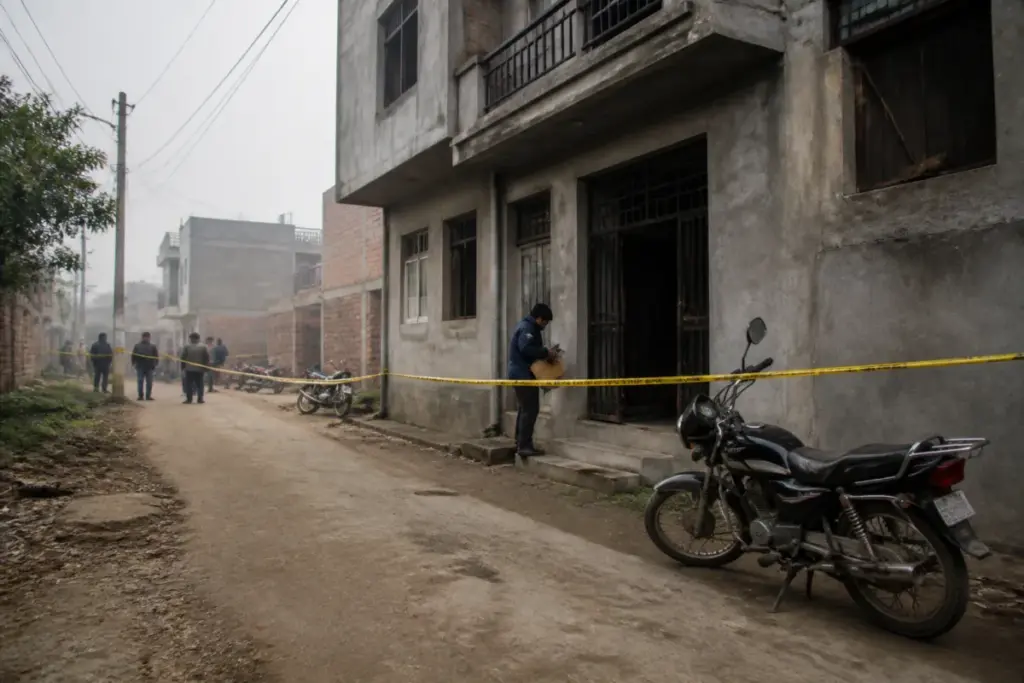
An investigation into an alleged synthetic-drug factory in Rabupura, Greater Noida, has raised concerns about the use of rented residential properties for illicit activity, while a reported link to Mexico’s Jalisco New Generation Cartel remains subject to verification. The claims were reported by Navbharat Times – Noida, which attributed the cartel connection and related financial details to unnamed sources.
The Narcotics Control Bureau (NCB) reportedly uncovered the facility near Kadalpur village in Rabupura last week under Operation Crystal Hunt. Two people were arrested, according to the report: foreign national Destiny Abraham Dambiri and Mizoram resident Lallawmawzuali, also identified as Olivia Lalchawimawi.
The report said Dambiri identified himself as a Nigerian citizen. It also cited immigration records as showing that he entered India in January 2020 under the name Francis Kalokoh as a citizen of Sierra Leone. The account does not provide the underlying immigration documents or an official NCB statement, and the significance of the identity discrepancy remains to be established through the investigation.
According to the report, the facility was allegedly being used to manufacture synthetic drugs. It said investigators found indications of a link with the Jalisco New Generation Cartel, commonly known as CJNG, a Mexican criminal organisation. The report attributed this information to sources familiar with the questioning and investigation. No primary document or on-record agency statement confirming the alleged international connection was included in the supplied material.
The reported cartel angle has an important urban dimension because the alleged operation involved a rented house rather than an isolated industrial premises. The report said investigators believe residential properties are being rented in densely populated areas and locations some distance from established city centres to avoid suspicion. It further said tenants may present themselves as students, with foreign nationals and people from the Northeast allegedly being used to secure accommodation.
These claims, if established by investigators, would place greater pressure on the systems through which landlords, property dealers and local authorities verify tenants. In fast-growing urban regions such as the National Capital Region, homes are frequently rented through informal networks, brokers and short-term arrangements. The supplied report, however, does not provide data on the scale of such practices, the number of properties examined or whether any landlord or property dealer has been charged in connection with the Rabupura case.
The report also linked the Rabupura investigation to an earlier NCB operation in Greater Noida. In October 2024, the agency reportedly dismantled an illegal synthetic-drug laboratory operating in the Kasna Industrial Area and seized 95.5 kilograms of synthetic drugs. The earlier case suggests that the region has previously appeared in investigations involving illicit drug production, although the supplied material does not establish that the two cases are connected.
According to the report, investigators believe the alleged network may be shifting towards production within India because large consignments are increasingly being intercepted during trafficking. It said Delhi, Noida, Greater Noida, Faridabad, Ghaziabad and nearby areas were being examined as possible locations. It also attributed claims about funding through cryptocurrency and hawala channels from Dubai to unnamed sources.
Those financial and geographic claims require particular care because they extend beyond the arrests and the reported seizure operation. The supplied article does not identify the specific transactions, financial records, properties or investigative documents supporting them. They should therefore be treated as allegations reported by the source, rather than established facts.
The NCB has reportedly appealed to landlords and property dealers to share information about suspicious activity through the national narcotics helpline, 1933. The appeal places property intermediaries at the centre of the agency’s prevention strategy. It also reflects a wider administrative challenge: local rental markets often operate across multiple layers, including owners, brokers, caretakers, tenants and informal documentation, making responsibility and oversight difficult to trace.
For residents, the case highlights how public safety can intersect with ordinary housing transactions. A rented property in a residential neighbourhood can become part of a criminal investigation without the wider community being aware of the activity. At the same time, suspicion based only on nationality, region of origin, occupation or lifestyle can lead to discriminatory profiling. Any enforcement response must therefore rely on verified evidence, lawful investigation and documented tenant and property records rather than generalised assumptions.
The reported arrest of Olivia Lalchawimawi is also presented as part of a broader investigative trail. The report said she had been arrested in March 2026 at Goa’s Dabolim Airport in a heroin-related case. It did not provide details of the status of that case, any court proceedings or the legal basis on which investigators connected it to the Rabupura operation. Those details remain important for understanding whether the cases are formally linked.
The central question is not only whether an international cartel was involved, but also how an alleged drug-manufacturing operation could function inside or near a residential settlement. That question involves tenant verification, property brokerage, local intelligence, industrial monitoring, immigration records and coordination between agencies. The supplied report does not establish which of these systems failed or whether officials had previously received warnings about the property.
The NCB’s appeal for information through helpline 1933 is the clearest reported next step for landlords and property dealers. Further clarity would require an official agency statement, seizure details, arrest records, court filings or other primary documentation confirming the nature of the facility, the substances allegedly manufactured, the identities of those arrested and any international links. Until such evidence is made available, the cartel connection and the reported financing network remain claims requiring verification.


