

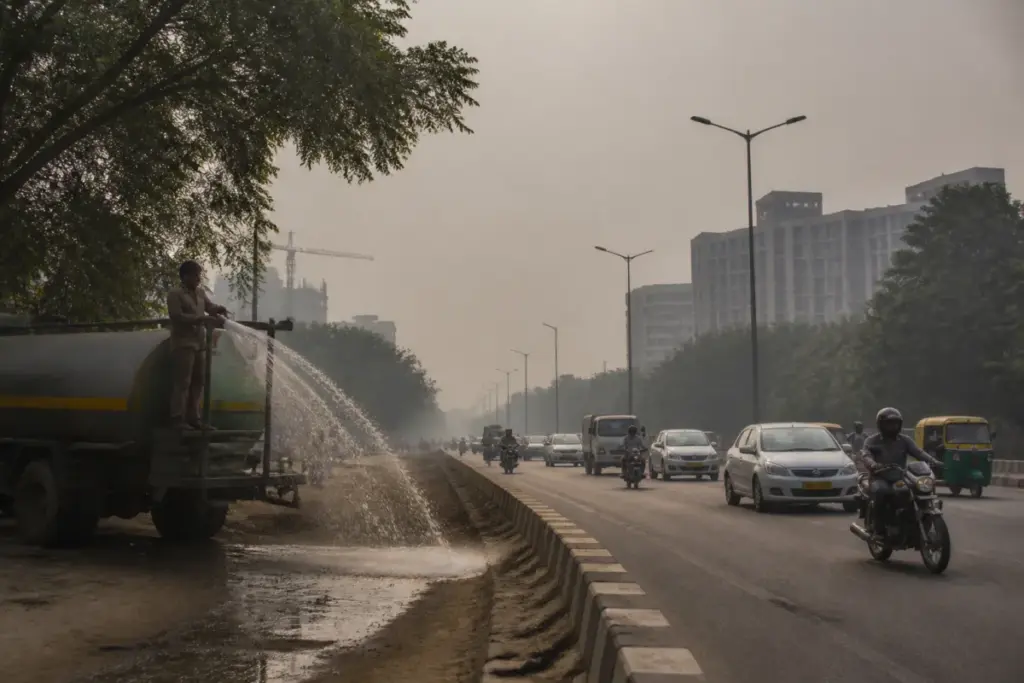
GRAP 1 Delhi restrictions came into force across the National Capital Region on Wednesday after the city’s air quality deteriorated to the poor category, with the Commission for Air Quality Management directing agencies to intensify pollution-control measures. Schools and offices will continue to function normally under the first stage of the plan.
Delhi’s Air Quality Index stood at 244 at 2 pm on October 21, placing it in the poor category. The AQI had been recorded at 179, in the moderate category, on October 20. The sharp deterioration led the GRAP Sub-Committee to review the city’s air quality along with weather and air-quality forecasts before ordering the immediate implementation of Stage I across the entire NCR.
The Commission for Air Quality Management said the India Meteorological Department and the Indian Institute of Tropical Meteorology had forecast that the AQI was likely to remain in the poor category over the coming days. The forecast was cited in the order that triggered the pollution-control response.
Under the revised GRAP schedule issued on September 29, Stage I applies when Delhi’s AQI is between 201 and 300. The measures include intensified dust-control action by the concerned agencies. The supplied order, as reported, also directs agencies to strengthen pollution-control measures across the region, although it does not provide the complete list of operational instructions.
The first-stage restrictions do not include a shutdown of schools or offices. Both will continue to operate normally while agencies implement the measures specified under GRAP Stage I. The decision therefore marks an escalation in pollution-control operations without introducing the wider restrictions associated with more severe air-quality conditions.
The GRAP framework is organised around AQI thresholds. Stage II is imposed when air quality becomes very poor, with an AQI between 301 and 400. Stage III applies when the AQI reaches the severe range of 401 to 450, while Stage IV is reserved for severe-plus conditions above 450. Each stage represents a progressively stronger administrative response to deteriorating air quality.
The move places the responsibility for immediate implementation on agencies across the NCR rather than on Delhi alone. The CAQM’s order follows a review of measured pollution levels and projected weather conditions, making the forecast an important part of the decision to activate the first stage before conditions worsen further.
For residents, the immediate change is the stepped-up enforcement of dust-control and other pollution-control measures, while routine schooling and office activity remain unaffected. The next operational milestone will be the implementation of the Stage I directions and continued assessment of AQI and forecasts to determine whether the existing measures remain sufficient or a higher GRAP stage becomes necessary.


