

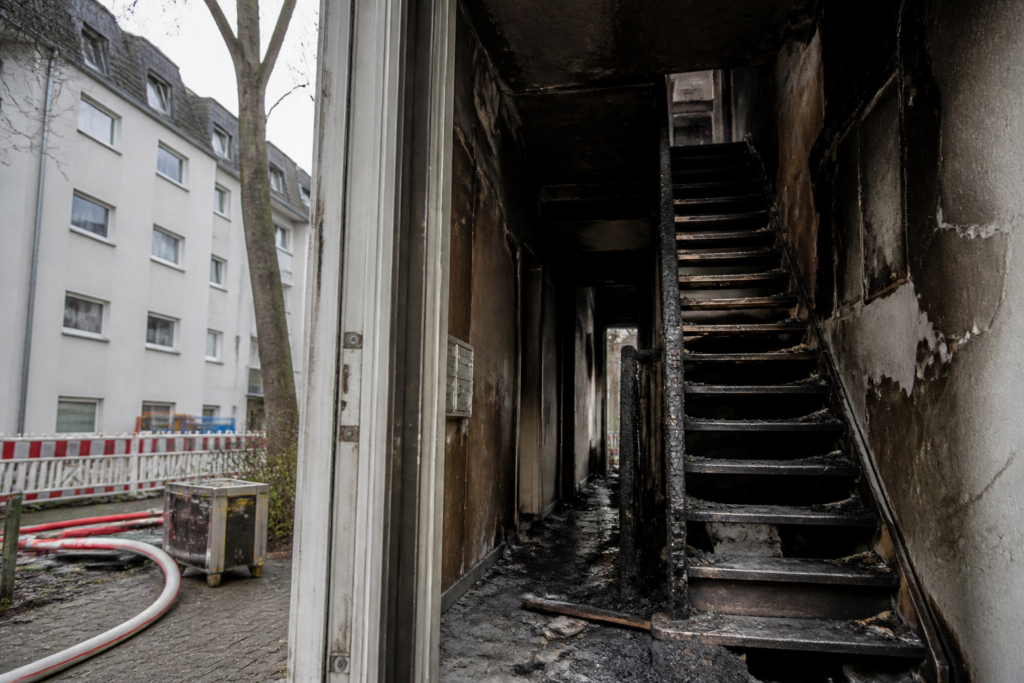
The deaths of three Malayalis in an apartment fire in Bochum, Germany, have drawn attention to a basic but decisive feature of residential safety: whether people can get out when smoke, flames or structural damage block the usual route. According to a report by Malayala Manorama, Anjali S. Joy, 27, Nova Sabu, 25, and Sिवിൻ ജോണി, 27, died after inhaling smoke. They were living on the third floor when a wooden staircase in the apartment building collapsed in the fire, leaving them unable to escape.
The incident is being investigated by German police. The report said a Romanian neighbour suspected of involvement had been arrested and questioned. Five people from nearby flats were also admitted to hospital in serious condition after inhaling smoke. The account does not establish the cause of the fire, the exact condition of the building before the incident, or whether any safety rules were breached. Those questions remain with the investigation.
What the available facts do establish is the way a residential fire can become a circulation and evacuation crisis. The victims were not described as dying from burns but from smoke inhalation. Their reported location on the third floor and the collapse of the wooden staircase meant that the primary escape path was no longer usable. In such circumstances, the design, construction and maintenance of common areas can determine whether residents have time and access to reach safety.
## Germany apartment fire turns an ordinary rental decision into a safety question
The three victims had reached the apartment at different points in their migration and employment journeys. Sivin Johny, from Thottakam near Kalady in Ernakulam district, had travelled to Germany about a month earlier and moved into the apartment on the Sunday before the fire. He was expected to begin work at a hotel the following Monday. He had chosen the accommodation for easier access to work, the report said.
Anjali and Nova had travelled together after studying German and obtaining work visas through an agency in Bengaluru. They reached Germany on July 28 and found work at a private company warehouse in Bochum. Anjali had initially lived near her employer’s house but was moved to the apartment about two weeks before the fire when the owner’s relatives needed accommodation. Nova joined her there, followed by Sivin the previous week.
These details matter because they show how accommodation decisions are often connected to work, visa arrangements, travel time and changing household needs. The apartment was not presented in the report as a permanent family home selected after a long search. It was a rented place used by people who had recently arrived, were adjusting to a new country and were dependent on employment and accommodation arrangements made around them.
That does not by itself establish that the apartment was unsafe or that the victims had been placed there improperly. It does, however, highlight the information gap that can surround temporary or recently arranged housing. The supplied report does not say whether the tenants had received fire-safety instructions, whether they knew alternative exits, or whether the building had emergency lighting, alarms or other protective systems. It also does not identify the authority responsible for inspecting the building or clarify whether any such inspection had taken place.
## A staircase can be infrastructure inside a home
Residential safety is often discussed through the condition of roads, bridges, elevators or public buildings. The Bochum incident shows why internal circulation spaces deserve similar attention. A staircase is not merely an architectural feature. In a multi-storey building, it is a critical evacuation route, and its ability to remain usable during a fire can be more important than its everyday appearance or convenience.
The report states that the apartment’s wooden staircase collapsed after catching fire. It does not provide technical details about the staircase’s construction, fire resistance, age, maintenance or relationship to other exits. It is therefore not possible to conclude from the supplied material whether the staircase complied with German requirements or whether its design directly caused the deaths. The documented sequence is narrower: the fire damaged the staircase, the residents were on the third floor, and the three Malayalis died after inhaling smoke.
The same distinction applies to smoke. The deaths underline the danger of smoke moving through a building before residents can reach an exit, but the report does not establish how smoke spread, whether alarms sounded, or how long emergency services took to arrive. Those facts will be important to any official reconstruction of the incident.
For residents, the practical risk is immediate. A person may be able to leave an apartment quickly under normal conditions but lose that option when a staircase is burning, collapsed or filled with smoke. The availability of a second escape route, the visibility of exit paths and the ability to understand emergency instructions become critical. For people who have recently moved to another country, language and unfamiliarity with the building may add another layer of difficulty, although the report does not state whether that affected this incident.
## The migrant housing dimension is visible, but not yet fully documented
The victims’ stories also bring the migrant housing system into view. The report says Anjali and Nova spent more than Rs 25 lakh on visas and related expenses, with Anjali’s family using retirement savings and chit-fund money. Sivin had left a private travel-agency job in Kerala for a hotel position in Germany. Anjali had worked as a teacher in Kerala and was exploring opportunities linked to English-language teaching, while also studying German.
These details demonstrate the financial and personal investment behind overseas employment. A rented room or apartment can become part of a much larger chain involving agents, employers, relatives and fellow migrants. Yet the supplied report does not establish who arranged the Bochum accommodation, what rent was paid, how many people were officially registered there, or whether the tenants were given written information about fire exits and emergency procedures.
Those unanswered questions are important because housing is not separate from labour mobility. Recent arrivals may prioritise proximity to work, affordability and availability. Employers or intermediaries may influence where workers stay, directly or indirectly. When accommodation changes quickly, residents may have limited opportunity to assess the building or understand its emergency layout. None of this proves a systemic violation in Bochum, but it identifies the institutional links that an investigation would need to examine.
The account also indicates that Anjali was moved from one accommodation to another when the employer’s relatives needed space. That specific change was described by relatives and does not, on its own, indicate wrongdoing. It does show how housing arrangements for migrant workers can be fluid and shaped by household and employment requirements rather than by a stable tenancy relationship.
## What authorities have confirmed—and what remains open
The report said the Indian Embassy had contacted the families and that efforts were under way to bring the bodies to India. Members of Parliament Benny Behanan and Dean Kuriakose were also involved in efforts through Norka, the Kerala government’s support mechanism for non-resident Keralites. Post-mortem examinations were reported to have been completed.
These actions address the immediate needs of the families, including identification, documentation, repatriation and funeral arrangements. They do not replace the investigation into the fire itself. The report does not include a statement from German fire authorities, the building owner, the local municipality or the police on the suspected cause, the condition of the staircase, the occupancy of the building or the status of fire-protection equipment.
The arrest and questioning of a Romanian neighbour are also reported as part of the police inquiry. At this stage, the report only describes the person as suspected of involvement. It does not establish criminal responsibility or explain what investigators believe happened. That distinction is essential while the inquiry continues.
The next stage of public understanding will depend on documentary and technical findings: the origin of the fire, the condition and construction of the staircase, the number and position of escape routes, the operation of alarms, the spread of smoke, and the circumstances of the five injured residents. The supplied report does not provide those findings.
## The larger urban question is safe access, not only safe rooms
The Bochum fire shows that housing safety cannot be measured only by the condition of an individual room. It also depends on shared infrastructure: staircases, corridors, doors, alarms and routes that connect private homes to the outside. When any of these fail, the entire building’s safety can change rapidly.
It also shows why urban housing investigations must connect building conditions with the social circumstances of residents. Three people from Kerala had recently entered a foreign labour and housing system. Their accommodation was linked to work, travel distance, family arrangements and recent migration. A fire in that setting becomes both a building-safety event and a question about how temporary residents receive information, protection and accountability.
The evidence presently available confirms the deaths, the reported smoke inhalation, the collapse of the wooden staircase, the serious injuries to five other residents and the continuing police inquiry. It does not yet establish the fire’s cause or whether the building breached any safety requirement. Those findings, along with the official explanation of the escape routes and the accommodation arrangements, will determine whether the Bochum tragedy remains an isolated fire or exposes wider failures in residential safety and migrant housing oversight.


