

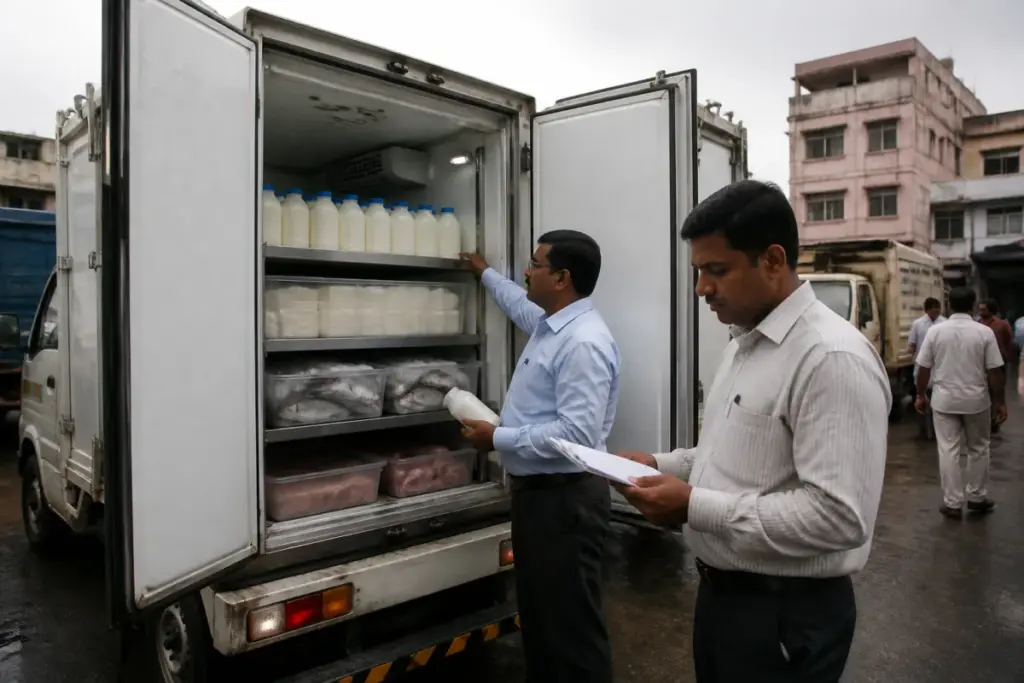
The Food Safety and Standards Authority of India (FSSAI) has directed food businesses and enforcement authorities to tighten controls on the transportation of perishable foods, as special inspections in Tamil Nadu reportedly found milk, paneer, meat and fish being moved without adequate temperature control.
The directive covers the supply chain from production and procurement to distribution and delivery to consumers. FSSAI has instructed businesses to use only clean, fully enclosed vehicles for transporting perishable food items and to maintain the prescribed low temperatures at every stage of movement.
The measures follow intensified action against complaints involving substandard and adulterated food across the country, after similar action in Maharashtra, according to a report by Dinamalar. In Tamil Nadu, special inspections found that several perishable food products were not being transported under the temperature conditions required to prevent spoilage.
FSSAI has warned that bacteria and other microorganisms can multiply rapidly when such foods are transported without adequate cooling. This can lead to deterioration and create risks to public health, particularly in supply chains where products move through several handling and distribution points before reaching consumers.
The authority has also instructed traders to use suitable food-grade packing materials. Perishable products must not be packed or transported in jute bags or unhygienic sacks. Businesses have been told to protect food from dust, moisture and insects during transit and handling.
Transporters and traders must keep the relevant receipts and documents for consignments available for inspection. These records are to be produced immediately when requested by food-safety officials, creating a traceability requirement for goods moving through the supply chain.
FSSAI managing director Dr Amit Sharma has directed state food-safety authorities and railway officials to conduct intensive vehicle inspections to check compliance. The instructions apply to transportation by road and also require railway authorities to participate in enforcement.
Officials have been told to register cases against those who violate the rules. Food products found to be substandard are to be seized and destroyed immediately, according to the directive reported by Dinamalar.
The enforcement focus places transportation alongside production and retail as a critical food-safety control point. For cities and towns, where consumers depend on daily deliveries of milk, meat, fish and other chilled products, the instructions make temperature control, clean vehicles, suitable packaging and supply-chain documentation central to compliance. The report does not specify the number of inspections conducted in Tamil Nadu, the quantity of food seized or the penalties imposed in individual cases.


