

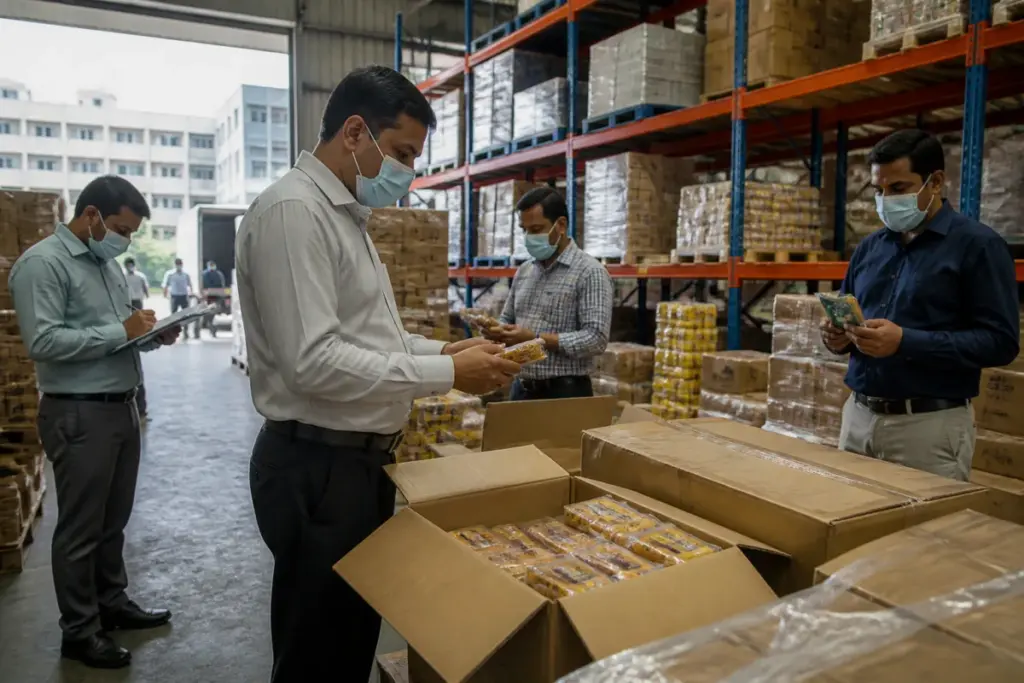
Food safety raids in Thane and Pune have uncovered an alleged system in which expired, spoiled, rejected and customer-returned food products meant for destruction were routed back towards the open market. The Food and Drug Administration (FDA) has registered an FIR against 10 people, including officials and employees linked to Reliance Retail, Blinkit and Zomato Hyperpure, as well as disposal-agency operators and local suppliers. The case places the spotlight not only on the alleged conduct of individuals, but also on the chain of custody that governs food after it leaves the saleable inventory of an urban supply network.
The FDA conducted coordinated raids on October 14 and 15 and reported the discovery of food stock valued at Rs 48 lakh. Its press release said five warehouse licences had been suspended. The affected facilities are associated with Reliance Consumer Products, Reliance Retail, Zomato Hyperpure and Blinkit at locations in Bhiwandi, Ambernath and Khed in Pune district. Two unlicensed establishments were also directed to shut down.
According to an FDA police complaint filed by assistant commissioner Praveen Shinde, expired, damaged and returned food products were allegedly routed through disposal agencies, middlemen and unlicensed sorting centres for resale instead of being destroyed as required under regulations. Investigators also found discrepancies in disposal documents, purchase bills and stock movement records. These are allegations recorded in the complaint; the FIR and regulatory action do not by themselves establish criminal liability, which will depend on the investigation and subsequent legal process.
The significance of the case lies in the movement of food through a distributed urban logistics system. Modern retail and quick-commerce operations depend on warehouses, dark stores, suppliers, delivery operators, reverse logistics and specialised disposal arrangements. A product can move through several entities even when the customer sees only a short ordering interface. That complexity makes the documentation of expiry, rejection, return and destruction a central part of food safety governance rather than a back-office formality.
The FDA account suggests that the alleged breakdown occurred after products were identified as unsuitable for ordinary sale. The products reportedly included expired and spoiled stock, along with rejected and customer-returned items. Such categories can have different operational reasons for removal, but they share one regulatory requirement in the account supplied by the FDA: items meant for disposal should not re-enter the market. The alleged use of middlemen and unlicensed sorting centres indicates that the disposal stage itself requires regulatory visibility.
The suspension of five warehouse licences is therefore an important part of the action. A warehouse licence is a point of administrative control over premises involved in storing or handling food. Suspending licences can interrupt operations at identified facilities while the authorities examine records and processes. The closure directions against two unlicensed establishments also highlight a second problem: food may be passing through locations that do not have the formal authorisation expected of food-handling premises.
The case also reveals why physical stock checks and document audits need to work together. The FDA said its investigators found stock worth Rs 48 lakh, while the police complaint referred to discrepancies in disposal documents, purchase bills and stock movement records. These records are meant to connect what entered a facility with what was sold, returned, rejected, destroyed or transferred. When the physical inventory and documentary trail do not match, regulators face difficulty determining where responsibility lies and whether products have been diverted.
For cities, this is a governance challenge created by scale and fragmentation. Thane, Bhiwandi, Ambernath and Pune district form part of a wider regional distribution landscape serving dense urban markets. Warehouses and sorting facilities located on the metropolitan periphery can support rapid delivery into multiple neighbourhoods. They can also place regulatory agencies in the position of supervising supply chains that cross municipal and district boundaries, involve private contractors and operate through facilities that may not all be licensed.
The supplied FDA account does not establish how many consumers may have received the allegedly diverted products, how long the activity continued, or whether any illness was linked to the stock. It also does not provide the names of all 10 accused persons, the specific products seized or the individual responsibilities assigned to each company employee or operator. Those gaps matter because a food-safety investigation must distinguish between a documentation failure, an unlawful resale operation and any proven public-health consequence.
The involvement of disposal agencies is another institutional issue. Companies may outsource the physical handling or destruction of rejected and expired inventory, but outsourcing does not remove the need for traceability. The reported discrepancies raise questions about how vendors are selected, how destruction is recorded, whether companies receive verifiable proof and how regulators audit the final destination of products. The material supplied does not state what internal controls the companies had in place or whether they reported suspected irregularities before the raids.
The FDA’s action indicates that enforcement is not limited to the retail-facing brand. The complaint covers a chain that includes corporate entities, disposal operators and local suppliers. That approach is important in a market where the visible seller, warehouse operator, disposal contractor and original supplier may be different entities. Establishing responsibility across that chain will require investigators to match purchase bills, stock registers, disposal records and physical movement data.
The incident also demonstrates the limits of treating quick commerce only as a transport or convenience story. Its urban footprint includes storage facilities, inventory decisions, returns management and waste or disposal systems. Each part affects public health. A failed disposal process can convert a product that has already been removed from sale into a new supply risk, especially when the route back to the consumer is difficult to observe.
At this stage, the FDA press release and complaint establish regulatory intervention, alleged diversion, licence suspensions, closures and the seizure of stock valued at Rs 48 lakh. They do not establish guilt, the final condition of every seized product or the outcome of the criminal investigation. The next important developments will be the investigation into the 10 accused people, the examination of stock and documentary records, and any further regulatory or court action arising from the FIR.


