

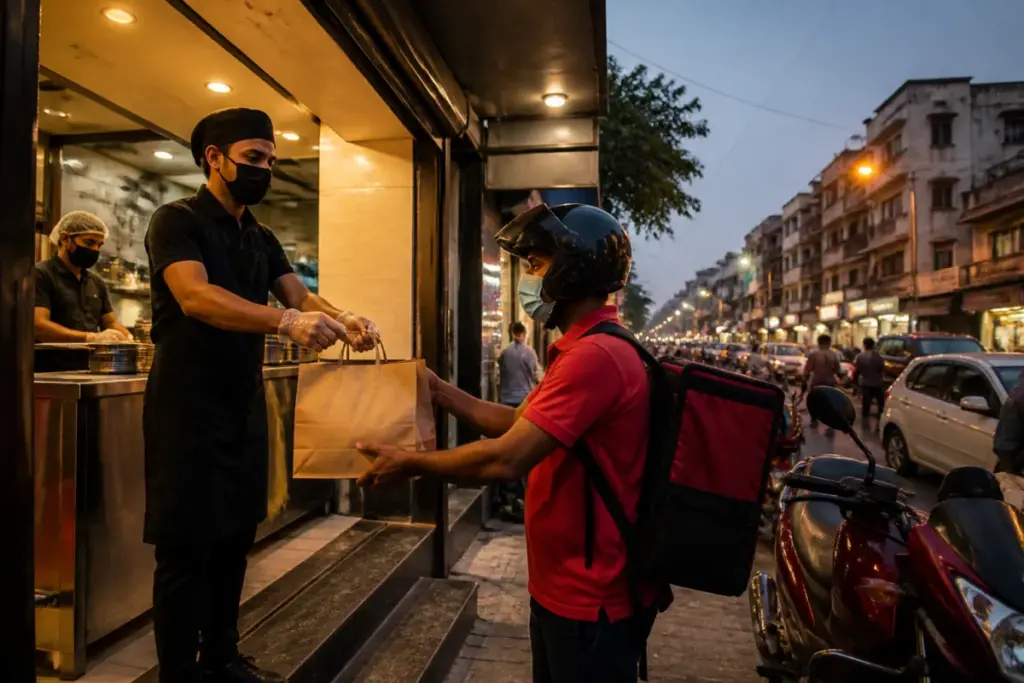
Shiprocket’s entry into direct food ordering is not simply another restaurant technology launch. It is an attempt to change who owns the customer relationship, who pays for the last mile and how much of every urban food order remains with the restaurant. The company is testing its fastrr platform with Delhi-NCR restaurant chains Punjabi Angithi and Bikkgane Biryani, while using Shiprocket Quick to arrange doorstep deliveries through third-party riders.
The move comes as restaurants face a difficult trade-off. Food aggregators provide discovery, payments, promotions and delivery, but the combined cost of commissions, taxes, discounts and marketing can substantially reduce the value of an order. Shiprocket’s model seeks to separate those functions and offer restaurants a technology and logistics layer that they can use under their own brands.
That distinction matters because food delivery is an urban system built around more than an app. It depends on restaurant density, short-distance delivery networks, customer data, digital payments, packaging, traffic conditions and the availability of riders. The platform that controls the customer’s ordering journey can influence how restaurants spend on marketing, how delivery is priced and whether repeat customers continue to return through an intermediary.
### The cost of depending on aggregators
The report cites a December 2025 study by the National Council of Applied Economic Research, conducted with Swiggy investor Prosus, which found that average aggregator commissions rose from 9.6 per cent in 2019 to 24.6 per cent in 2023. At the 2023 average rate, a restaurant would pay ₹24.6 lakh on every ₹1 crore of commissionable orders before accounting for other expenses.
The calculation illustrates why direct ordering has become attractive to restaurant businesses. A commission is only one component of the cost structure. Restaurants may also spend on discounts, advertising, payment processing, packaging and fulfilment. Shiprocket’s supplied account says that commissions, taxes, discounts and promotional expenses can potentially consume up to 40 per cent of an order’s value.
These figures do not establish that every restaurant pays the same amount or that direct ordering will always be cheaper. They do show the pressure behind the search for alternatives. Restaurants want access to the demand generated by aggregators while reducing the recurring cost of serving customers who already know and have previously purchased from a brand.
This creates a two-stage problem for urban food commerce. Aggregators remain useful for customer acquisition because they bring restaurants visibility and access to a large ordering base. Once a customer has discovered a restaurant, however, the business has an incentive to encourage future transactions through a channel it controls. Shiprocket’s proposed opportunity lies in making that transition operationally possible.
### From ordering software to delivery infrastructure
Shiprocket is positioning fastrr as more than a branded ordering page. Under its partnerships with Vegorama Group, which operates Punjabi Angithi and Bikkgane Biryani, fastrr Identity and fastrr Signals will help identify potential and returning customers. The tools are intended to support targeted advertising, WhatsApp reminders, personalised offers and recovery of abandoned orders.
This data layer is central to the direct-ordering proposition. If a restaurant can identify returning customers and communicate with them directly, it can potentially spend less on reacquiring the same customer through an aggregator. Gaurav Mangla, CEO of Ads and Checkout at Shiprocket, said brands should be able to build the relationship directly rather than have it mediated entirely by third-party platforms.
The second layer is fulfilment. Shiprocket Quick will use a network that includes Ola, Porter, Borzo and Shadowfax Local to handle deliveries from individual outlets. The service is described as offering advertised rates starting at ₹10 per kilometre, uniform pricing across partners and no surge fees, with live tracking for customers.
This arrangement reflects an important change in how restaurants may think about delivery. They do not necessarily need to build and maintain their own fleets if an external network can provide riders, tracking and predictable pricing. For smaller chains, cloud kitchens and quick-service restaurants, outsourcing delivery may be more practical than managing recruitment, scheduling and vehicle operations themselves.
At the same time, the model does not remove the operational complexity of the last mile. A delivery still has to be assigned to a rider, collected from an outlet and completed within a commercially acceptable time. Restaurant locations, peak-hour demand and the distance between outlets and customers remain relevant even when the ordering interface is controlled by the restaurant.
### The urban platform question
Direct food ordering places customer ownership at the centre of the platform contest. Aggregators combine discovery, ordering and delivery in one consumer-facing system. Shiprocket’s approach attempts to unbundle those functions: restaurants retain their brand and customer-facing relationship, while separate technology and logistics services support marketing and fulfilment.
The arrangement could strengthen existing channels rather than replace them immediately. Both Punjabi Angithi and Bikkgane Biryani already use apps built by uEngage, according to the report. Shiprocket is therefore adding marketing and delivery capabilities to channels that are already in place, rather than creating an entirely new ordering behaviour from the beginning.
The report places this strategy alongside offerings from DotPe and uEngage, direct-ordering platforms such as EatClub and Rebel Foods’ EatSure, and the Open Network for Digital Commerce. These models differ in structure, but they reflect a shared concern among restaurants: dependence on a single intermediary can limit control over customer data, pricing, marketing and repeat business.
For urban consumers, the experience may become more fragmented. A customer may discover a restaurant on one platform, order through its own website or app later, and receive the meal through a third-party logistics network. The result could be greater competition between ordering channels, but it may also require customers to navigate different loyalty programmes, delivery charges, service standards and complaint mechanisms.
The supplied material does not establish whether direct ordering will produce lower prices for customers. A reduction in aggregator commission could instead be used for marketing, technology, packaging, delivery or improved restaurant margins. The economic outcome will depend on the cost of acquiring a customer directly and the efficiency of completing the order.
### Why repeat customers matter
The strongest case for direct ordering is likely to arise with repeat customers. A restaurant that repeatedly serves the same customer has a stronger reason to invest in reminders, personalised offers and loyalty programmes. It also has more information about ordering patterns, provided that the relevant data is collected and used within applicable requirements.
Shiprocket plans to expand fastrr to quick-service restaurants, cloud kitchens, bakeries and packaged foods. The company also plans to add loyalty programmes and peak-hour delivery allocation. These proposed extensions indicate that the model is intended to operate across several parts of the urban food economy, from prepared meals to packaged products sold through brand websites and quick-commerce platforms.
However, direct ordering does not eliminate the need for customer acquisition. New customers may still find restaurants through aggregators, where location, cuisine, ratings and promotions are presented together. The commercial question is whether restaurants can convert enough of those first-time customers into repeat buyers to justify the additional spending on their own marketing and ordering channels.
This is also where delivery pricing becomes significant. Shiprocket says its partner network will provide uniform pricing and no surge fees. If those conditions are maintained across different demand levels, restaurants may find it easier to communicate delivery charges to customers. But the report does not provide a full cost comparison between Shiprocket Quick, aggregator fulfilment and restaurant-managed delivery fleets.
### A test of urban food-commerce infrastructure
Shiprocket’s experiment shows that the next phase of food delivery competition may be fought less over the basic ability to place an order and more over the infrastructure behind repeat transactions. Ordering software, customer identification, targeted communication and third-party delivery are being assembled as a service that restaurants can deploy under their own brands.
The model could give restaurants more control over customer relationships while preserving access to outsourced logistics. It could also create new responsibilities around data management, customer support, delivery reliability and coordination between restaurants and multiple rider networks. Those responsibilities remain important even when the technology provider is not the consumer-facing aggregator.
The evidence currently establishes a pilot involving two Delhi-NCR restaurant chains and a planned expansion across several food categories. It does not yet establish the scale of adoption, the savings achieved by participating restaurants or the effect on customer prices and delivery times. Those outcomes will determine whether direct ordering becomes a meaningful alternative or remains an additional channel used mainly by established brands.
The larger urban question is whether food-delivery businesses can retain the convenience of platform logistics without giving up control over the customer relationship. Shiprocket’s fastrr and Quick combination is an effort to answer that question by separating brand ownership from delivery execution. Its progress will be measured not only by the number of restaurants onboarded, but by whether repeat orders can be shifted into a more financially sustainable channel.


