

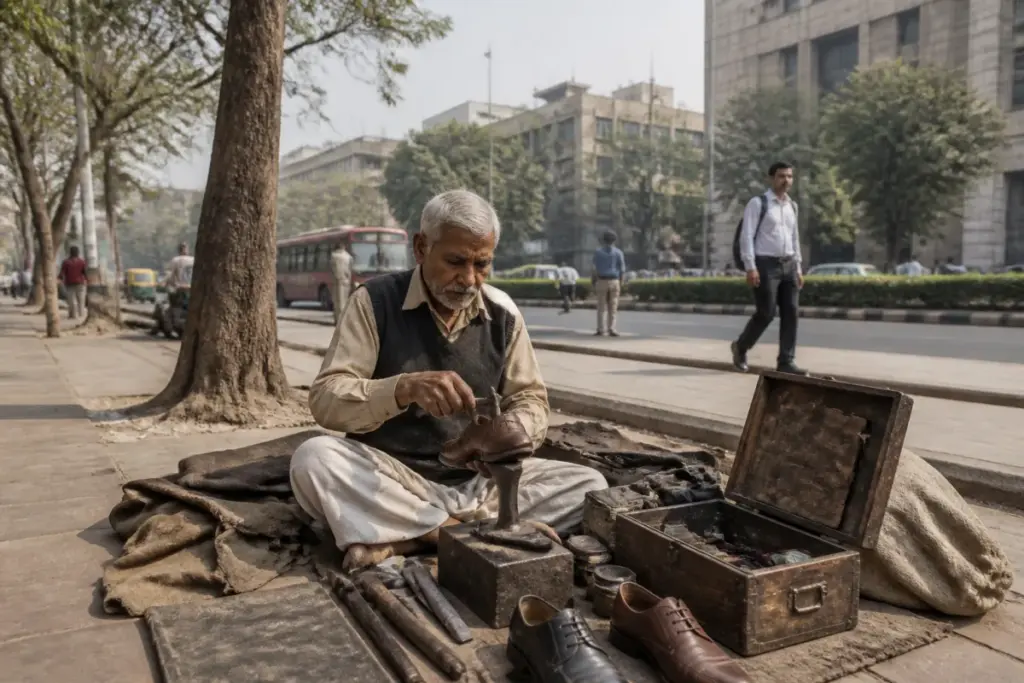
Aadhar Singh has worked on a pavement near Delhi’s Bahadur Shah Zafar Marg for more than 40 years, repairing shoes, sandals and leather bags for employees of nearby government offices. His small workplace offers an unusually clear view of how the capital functions: through informal workers whose labour is visible every day but rarely included in the city’s official story.
Singh sits near the post office, close to the ITO area, with an anvil, tools and a wooden box for storing them. He can identify the quality of leather at a glance and decide whether an old pair of shoes or a worn leather bag can be repaired. Many of his customers are employees of the Bureau of Indian Standards, the Comptroller and Auditor General of India and other government offices in the vicinity. During lunch hours, they bring him shoes, sandals and bags that remain useful because of his work.
His livelihood is modest, but it is not marginal to the urban economy. Singh provides a service that allows people to extend the life of everyday goods. His customers do not need to replace a damaged item immediately, and he earns from a skill that has been passed through informal training rather than a formal institution. A few years ago, he also began selling shoes, most of them priced below Rs 500, which he orders from Agra.
The setting of his work is as important as the work itself. Singh operates in the open, on a small patch of pavement exposed to Delhi’s heat, cold, rain and shifting public-space rules. Summer reduces the flow of customers as people avoid the fierce sun. Winter shortens his working hours. During the monsoon, he has to put his anvil and tools into a weathered wooden box and wait for the rain to stop.
These are not simply inconveniences. For a worker without an enclosed shop, weather directly determines working time and income. A formal business can close its shutters and protect its equipment. Singh’s workplace has no such buffer. The pavement is simultaneously his shop, waiting room and storage problem. Its availability depends on the surrounding public realm and on the authorities who regulate movement and access around it.
His account also shows how street livelihoods are shaped by the calendar of the formal city. November is a good month for work because it marks the beginning of the wedding season, he says. Sundays are less useful because government offices are closed and customers are fewer. On other days, police action for a parade or a visit by VIPs to Rajghat can shut nearby shops and force him to arrive late or take the day off.
This is an important distinction in the way urban administration is experienced. For the city, a parade, security operation or ceremonial visit may be an occasional event. For a pavement worker, the same event can remove an entire day of earnings. The loss is not recorded as an interruption to public infrastructure, but it is a real cost imposed on a livelihood that depends on predictable access to customers.
Singh’s work has also survived several rounds of physical and social change around ITO. He remembers an iron footbridge near Pearey Lal Bhawan being demolished, longer queues of cars at the traffic signal and metro stations coming into operation. He recalls actor Rajesh Khanna inaugurating the subway in front of The Times of India building. He also remembers the open drain near his workplace being covered around 15 years ago.
The memories form a street-level history of Delhi’s infrastructure. Bridges disappear, subways are inaugurated, drains are covered and metro stations become part of daily movement. These projects alter the way people travel through an area, but they do not necessarily remove the older occupations that have grown around it. Singh has remained in place while the surrounding city has been repeatedly rebuilt and reorganised.
That continuity matters because urban transformation is often measured through visible assets: roads, stations, buildings, drains and traffic systems. Singh’s story points to another measure—whether people who depend on these spaces can continue to work as the city changes. The covered drain improved the immediate environment. Metro expansion changed movement patterns. Road congestion extended travel times. Yet the informal service economy remained embedded in the same urban corridor.
His own commute reveals the uneven relationship between infrastructure and time. Singh travels from Sunder Nagari in north-east Delhi to the ITO area, usually by DTC bus route 331 or 263, which was earlier route 103. He says the journey once took about 40 minutes but now takes nearly two hours. The longer trip reduces the time available for work and increases the effort required to reach it.
For a salaried commuter, a longer journey may mean inconvenience, fatigue or a change in transport costs. For Singh, it is directly connected to productivity. His working day begins after he reaches his pavement workplace and ends when he must leave in time to catch a bus home. Any delay on the road compresses the hours in which he can earn. Public transport is therefore not only a mobility service for him; it is part of the infrastructure of his livelihood.
The account also underlines how mobility is experienced differently across income groups. Singh uses a basic keypad phone and does not own a smartphone. He says an earlier Samsung phone was pick-pocketed and that he is reluctant to spend more on another device. This limits the role that digital platforms can play in finding customers, receiving payments or communicating during disruptions. His business remains dependent on physical proximity and repeat relationships.
That dependence is visible in his customer base. Government employees from nearby offices can walk to his pavement during lunch hours. The arrangement works because the worker and the customer occupy the same daily urban circuit. It is a form of local convenience that formal retail does not necessarily replace. The value lies not only in the repair but also in the location, timing and familiarity of the service.
Singh’s life in Delhi began after he left Chhoti Harda, a village in southern Madhya Pradesh, a couple of years before Indira Gandhi was assassinated in 1984. He trained under his uncle after coming to the city and later took up the space outside the ITO post office when a previous cobbler left after securing a government job. His four feet of pavement became the foundation for a working life in the capital.
The story complicates the idea that migration to a city is measured only through formal employment or rapid economic advancement. Singh did not enter a government department, a factory or a registered company. He entered the city through a kinship-based skill network and built a livelihood around a location that had been made available by another worker’s departure. Over time, he used his earnings to construct a three-storey house in Sunder Nagari, with one room on each floor.
The house is described as high but narrow, a physical record of gradual investment. It represents neither a dramatic rise nor failure. It is evidence of how a migrant worker can convert decades of uncertain earnings into a durable family asset. Singh is the father of five daughters and one son. He speaks with pride about a daughter who works from home for a company installing smart meters and earns about Rs 25,000 a month.
This household also illustrates the changing relationship between older informal work and newer urban occupations. Singh remains dependent on a pavement, a bus route and face-to-face customers. His daughter works in a service linked to the city’s expanding utility infrastructure. Both forms of labour support the same household, but they occupy very different positions in the urban economy.
The contrast is not a simple story of old work disappearing and new work replacing it. Singh’s repair service continues because people still need maintenance, affordable products and convenient access. His daughter’s employment reflects a newer infrastructure ecosystem. The city contains both at once: manual repair on a pavement and smart-meter installation inside a more formalised technical economy.
Singh’s experience also raises a question about what public space is expected to do. Pavements are usually treated as corridors for pedestrians, sites for traffic management or areas to be cleared when security and ceremonial priorities arise. For workers such as Singh, they are also productive spaces. Their economic value is created through location, visibility and access rather than through a permanent structure.
Recognising this use does not remove the need for safe and accessible public paths. It does, however, show why enforcement alone cannot explain the relationship between streets and livelihoods. A pavement worker depends on the same space that pedestrians need, but the two uses are not automatically incompatible. The central administrative challenge is to understand how different claims on public space are arranged, protected and disrupted.
The supplied account does not establish a formal licensing arrangement for Singh, nor does it describe any municipal support, designated vending space or welfare protection. What it does establish is the fragility of his working conditions. His income changes with weather, office schedules, weddings, traffic and police restrictions. These pressures are ordinary enough to be overlooked, but together they define the economic geography of his working life.
Singh’s story is therefore less about nostalgia than about continuity under pressure. He has watched ITO change while remaining tied to the same small workplace. He has experienced better drainage, new metro infrastructure and longer bus journeys. He has moved from a village to a dense capital city, raised a family and built a house, but his ability to earn still depends on a patch of pavement and the daily movement of government employees.
The larger urban question is whether Delhi’s infrastructure can be understood only through the projects that are formally planned and counted. The capital also runs through repair workers, vendors, bus passengers and other people whose work depends on access to streets. Their experiences reveal the time costs, weather risks and administrative interruptions that conventional infrastructure assessments may not capture.
Singh does not describe his life as dramatic. Yet his four decades outside the post office show how ordinary workers hold together the practical economy of the city. The evidence in his account confirms the value of durable skills and local customer networks, while also showing the limits imposed by exposure, commuting and unpredictable access to public space. As Delhi continues to change around him, the question is not simply whether the city builds new infrastructure, but whether its existing workers can continue to find a place within it.


