

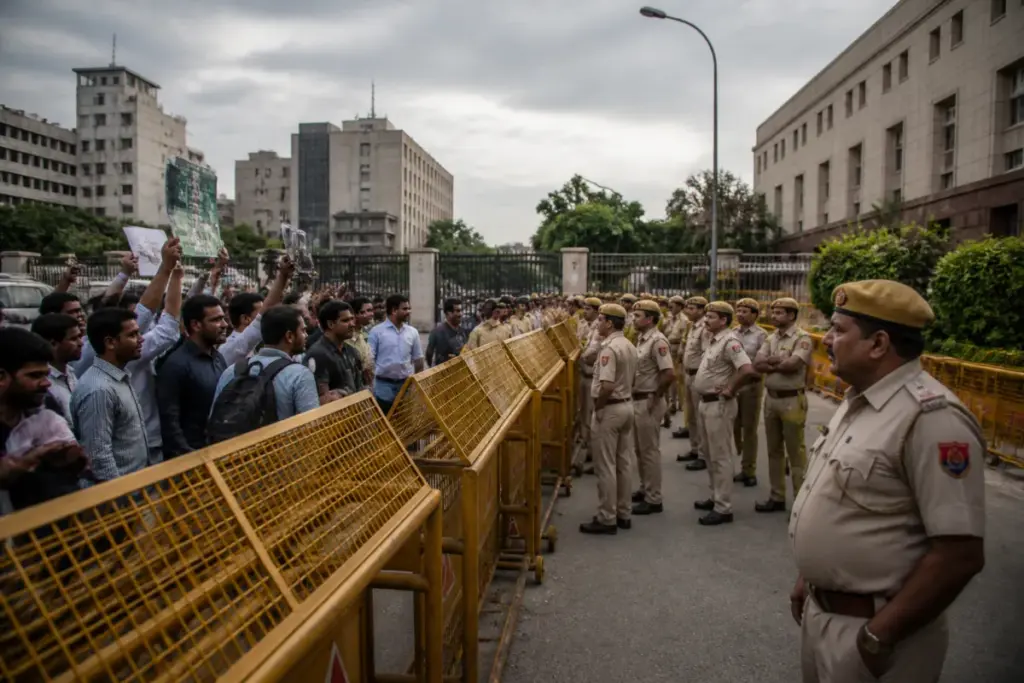
The extension of custody for Cockroach Janta Party leaders Ashutosh Ranka and Saurav Das has brought Delhi’s Special Executive Magistrates (SEMs) back into focus. The immediate dispute concerns protests against the Special Intensive Revision of electoral rolls, but the larger issue is how preventive powers are exercised by police officers who operate within the executive branch while using the title of magistrate.
On October 14, Ranka and Das were arrested for allegedly breaching security and entering Jantar Mantar during the protests. An SEM later extended their custody by two days, taking the total period to seven days. The order, signed by SEM Ritu Raj, an ACP-rank officer with the Delhi Police, stated that the two leaders’ conduct did not inspire confidence, that they had “no respect for law” and that they had habitually called for protests at a de-notified site. Das, while being taken away, described the SEM as a “police court” and said there was “no justice”.
At the same time, AISA president Neha Bora challenged a notice issued by another SEM, Mahesh Kumar Meena. The notice asked her to show cause why she should not be required to execute a peace bond because of the likelihood of a “breach of peace”. These proceedings have placed a preventive legal mechanism, rather than a conventional criminal trial, at the centre of the current controversy.
The distinction matters because SEMs cannot conduct trials. Executive Magistrates function under the government, and their promotions, increments and service seniority depend on executive superiors. Judicial magistrates, by contrast, are administered by the judiciary through the high courts and can conduct trials. In Delhi, the Delhi Police Act allows the central government to authorise the Police Commissioner and subordinate officers not below the rank of ACP to exercise powers of district and executive magistrates.
That arrangement gives Delhi’s police administration a role in preventive proceedings intended to maintain public order. The powers are limited in purpose: they are meant to prevent an anticipated breach of peace, rather than punish a person for an offence already proved. In practice, however, the use of detention, peace bonds and sureties can directly affect personal liberty before a trial takes place.
This tension has been recognised in the legal history of preventive powers. The provisions in the Bharatiya Nagarik Suraksha Sanhita, or BNSS, have roots in colonial criminal procedure and ultimately in the Justices of Peace Act of 1361 in England. That law empowered justices of the peace to restrain people considered likely to cause a breach of peace or bind them with sureties for good behaviour. Similar provisions entered India’s criminal procedure framework in 1861, continued under the Code of Criminal Procedure and were carried into the BNSS.
The BNSS was enacted in 2023 and came into force on July 1, 2024, replacing the CrPC. The change in legislation did not remove the institutional question over who should exercise preventive powers. Law Commission reports have examined whether proceedings requiring individuals to furnish bonds for good behaviour should remain with the executive or be assigned to the judiciary. While earlier reports supported retaining such powers with the executive, the 41st Law Commission report in 1969 argued that preventive measures affect personal liberty and should therefore vest exclusively with judicial magistrates.
Delhi’s courts have repeatedly returned to the same concern: whether preventive authority is being used with adequate procedural safeguards. In 1984, the Delhi High Court received an application from Tihar Jail by death-row prisoner Sunil Batra. The application alleged that large numbers of people were being arrested under Section 107 of the CrPC without the prescribed procedure being followed, and were kept in jail without being offered the facility of release on bail.
The court criticised a system in which citizens’ liberty could be controlled by police officers exercising executive-magisterial powers. It also found that the proformas used by SEMs were cyclostyled and identified other procedural irregularities. The court directed that people must be informed of the reasons for requiring them to execute a bond. Where a person was sent to jail for failing to furnish sureties, the warrant had to accompany the SEM’s order.
More than three decades later, a 2018 Delhi High Court division bench comprising Justices S Muralidhar and Vinod Goel observed that “nothing much appears to have changed since” the Sunil Batra case. The bench noted that cyclostyled proformas continued to be used and issued directions on the procedures SEMs were required to follow strictly.
The 2018 ruling also addressed the duration and oversight of preventive custody. The court directed that judicial custody under preventive arrest provisions should not exceed seven days at any one time. It also said there should be a weekly review by SEMs of the need to continue detention. The current custody extension involving Ranka and Das, which has reached seven days, therefore falls within a period that the Delhi High Court had specifically addressed in its directions.
The court further asked the Lieutenant Governor to consider creating an oversight mechanism to periodically review the exercise of preventive powers. It suggested that retired district judges could form part of such a mechanism. The court also proposed that these officials be called “Special Executive Officers” rather than SEMs, because the word “Magistrate” could cause people to mistake them for judicial magistrates. The report indicates that this suggestion does not appear to have been implemented.
The institutional design has consequences beyond legal terminology. A person appearing before an SEM may understand the proceeding as a court process because of the title, even though the official is part of the executive administration and cannot conduct a trial. That difference affects how citizens understand the authority before which they are being produced, the nature of the proceeding and the safeguards available to them.
The 2018 Delhi High Court judgment also raised concerns about unequal impact. It found “palpable bias in the exercise of these powers” and observed that a significant percentage of those incarcerated belonged to minority communities. The court further noted that many were from economically weaker sections and unable to provide the sureties required. In such cases, the inability to furnish surety could become the practical reason for continued detention, even where the original purpose was preventive rather than punitive.
The court’s concern was therefore not limited to individual paperwork. It described the use of preventive powers as rampant and indiscriminate despite standing orders and earlier judgments. That observation connected procedural failures with a broader access-to-justice problem: people with fewer financial resources may face longer detention because they cannot satisfy a surety requirement.
Other court proceedings have reinforced the need for a reasoned process. In 2007, the Delhi High Court endorsed a Madhya Pradesh High Court decision stating that an executive magistrate should record statements from the investigating officer or witnesses before beginning proceedings under Sections 107, 116 and 151 of the CrPC. The decision also said a person should not be sent to jail for failing to furnish surety if those statements had not been recorded. Orders, it said, should be detailed and reasoned rather than signed mechanically on cyclostyled paper.
The issue also arose in the case of activist Medha Patkar and other protesters opposing the Sardar Sarovar dam project. In July 2007, Patkar and 120 other protesters were arrested in Madhya Pradesh under Section 151 of the CrPC for allegedly attempting to breach the peace. Some men were released after furnishing personal bonds, while others, including Patkar, were sent to jail after refusing to execute such a bond.
In 2008, the Madhya Pradesh High Court held that the arrests violated the protesters’ fundamental right to peaceful protest because due process had not been followed. It also held that demanding bonds when there was no sufficient basis to apprehend a disturbance of public tranquillity, public peace or public order, and detaining people when they refused to furnish them, was without authority of law and violated personal liberty. The court directed the state government to pay compensation of Rs 10,000 each to those wrongfully arrested and detained.
These precedents show why the present proceedings cannot be understood only as an administrative response to a protest. They raise a recurring governance question: how should a city prevent violence or disorder without allowing preventive powers to become a substitute for investigation, prosecution or trial?
For Delhi, the question is particularly significant because the authority to exercise executive-magisterial powers is embedded in the city’s policing structure. The law permits senior police officers to perform these functions, while the courts have repeatedly insisted that the powers be used cautiously, with clear reasons, proper records, regular review and safeguards against arbitrary detention.
The current proceedings also demonstrate the difference between public-order administration and judicial adjudication. An SEM may take preventive action where the legal threshold is met, but the official does not determine guilt through a trial. The legitimacy of the process therefore depends heavily on whether the person receives clear reasons, whether the evidence supporting the apprehension of a breach is recorded, whether the order is reasoned and whether detention is reviewed within the limits set by the courts.
The evidence in the supplied report confirms that Delhi has had judicial directions on these safeguards for decades, including requirements relating to reasons, warrants, weekly review, custody periods and oversight. It also records the courts’ repeated concern that procedural defects have persisted. What remains to be established in the current cases is how the SEM orders and notices apply those safeguards to the specific conduct alleged against the individuals involved.
The next stage will depend on the proceedings concerning the extended custody of Ranka and Das and Bora’s challenge to the peace-bond notice. Those proceedings will indicate how Delhi’s preventive framework is being applied under the present legal regime and whether the procedural questions identified by the courts continue to shape the exercise of SEM powers.


