

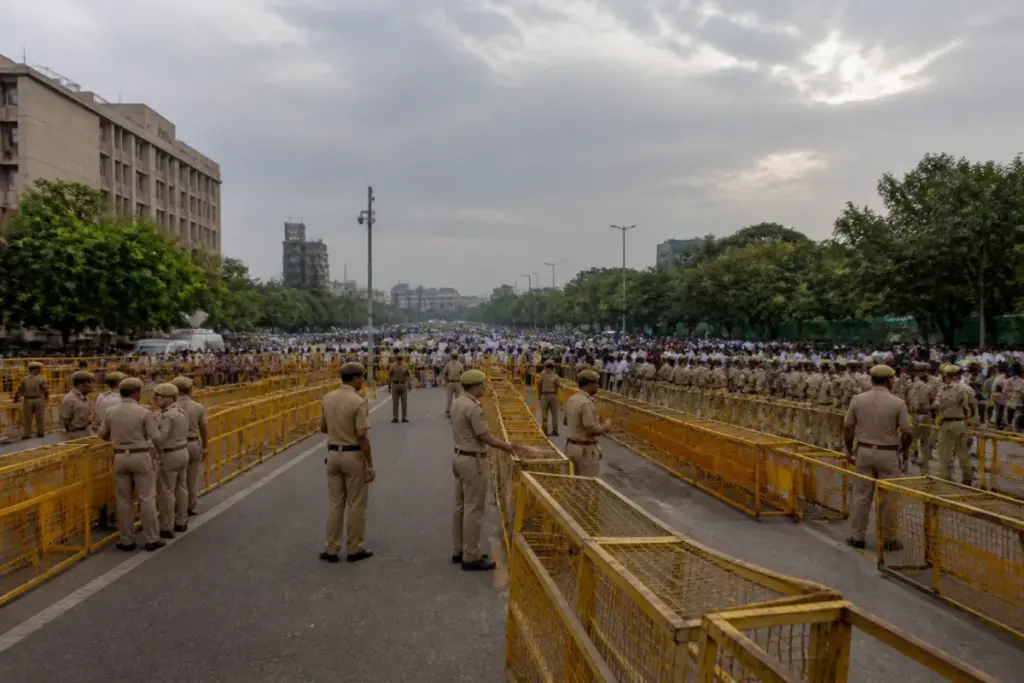
Kiran Bedi’s recommendations on managing protests point to a problem that Delhi has repeatedly treated as a policing issue rather than a city-planning responsibility: where democratic expression should take place, and how those spaces should be designed to protect both public safety and the right to assemble.
The former IPS officer has argued that women police personnel equipped with body cameras should be deployed alongside and lead male police personnel during law-and-order protests. She also called for all such demonstrations to be recorded through closed-circuit television or other cameras, with footage securely preserved and reviewed through a control room. Her broader argument is that preparation, equipment, training, deployment and evidence management should begin before a crisis occurs.
That approach shifts the focus from the moment of confrontation to the institutional systems built around a protest. A police response is not determined only by the behaviour of demonstrators or the force available on the ground. It is also shaped by the location, street width, proximity to sensitive buildings, access routes, commercial activity, crowd-control protocols and the quality of documentation available afterwards.
Bedi’s comments, as reported by Live Hindustan – NCR, also revisit how Delhi’s protest geography has changed. She said that during her career in the Delhi Police, demonstrations moved from locations near the Prime Minister’s residence and Teen Murti Marg to the roads of Lutyens’ Delhi in the early 1970s, India Gate in the 1980s, and later the area stretching from Boat Club to Jantar Mantar. This history is important because it shows that protest spaces are not fixed features of a city. They are administrative choices, often altered when authorities decide that an existing location has become too disruptive, too difficult to secure or too close to important institutions.
The central planning failure, in Bedi’s view, is that cities often do not provide a clearly designed open space for democratic expression. She said city planners should pay attention to this requirement, rather than leaving the issue to be resolved after protests begin. A designated protest ground is therefore more than an empty parcel of land. It must be accessible, capable of handling large gatherings, connected to transport and emergency services, and separated sufficiently from narrow streets, sensitive buildings and major commercial areas.
Her criticism of Jantar Mantar illustrates the consequences of treating a protest location as an administrative convenience rather than an urban system. Bedi described the site as unsuitable because its roads are narrow, it is close to sensitive buildings and offices, and it lies near Connaught Place, a major commercial district. These conditions create overlapping pressures: a gathering can affect movement, office access, business activity, security arrangements and the ability of emergency services to operate.
The source report says that the Ministry of Home Affairs has identified Ramlila Maidan and some other locations for protests. Bedi said Ramlila Maidan should have a clear security and operating plan, with the conditions communicated when permission is granted. This is a significant administrative point. A protest permission cannot function only as approval for a date and location. It also needs to define how the space will operate, what access arrangements apply, how emergency movement will be protected, where police and medical teams will be positioned, and how responsibilities will be divided among the authorities involved.
The available report does not provide the details of such a plan, nor does it specify the exact locations identified by the ministry beyond naming Ramlila Maidan. That absence matters because the effectiveness of a designated protest space depends on its operating framework as much as its physical boundaries. Without clearly communicated procedures, the designation of a ground may simply relocate uncertainty rather than resolve it.
Bedi’s proposed use of body cameras, CCTV and other recording systems addresses another persistent governance problem: disputes over what happened during a confrontation. She said footage should be reviewed through a control room and securely preserved. She also suggested using facial-recognition technology available with police forces to prevent what she described as unfounded allegations by giving officials evidence for review.
These proposals reveal two different functions of surveillance in protest management. Recording can create an evidentiary record of police action, crowd behaviour and the sequence of events. It can also support the identification of individuals. The source material records Bedi’s recommendation but does not establish the legal safeguards, retention rules, access controls or oversight mechanisms governing the use of facial-recognition technology. Those questions are therefore part of the institutional gap that any such system would need to address before deployment becomes routine.
The question of who controls the evidence is as important as whether cameras are installed. Bedi’s emphasis on secure storage and control-room review recognises that footage has value only when it is preserved, retrievable and examined systematically. Equipment procurement alone cannot guarantee accountability. The police would also require trained personnel, defined review procedures and a clear chain of responsibility for recording, storing and assessing material after an event.
Bedi further argued that the sequence of force used during protests should change. She questioned why student protests should move directly into confrontation with armed forces and described the reliance on armed forces for every law-and-order situation and lathi-charge as a legacy of the British system. Her proposed first line of response is civil defence personnel, whom she described as young, trained and available in every state. She said they would not carry lathis. If barricades were breached, she proposed women police as a second line, equipped with helmets and body armour but without lathis. Armed police, in her model, would be used only as a final measure based on the situation.
This proposal is built around graduated deployment rather than a single undifferentiated police response. It separates crowd engagement, protective deployment and the use of armed personnel. The institutional implication is that authorities must plan not only the number of personnel required but also their roles, equipment, training and order of deployment. The model would require coordination between civil defence, civil police, women police units and armed police, with commanders able to determine when responsibility moves from one layer to the next.
The proposal also links physical protection with public visibility. Bedi said cameras should monitor the interaction and that protective equipment should reduce the risk of injury from stone-pelting. In an urban setting, this makes the design of barricades, entry points, observation positions and emergency routes part of the policing architecture. A city that designates a protest site without designing these operational features leaves both demonstrators and police exposed to avoidable confrontation.
The larger lesson is that Delhi’s protest policy has evolved through relocation. Demonstrations have moved across prominent public spaces, and the source report suggests that administrative decisions have often followed conflict or inconvenience rather than anticipating the need for a permanent, suitable civic setting. The result is a recurring tension between democratic assembly and the ordinary functioning of the city.
That tension cannot be resolved by policing alone. It involves land-use decisions, access, public-space management, traffic movement, security around government buildings and the functioning of nearby commercial areas. It also involves the terms under which citizens can assemble and authorities can respond. A designated protest ground can help manage these competing demands, but only if it is planned as civic infrastructure rather than treated as a place where disruption is temporarily contained.
The report establishes Bedi’s recommendations and identifies Ramlila Maidan as one of the locations named by the Home Ministry. It does not establish whether a detailed operating plan has been issued, how the proposed sites were evaluated, what technical standards apply to surveillance, or how complaints involving police conduct would be independently reviewed. Those are the next questions for public authorities.
Delhi’s protest-space debate therefore has two connected dimensions. The first is spatial: whether the city provides an appropriate and accessible place for public assembly. The second is institutional: whether the police and administration have transparent, proportionate and evidence-based procedures for managing gatherings. Bedi’s remarks bring both dimensions together. They suggest that the city’s future protest policy will be judged not only by where demonstrations are allowed, but by whether the spaces and systems around them reduce confrontation while preserving democratic expression.


