

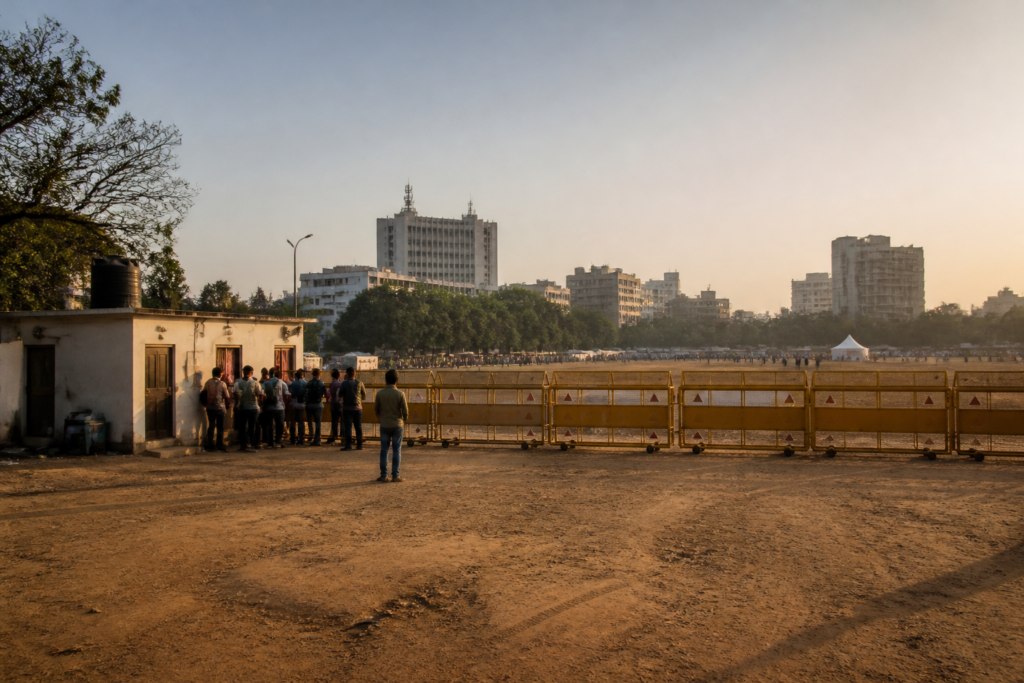
Delhi’s decision to move protests from Jantar Mantar to Ramlila Maidan, Burari and CBD grounds has exposed a larger problem than the availability of alternative venues: the city’s public-space governance remains divided between agencies with different rules, booking systems and priorities. Five days after Delhi Police issued the relocation order, only one of the three designated sites had a functioning protest-specific process.
The Municipal Corporation of Delhi has drafted a revised standard operating procedure for Ramlila Maidan. The venue can be booked free of charge, but organisers must first obtain a police no-objection certificate, submit a manual application on the letterhead of their organisation with Aadhaar details, and pay a refundable security amount of Rs 5,000. The application must be cleared by the deputy commissioner of the City-Sadar Paharganj zone before a date is allotted.
The MCD has said that the booking process is open and can be completed offline. That makes Ramlila Maidan the only location among the three where the purpose of protest has been incorporated into a defined administrative procedure, based on the information currently available. It does not, however, make access entirely straightforward: organisers must navigate a police clearance, a physical application and an internal municipal approval before a public gathering can be scheduled.
The arrangements are less settled at the two sites controlled by the Delhi Development Authority. CBD Ground in east Delhi has an online booking facility, but its website does not include protest or dharna as a category. The ground covers around 3,000 square metres, and booking it for a plot costs Rs 1.8 lakh a day, including Rs 95,000 as security charges. Those rates are presented in the context of general bookings rather than a dedicated system for demonstrations.
A DDA official cited in the report said CBD Ground was booked for months because it had been leased to event companies for marriages and other functions. Protest dates would be offered only when no other booking existed, the official said. This places demonstrations within a general events market in which commercial or private bookings may already have priority, even though the site has been identified as an alternative public venue for political or civic mobilisation.
The gap is not only administrative. It raises a question about how a city classifies public space. A ground used for weddings, temporary events and protests may be physically available for all three purposes, but the institutional rules governing each activity are not interchangeable. Commercial events can be priced through standard rates and scheduled through an online calendar. A protest, by contrast, requires police clearance, public-order coordination and a process that can account for the exercise of a civic right. The DDA’s own sources acknowledge that ordinary rates cannot simply be applied to agitations.
That admission is significant because it shows that the problem is not merely that the online form has not been updated. The authority still has to decide what a protest booking is, how it should be priced, what security conditions should apply and how it should be prioritised against existing users. Until those questions are settled, a venue can be listed as an alternative in principle while remaining difficult to use in practice.
Burari Ground presents a different version of the same institutional problem. The booking fee is not specified on the DDA website because the process remains offline. A direction was issued only last week to list the site online for permitting temporary events, while DDA sources said a file would be moved to the institutional land wing of the land disposal department to formulate standard operating procedures and rates for both Burari and CBD grounds.
This means Delhi has three designated grounds but three different stages of administrative readiness. Ramlila Maidan has a manual protest booking process and a stated refundable security payment. CBD Ground has an online platform but no protest category, an existing commercial booking pipeline and a general daily charge that may not be suitable for demonstrations. Burari has neither a specified fee nor a completed online process. The relocation order therefore has not produced a single citywide system; it has distributed responsibility across separate administrative arrangements.
The division of responsibility is central to understanding why implementation has been uneven. Delhi Police initiated the shift away from Jantar Mantar, while MCD controls the procedure for Ramlila Maidan and DDA controls the other two grounds. The municipal corporation’s process requires a police NOC, meaning the authority responsible for public-order clearance remains part of the access chain even where the land-owning or managing agency is different. DDA, meanwhile, must formulate separate rules through its institutional land and land disposal structures.
Such fragmentation can create uncertainty for organisers even when the official policy objective is clear. A person or organisation seeking to hold a protest must know which agency controls the selected ground, whether the venue accepts protest applications, which documents are required, how much money must be deposited, whether the date is available and whether the police clearance must precede the booking. The supplied information shows that these answers vary by location and are not yet consolidated in one public-facing system.
The financial distinction between the venues is also considerable. Ramlila Maidan is available free of charge apart from the refundable security payment of Rs 5,000. CBD Ground, by contrast, is listed at Rs 1.8 lakh per day for a roughly 3,000-square-metre plot, with Rs 95,000 described as security charges. The report does not establish whether these general rates will apply to protests after the DDA finalises its dedicated norms. It does establish that applying commercial-event pricing to civic gatherings is already recognised by DDA sources as inappropriate.
That unresolved pricing question has a direct bearing on equal access to public space. A free venue with a modest refundable deposit and a site carrying a substantial daily charge do not offer equivalent options, even if both are formally designated for protests. The final DDA rules will determine whether the alternatives are genuinely usable for different groups or whether the practical choice is constrained by money, timing and administrative capacity. The available material does not yet show what rates, exemptions or prioritisation rules DDA will adopt.
The episode also demonstrates the difference between announcing a spatial policy and building the operating system required to deliver it. Naming locations is a planning decision. Making them accessible requires procedures, forms, digital categories, fee schedules, police coordination, approval timelines and publicly available information. In Delhi’s case, the relocation was announced before all of those components were ready at each site.
For residents and organisations, the immediate issue is not simply where protests may take place. It is whether the city’s public-space system gives predictable and transparent access to designated grounds. A process that is offline at one location, incomplete online at another and still under formulation at a third leaves the practical meaning of the policy dependent on agency-level decisions.
The evidence currently confirms that Ramlila Maidan has an operational booking route, while DDA’s frameworks for Burari and CBD grounds remain unfinished. It also shows that commercial bookings, police permissions, land ownership and municipal approvals intersect in the allocation of protest space. The next important developments are the DDA’s formulation of standard operating procedures and rates, the addition of protest categories to its booking systems, and the clarification of how dates will be prioritised when public demonstrations compete with private events.


