Delhi’s new pollution-control plan is built around a practical experiment: instead of treating the city’s air as one undifferentiated crisis, the government will test pollution-reduction technologies at 40 public and commercial sites. The Rs 104-crore pilot aims to reduce PM10 and PM2.5 levels by 20% at each location, while requiring the selected firms to maintain that reduction during a one-year trial.
The project places private companies and startups inside a difficult urban operating environment. The shortlisted sites include crowded markets, commercial districts, transport hubs, tourist destinations, hospitals and educational institutions. They range from Khan Market and Connaught Place to bus terminals at Kashmere Gate, Anand Vihar and Sarai Kale Khan. The experiment therefore concerns not only whether a device can reduce particulate matter, but whether it can work amid traffic, pedestrians, commercial activity, road dust and vehicle idling.
That distinction matters. Delhi’s pollution is often discussed through citywide air-quality readings, seasonal episodes and emergency restrictions. The pilot takes a more localised approach: district administrations were asked to identify vulnerable locations using air-quality data and sources within a 3-km radius. The selected sites are meant to become controlled locations where interventions can be installed, monitored and assessed.
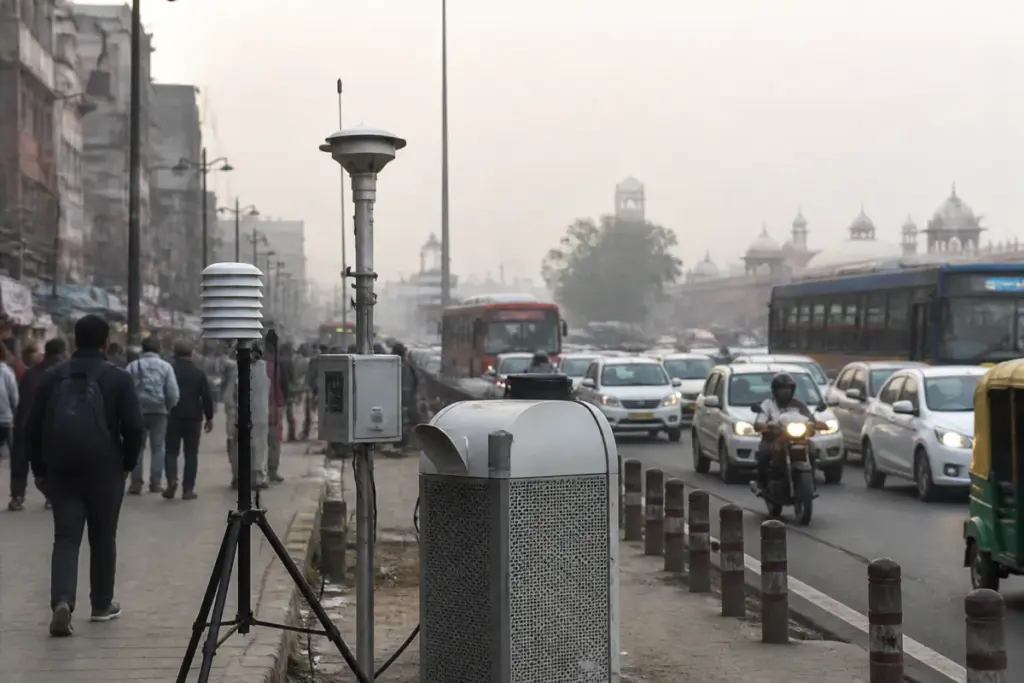
The plan’s most important institutional feature is its attempt to link technology deployment with measurable performance. Firms will receive a four-week window to install and commission their equipment after the sites are handed over. Sensors will be installed, the Delhi Pollution Control Committee will supervise daily monitoring, and an independent committee will assess the impact. The equipment must be certified by a government laboratory and must not create secondary hazards such as ozone emissions or excessive noise.
This structure gives the pilot a clearer test than a general promise to improve air quality. It identifies locations, establishes a reduction target, sets an installation deadline and assigns monitoring responsibilities. But it also raises a basic question about what kind of pollution problem the project is designed to solve: a local concentration of particulate matter at selected public spaces, or the wider emissions system that produces Delhi’s air pollution.
The geography reveals the limits of the intervention
The spatial distribution of the 40 sites is a significant part of the project. Central and South Delhi together account for 19 locations, or nearly 48% of the total. Commercial areas account for 29 sites, representing 72.5% of the pilot. The list includes high-footfall areas such as Khan Market, Connaught Place and Defence Colony, along with selected roads, tourist locations, hospitals and transport hubs.
By contrast, several outer and industrial areas are not included. The Indian Express reported that Bawana and Narela in North Delhi, Mayapuri in West Delhi and Okhla Industrial Area in the southeast were excluded. East Delhi, despite its dense population, accounts for five sites, or 12.5% of the total.
The distribution does not by itself prove that the project is inequitable or ineffective. The sites were selected after consultations with district magistrates and traffic police, and officials were directed to consider localised sources such as congestion, tailpipe emissions, unpaved-road dust and vehicle idling. Anand Vihar Bus Terminal, for example, was chosen because of heavy vehicle parking and congestion.
However, the distribution does establish what the pilot will be able to measure. A programme concentrated in commercial centres will generate evidence about pollution-control interventions in busy public and commercial environments. It will not, on the basis of the supplied information, establish how the same technologies perform in industrial areas, peripheral settlements, residential neighbourhoods or other locations outside the pilot.
This is where the difference between a site intervention and a citywide pollution policy becomes important. A device that reduces particulate matter in a defined open or semi-enclosed space may have a measurable local effect. That result would still need to be interpreted separately from changes in emissions across roads, industries, construction sites, diesel generators, waste-burning locations or regional pollution sources. The pilot’s stated purpose is to assess targeted interventions, not to claim that 40 sites can solve Delhi’s entire air-quality problem.
A technology-agnostic model with a strict target
The DPCC has deliberately avoided prescribing one technology. Outdoor air purifiers, mist-based scrubbers and electrostatic precipitators are among the possible options, provided they meet the certification, performance and environmental-safety conditions. This approach allows companies to compete on the basis of results rather than on a government-selected technology.
That flexibility may help the administration test different responses in different settings. A transport hub with heavy vehicle movement may present a different operational challenge from a market road, a hospital campus or a tourist corridor. The use of sensors and daily monitoring could allow the authorities to compare outcomes across these environments, although the supplied report does not specify the sensor specifications, baseline periods, measurement methodology or criteria for attributing reductions to the installed equipment.
Those details will be central to the credibility of the pilot. A 20% reduction target requires a clearly established starting point and a consistent method of measurement. It also requires the authorities to separate the effect of the intervention from other changes, including traffic variation, weather, road cleaning, seasonal conditions or temporary reductions in activity. The independent committee’s assessment will therefore be important, but the structure and publication of its findings will determine how useful the experiment becomes for future policy.
The maintenance obligation is another notable feature. The selected firms are not only expected to install equipment; officials said they will also have to maintain the reduction at the sites. This places responsibility for continuing performance on the operators rather than treating installation as the completion of the project.
Yet maintenance in public spaces is not a purely technical task. Equipment may require power, cleaning, replacement parts, security, access and coordination with traffic or market authorities. The report does not provide the operating-cost structure or explain which agency will manage site access and disruptions. Those administrative details could influence whether the pilot remains functional after its commissioning period.
The roads and public spaces at the centre of the trial
The shortlisted road stretches show how closely the plan is tied to ordinary urban conditions. They include Chandni Chowk Main Market Road between Gauri Shankar Mandir and Fatehpuri, Lotus Temple Road between the Astha Kunj crossing and Okhla NSIC Metro station, and Baba Kharak Singh Marg between Connaught Place Police Station and the Delhi Traffic Police Training Park.
Previous DPCC assessments identified road dust from unpaved roads and vehicular tailpipe emissions as key concerns on these stretches. These sources point to a wider governance challenge. Pollution at a public road is shaped by the condition and management of the street itself, the movement and idling of vehicles, traffic enforcement, construction activity and the maintenance of surrounding surfaces.
A technology installed on such a road may be able to reduce measured particulate matter at a specific point. But the result will remain connected to the underlying street-management system. If dust is repeatedly generated by unpaved surfaces or vehicles continue to idle in congestion, the intervention will be operating against a continuing source. The pilot may therefore produce useful evidence not only about devices, but also about the circumstances in which device-based solutions have limited or sustained value.
The institutional test is as important as the technical one. District magistrates, traffic police, the DPCC, private operators and the independent monitoring committee all have roles in the programme. Their coordination will affect site handover, installation, daily monitoring, enforcement around traffic and maintenance. A pollution-control intervention cannot be evaluated only as equipment if its performance depends on several public agencies keeping the site operational.
What the pilot can establish
The one-year trial can potentially answer a narrow but useful set of questions. It can show whether certified technologies achieve the stated particulate-matter reduction at selected open or semi-enclosed sites. It can compare performance across markets, commercial hubs, transport locations, tourist areas, hospitals and educational spaces. It can also reveal the operational cost and administrative burden of maintaining interventions in active public places.
The project cannot, based on the available information, establish a citywide reduction in Delhi’s pollution. Nor can it demonstrate that the selected technologies address every major source of particulate matter. Its strongest contribution would be a transparent record of where interventions worked, under what conditions, at what cost and with what environmental side effects.
That makes the publication of evidence a central policy issue. The authorities have identified a measurable target and an independent assessment mechanism, but the supplied report does not say how often results will be released, whether baseline readings will be made public or how failed interventions will be handled. Without that information, the pilot risks being judged mainly by installation and visibility rather than by sustained performance.
Delhi’s pollution-control plan is therefore best understood as a bounded urban experiment. It moves beyond a generic call for innovation by selecting sites, setting a reduction target and assigning monitoring responsibilities. At the same time, its concentration in commercial locations and exclusion of several outer and industrial areas define the limits of what it can prove.
The next milestones are the completion of technical reviews, handover of sites, installation and commissioning within four weeks, and the start of the one-year pilot. The quality of the baseline data, the transparency of sensor readings and the independent committee’s eventual assessment will determine whether the programme becomes a credible model for targeted pollution control or remains a collection of isolated site interventions.