

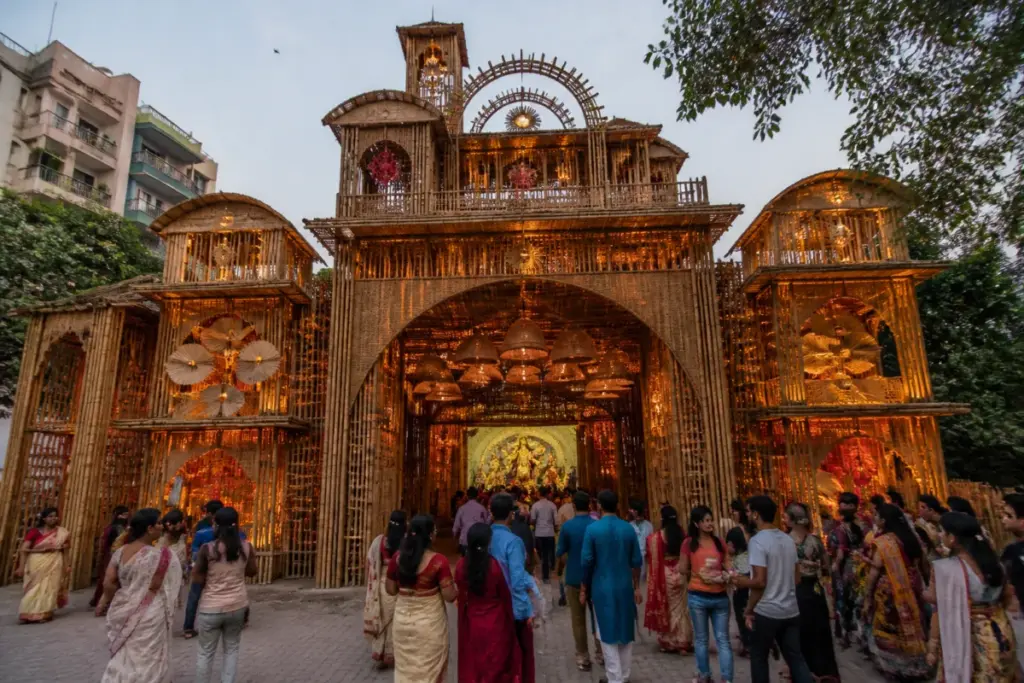
Delhi’s Durga Puja pandals are often treated as temporary festival venues, but this year’s installations show how they also function as community-built urban spaces. In Paharganj and CR Park, committees have used the festival to preserve print culture, revive bamboo and jute craft, reduce the use of non-biodegradable materials and organise food services for thousands of people each day.
The projects are not merely decorative. They require months of planning, budget allocation, committee structures, specialised artisans, locally coordinated idol-making and the temporary transformation of public or community spaces. Their scale reveals a form of urban organisation that operates outside the conventional language of infrastructure, even though it performs several infrastructure-like functions: it gathers people, manages movement, creates shared facilities and gives a neighbourhood a temporary civic centre.
At the Arambagh Durga Puja Samiti pandal in Central Delhi’s Paharganj, the built environment itself has become part of the message. The committee has recreated a North Kolkata lane associated with Shyambazar, including the visual details of alleys, tea stalls and balconies where residents read newspapers. The installation also references Rabindranath Tagore’s ancestral home at Jorasanko Thakur Bari.
Its theme, “Power of Print Never Fades”, places a printing press at the centre of the pandal. According to samiti chairman Abhijit Bose, the model shows newspapers being printed, a newsagent sorting copies and a cyclist delivering them to homes. Typography is used to show how written letters have changed over time, while a sound track draws on old radio broadcasts and the Doordarshan news tune.
Front pages relating to the Emergency, Independence and Rabindranath Tagore’s death are also displayed. Bose said some of the material was sourced from the Parliament Library and the National Library. The installation therefore works as a temporary archive as much as a religious venue, using spatial reconstruction and objects to connect a neighbourhood festival with the history of public information.
The approach also reflects the changing relationship between urban residents and shared media. Bose recalled growing up in Odisha, where newspapers arrived a day late and several people would wait to read a single copy. That memory describes a form of collective access to information: the newspaper was not only a product delivered to an individual household but also a shared object around which people gathered.
The Arambagh committee began organising themed pujas in Delhi-NCR in 2013. Its decision to use a theme each year, including Bengal’s Jatra folk theatre in the previous year, indicates how committees have expanded the festival’s role from ritual presentation to cultural interpretation. The pandal becomes a temporary exhibition, performance setting and neighbourhood meeting point, even though its primary purpose remains religious.
The clearest material and environmental dimension appears in CR Park. At the Park Mela Ground, the CR Park Mela Ground Durga Puja Samiti has adopted the theme “Mati, Manush, Mohon”. The three words refer respectively to the clay used for the idol, the craftspeople who create the pandal and the quality of enchantment associated with the finished space.
The choice of materials is central to the theme. The idol is made of clay, decorations are cut from biodegradable foam boards and fruits and vegetables are used to provide colour to the faces and hands. A dark green element in the colour palette is intended to underline the use of eco-friendly material. Red and white, inspired by the traditional Lal Paar saree worn by Bengali women, form the main palette.
These choices show that sustainability at a temporary public installation is not limited to a visual claim. It involves decisions about what is used to construct the space, how the idol is made and how colour is applied. The supplied account does not provide a comparative assessment of the materials’ environmental performance, nor does it establish how they are disposed of after the festival. But it does show that material selection has become an explicit part of the committee’s planning and public communication.
The scale of the operation is also significant. Avik Mitra, assistant treasurer of the Park Mela Ground committee, said the community meals serve approximately 8,000 to 10,000 people a day. Waterproofing material and carpets alone cost about Rs 40 lakh, while sponsorship carries much of the financial load. These figures illustrate the hidden systems behind a temporary festival space: weather protection, flooring, food service, procurement, volunteer or staff coordination and fundraising.
The committee’s preparation begins two to three months before the festival. Meetings are held to decide the budget, after which departments are formed and responsibilities assigned. This resembles a temporary project-management structure, with a defined timeline, financial planning and separate operational responsibilities. Unlike a municipal project, however, the organisation is rooted in a community committee and supported substantially through sponsorship.
The idol-making process is also linked to the neighbourhood. Idols are made within the colony at the Chittaranjan Park Kali Mandir, where a dedicated space has been set aside for the purpose. This arrangement keeps part of the production process within the locality instead of treating the pandal as a finished installation brought in from elsewhere.
At the K-Block Durga Puja pandal in CR Park, the emphasis is on traditional craft labour. The structure has been made with jute and bamboo, and artisans travelled from villages around Kolkata about a month before the festivities began. General secretary Saurav Chakravarty said the entire pandal was hand-crafted and that the committee wanted to promote traditional artisans because modernisation had reduced the use of bamboo.
This creates a direct connection between urban cultural events and rural or semi-rural craft economies. The pandal is located in Delhi, but its construction depends on skills, materials and labour networks extending beyond the city. The temporary structure therefore makes visible a supply chain that is usually hidden behind the finished appearance of public events.
The use of bamboo and jute also raises a larger question about what cities consider modern. In permanent construction, modernity is often associated with industrial materials, standardisation and speed. A hand-crafted pandal follows a different logic. It depends on skilled labour, material knowledge and a defined period of assembly. Its value lies partly in the fact that it is temporary and rooted in a particular cultural practice.
At the same time, the committees’ approach does not eliminate the practical pressures of urban event management. The Park Mela Ground installation requires waterproofing and carpets, while the food service must operate at a scale of several thousand meals each day. Eco-friendly materials and traditional craftsmanship therefore exist alongside substantial procurement and logistical requirements. The festival’s environmental message is embedded in a broader operation that must still manage weather, crowds, food and finances.
The contrast between the three installations is useful. Arambagh uses a reconstructed lane and a printing press to examine memory, media and technological change. The Park Mela Ground committee uses clay, biodegradable foam boards and natural colours to connect ritual with material choices. The K-Block committee uses bamboo, jute and hand-crafted construction to support traditional artisans. Each pandal treats design as a form of public communication, but each does so through a different urban concern.
Together, they also show how neighbourhood institutions can create temporary public spaces without operating as formal planning agencies. The committees decide themes, raise funds, allocate responsibilities, bring in artisans, coordinate construction and manage community meals. Their work is not a substitute for municipal infrastructure, and the available account does not establish the full regulatory or safety framework governing the pandals. It does, however, demonstrate that civic capacity can be organised through cultural associations and community networks.
The built environment created by these committees is temporary, but its social effects are not necessarily limited to the festival period. The installations preserve memories, sustain craft relationships, provide a setting for collective meals and create a shared identity for residents. Their temporary nature also allows experimentation: a committee can recreate a historic street, test a material palette or centre a public message without committing to a permanent building.
The evidence from Delhi’s pandals confirms three features of this model. First, cultural festivals can operate as complex urban projects requiring planning, funding and labour. Second, material choices can be used to communicate environmental and cultural values, even when the complete environmental lifecycle of those materials is not documented. Third, community committees can connect neighbourhood spaces with wider networks of artisans, sponsors, suppliers and cultural memory.
What remains less clear is how these temporary structures are dismantled, how materials are reused or discarded, and how their environmental claims are measured. Those questions matter because the scale of food service, flooring, waterproofing and construction can be substantial. For now, the pandals offer a visible example of how Delhi’s communities use temporary architecture to organise public life, preserve inherited practices and negotiate the meaning of modern urban culture.


