

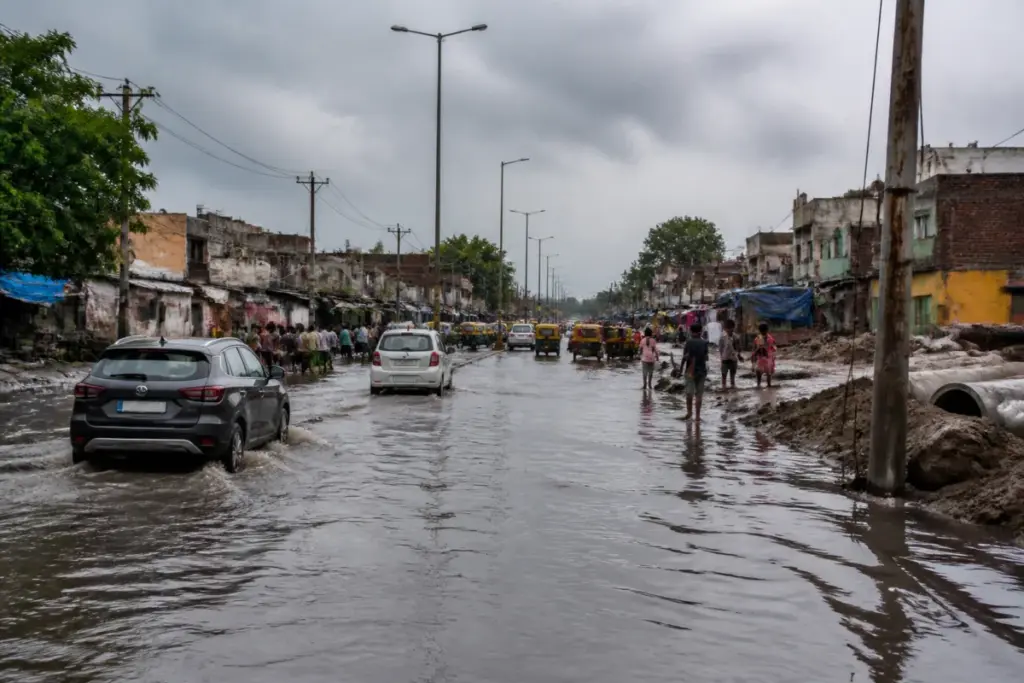
The Delhi government has sanctioned Rs 25.60 crore to tackle recurring waterlogging on Mandi Road and Bandh Road in South Delhi’s Chhatarpur, with the project covering new drains, two pump houses and the rebuilding of a 4-km stretch of Mandi Road.
The works are intended to improve stormwater removal in and around Sultanpur, Gadaipur and Jaunapur villages, where residents have faced flooding during the monsoon for several years. Officials said the project will involve precast drains on both sides of Mandi Road and on one side of Bandh Road.
Under the plan, 710 metres of precast drain will be built on each side of Mandi Road, creating 1,420 metres of drainage in total. Bandh Road will receive a 1,920-metre precast drain along one side. Two pump houses will also be constructed to enable quicker removal of accumulated stormwater.
The government has separately planned to rebuild a 4-km section of Mandi Road with a bituminous surface. Financial bids for the roadwork have already been opened, and officials said the contract is expected to be awarded shortly under the Public Works Department’s South Zone combined tender.
The project follows a site inspection by PWD and Water Minister Parvesh Sahib Singh in July, when heavy rainfall left the roads severely waterlogged. Residents told the minister that flooding disrupted daily commutes, affected businesses and damaged roads during every monsoon season. The minister said the issue would be addressed on priority.
“The people of Sultanpur, Gadaipur, Jaunapur and nearby areas have waited long enough,” Singh said, according to the statement cited by officials.
The two roads were previously under the supervision of the Municipal Corporation of Delhi. Their responsibility has now been transferred to the PWD under the government’s “One Government, One Governance” approach. Officials said the change is intended to streamline decision-making and bring road and drainage works under an integrated administrative framework.
Officials attributed the repeated flooding to the area’s low-lying terrain and the closure of a natural drainage channel that once carried rainwater towards Haryana. Rapid urbanisation had obstructed the outlet, leaving the roads and surrounding settlements vulnerable to water accumulation during heavy rain.
Temporary pumping arrangements have provided only short-term relief, officials said. The new project is therefore designed to combine permanent drainage infrastructure with pumping capacity and road reconstruction rather than relying only on emergency water removal.
The immediate milestones are the award of the roadwork contract and the execution of the planned drains and pump houses. The project’s effectiveness will depend on the completion and functioning of these components before the next period of heavy monsoon rainfall.


