

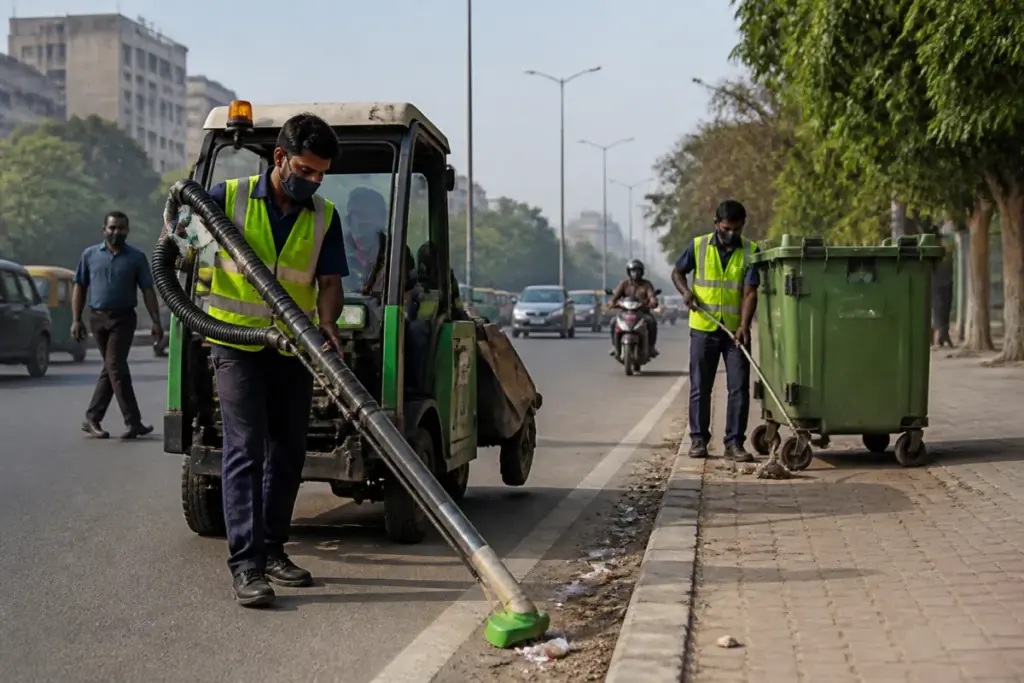
Delhi will deploy 1,000 battery-powered mechanical litter pickers across all 250 MCD wards as the government expands waste collection, transportation and processing infrastructure to address the nearly 15,000 metric tonnes of garbage generated in the city every day.
Chief minister Rekha Gupta announced the plan on Saturday while inaugurating a fixed compactor transfer station in Sarita Vihar and flagging off the first batch of 50 litter pickers. The event also marked the launch of new waste collection vehicles to be operated by 35 newly appointed women drivers.
Gupta said Delhi had previously been able to process only 6,000-7,000 metric tonnes of the approximately 15,000 metric tonnes of waste generated daily. The gap, she said, had contributed to the continued growth of garbage mountains around the city. The government aims to strengthen collection and ensure that waste generated in Delhi is processed and disposed of on the same day.
The battery-operated machines are designed to collect small pieces of litter from roads and public spaces and support vacuum cleaning operations. Of the 1,000 machines planned, 150 have arrived, while the remaining units are expected within a month, according to Gupta. The government has also provided funds for 100 mechanical sweeping machines.
The expansion includes measures beyond street cleaning. Gupta said the government was working to establish new waste-to-energy plants, increase the capacity of existing facilities, set up e-waste centres and install biogas plants to manage cow dung. The city is also planning additional arrangements for religious and household waste.
In the South-East zone, the government has approved 428 auto-tippers, 128 e-rickshaws and 25 Tata 407 vehicles for door-to-door collection. The zone will also receive 27 refuse compactors, five additional compactors and 30 hook loaders. Supporting equipment includes 100 compactor bins, 1,500 steel dustbins, 300 HDPE dustbins and 10 tipper trucks for horticultural waste.
The government is urging residents to deposit unwanted clothes at Arpan centres near metro stations for recycling and reuse instead of placing them in regular municipal waste. Separate arrangements are being made to collect broken idols and puja material so these items do not enter the municipal waste stream.
Immersion kiosks are planned across all 250 wards, with around 100 already established, Gupta said. These facilities are intended to prevent religious material from mixing with other municipal waste and to support separate collection and processing.
The chief minister said the government was preparing a long-term plan aimed at ensuring that Delhi residents would not face waste management problems over the next 15 to 30 years. The announced measures will be implemented alongside the planned expansion of waste processing capacity and citywide sanitation machinery.


