

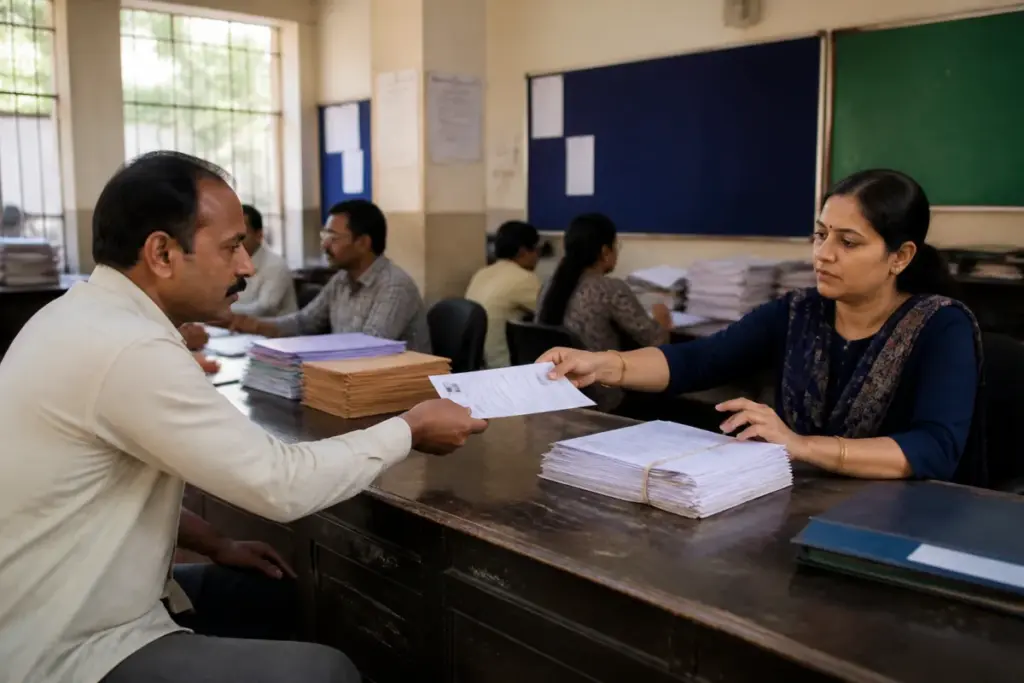
The Delhi High Court’s decision to leave open the Form 6 route for voters missing from the draft electoral roll during the ongoing Special Intensive Revision (SIR) is more than a procedural clarification. It brings into view a recurring administrative problem in a mobile city: residents can remain the same citizens with the same voting history, yet become difficult to recognise within a revised register after moving home.
A bench of Justices Dinesh Mehta and Aditi Choudhary disposed of a petition filed by advocate Nilotpal Datta and his kin, who had not appeared in the SIR draft after failing to submit enumeration forms within the prescribed timeline. The petitioners said they had shifted from their old residence and consequently saw their names deleted from Delhi’s electoral rolls. The court recorded that they could apply through Form 6 as fresh voters, with the application to be processed according to law.
The case therefore turns on the difference between a person’s status in a previous electoral roll and the administrative process used to prepare the new roll. The petitioners had sought directions to “recast the procedure governing existing electors who could not be enumerated during the SIR” so that their entries could be corrected or transferred through Form 8 rather than requiring fresh inclusion through Form 6.
That distinction matters because Form 8 is used for correction of entries in existing electoral rolls. The petitioners argued that requiring them to use Form 6 created a problem of legal declaration. Their concern was that Form 6, described in the petition as the statutory form for fresh registration of first-time voters, asks an applicant to declare that they have never voted before. The petitioners said they had voted earlier and that filing such a declaration could therefore be false.
The Election Commission of India took a different view. Its counsel, Sanjay Vashishtha, submitted that Form 6 applied to the new roll being prepared through the SIR process. In that administrative context, he argued, an applicant could be treated as a first-time voter for the new roll, while Form 8 was meant for rectification after a voter had been included in the roll or for correcting details in the roll preceding the SIR exercise.
The court recorded that the petitioners’ grievance could be addressed by submitting Form 6. On October 14, the bench said that, since the suggestion came from the Election Commission’s standing counsel on the instructions of the Electoral Registration Officer, the apprehension that the applicants would be accused of making a false declaration was misplaced. The petition was disposed of while keeping the Form 6 option open to the petitioners.
## A mobility problem inside an electoral system
The facts of the case show how residential mobility can collide with administrative timelines. The petitioners’ stated difficulty was not that they had never been registered, but that they could not complete the enumeration process after shifting from their earlier residence. Their names subsequently did not appear in the SIR draft for Delhi.
For a city, this is a significant distinction. Electoral registration is organised through entries linked to rolls, addresses and prescribed forms, while urban residence is often more fluid. People move between rented homes, family residences and owned properties. The supplied case does not establish how widespread this particular problem is, nor does it provide figures on the number of Delhi residents affected. It does, however, identify the institutional point at which a change of address and a missed enumeration deadline can produce a gap between a person’s previous electoral record and their status in the new draft roll.
The High Court’s ruling does not create a general exemption from the SIR process. It also does not direct the Election Commission to restore the petitioners’ previous entries through Form 8. Instead, it leaves them to pursue inclusion through Form 6, with their applications to be processed as required by law. The practical outcome is therefore a route back into the electoral system, but not a finding that the earlier entries must automatically be carried forward.
## The institutional dispute over Form 6 and Form 8
At the centre of the case is an administrative classification. The petitioners viewed themselves as existing electors whose entries had been affected by a change of residence and an incomplete enumeration process. Their preferred remedy was correction or transposition through Form 8. The Election Commission treated the new SIR roll as the relevant framework for the application and maintained that Form 6 could address the grievance.
This difference reflects two ways of understanding an electoral register. One treats continuity of the individual’s earlier entry as the central fact. The other treats the preparation of a new roll as the operative administrative event and asks applicants to establish inclusion within that new process. The court, on the material reported, did not resolve that larger question in favour of the petitioners’ requested procedural redesign. It accepted the Form 6 route proposed by the poll body for the applicants before it.
The court’s reliance on the Election Commission’s submission is also important. The bench noted that the suggestion came from the standing counsel acting on the instructions of the Electoral Registration Officer. That institutional assurance shaped the court’s conclusion that the petitioners’ apprehension about a false declaration was misplaced.
The ruling thus places weight on the interpretation offered by the electoral authorities responsible for processing the new roll. It also leaves the applicants with a defined administrative next step rather than ordering a separate mechanism for voters who missed enumeration.
## What the case establishes—and what it does not
The supplied report establishes four immediate points. First, the petitioners did not appear in the SIR draft after missing the enumeration-form timeline. Second, they attributed the problem to having shifted from their old residence. Third, they sought to use Form 8 rather than register afresh through Form 6. Fourth, the High Court disposed of the plea after accepting that Form 6 remained available and could be processed according to law.
The report does not establish how many voters are in a similar position across Delhi. It does not provide the number of names omitted from the draft roll, the number of Form 6 applications filed in response, or the time taken for such applications to be decided. It also does not state whether the Election Commission has issued a separate public instruction specifically addressing previously registered voters who missed enumeration after moving residence.
Those limits are relevant because a court decision involving one family cannot by itself quantify the scale of an administrative issue. The case offers a clear example of the problem, but not a statistical assessment of its prevalence. Any broader conclusion about the impact of the SIR exercise would require additional information on applications, objections, deletions, accepted claims and rejected claims.
The ruling also does not decide whether Form 6’s declaration language should be amended for the SIR context. The Election Commission’s counsel explained how the form was understood for the new roll, and the court found the petitioners’ apprehension misplaced in light of that submission. But the report does not mention any change to the form itself or any alteration to the statutory process.
## The larger governance question
The Delhi case illustrates how a technical form can become the point at which citizenship, mobility and administrative continuity meet. Electoral rolls are built through formal procedures, but the people represented in them live through changing addresses and deadlines. When an existing voter falls out of a draft roll, the route to correction depends on how the authority classifies the person and the relevant register.
That makes the clarity of instructions important. In this case, the Election Commission’s position supplied the applicants with a route through Form 6. The court’s order, as reported, ensures that the petitioners can pursue that route without the concern that their earlier voting history automatically prevents them from applying for inclusion in the new roll. The final outcome will still depend on processing according to law.
For Delhi residents, the immediate lesson is procedural rather than political: absence from the SIR draft does not, according to the High Court’s recorded approach in this case, close the possibility of seeking inclusion. The available remedy identified in the proceedings is Form 6, even where the applicant had previously voted. The case does not establish automatic restoration, and it does not remove the need for the application to be examined by the competent electoral authorities.
The institutional question that remains is whether procedures designed around a new roll can preserve enough continuity for residents who were already registered but missed a time-bound enumeration exercise. The supplied material does not answer that question at a system-wide level. It does show that the issue has reached the High Court and that, for the petitioners, the court accepted the Form 6 route as the available next step.
The next developments to watch are the processing of the petitioners’ applications and any further instructions from the Election Commission or Electoral Registration Officers for similarly placed voters. Those steps will indicate whether the route identified in court remains a case-specific solution or becomes a more clearly communicated administrative pathway during the ongoing SIR process.


