

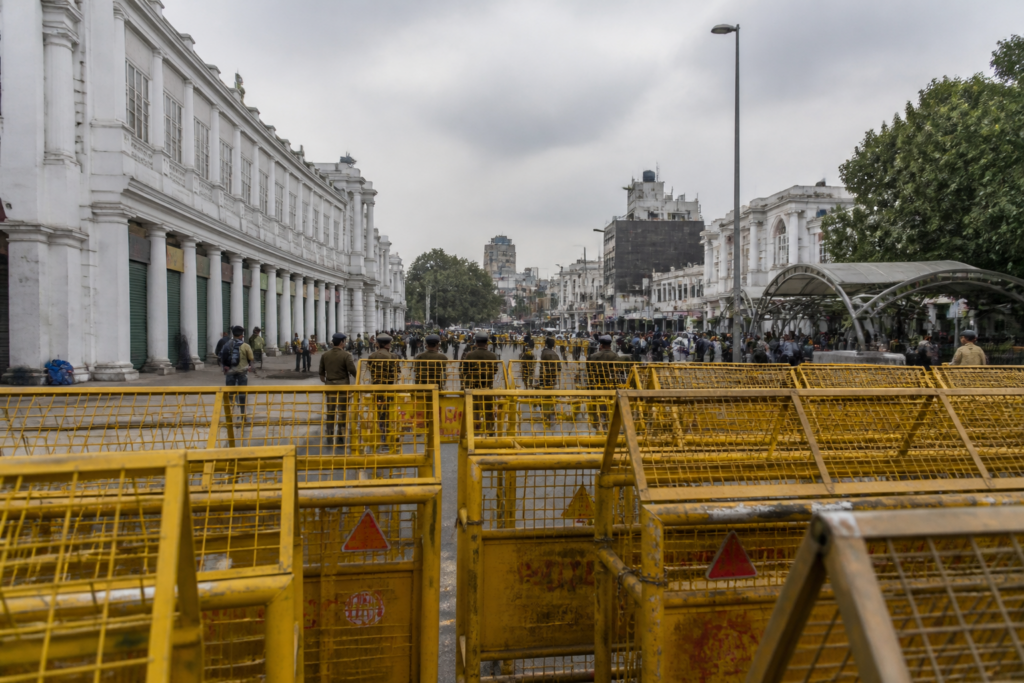
The reported losses faced by traders in Delhi’s Khan Market during the Cockroach Janata Party’s protests reveal how quickly a political mobilisation can become an urban economic disruption. Traders said festive-season footfall had fallen sharply, while barricading, traffic restrictions, transport cancellations and the closure of nearby businesses affected commercial activity across Central Delhi.
The Khan Market Welfare Association estimated that traders were losing at least Rs 5-7 crore a day. Its president, Anshu Tandon, told The Indian Express that the figure could rise to around Rs 50 crore when rent was included. These figures were presented as traders’ estimates, not as an independently audited assessment, but they highlight a central feature of city commerce: a shop’s income depends not only on its own operations, but also on whether customers can reach the market and feel confident moving through the surrounding area.
That vulnerability became visible after the CJP’s October 10 protest demanding the resignation of Chief Election Commissioner Gyanesh Kumar. The report said the mobilisation caused disruptions across Central Delhi, including the closure of 45 Delhi Metro stations, the cancellation of almost 250 trains arriving at or departing from New Delhi and Hazrat Nizamuddin railway stations, and a 24-hour mobile Internet shutdown. Barricades were placed across streets, while the New Delhi Traders Association advised shops, offices and restaurants in Connaught Place to remain closed as a precaution.
The sequence shows that the urban impact of a protest is determined by more than the number of people attending it. A gathering at one location can affect movement across a much wider area when authorities restrict access routes, transit stations and public spaces. Central Delhi’s commercial districts are especially exposed because markets such as Khan Market and Connaught Place depend on a combination of private vehicles, taxis, public transport, walking and occasional visitors travelling from other parts of the National Capital Region.
The disruption also affected the basic operating costs of businesses. Tandon said traders had to continue paying rent, salaries and other expenses even when sales declined. This distinction matters. A temporary fall in revenue does not automatically translate into a temporary fall in financial obligations. For businesses operating from rented premises, each closed or low-footfall day can add to an existing burden without reducing fixed costs.
The report also described an economic slowdown that traders said was already affecting business before the protests. The protests therefore became an additional shock during the festive season, when traders expected stronger sales and income. Khan Market traders said customers were apprehensive about stepping out, while the precautionary closure advisory in Connaught Place institutionalised the disruption by encouraging businesses to suspend activity rather than risk operating in an uncertain environment.
This is where the issue moves beyond a dispute between protesters and shopkeepers. Delhi’s commercial areas function as shared urban systems. Traders need predictable access, customers need safe and convenient movement, police need to manage crowds and public authorities must protect the right to protest. When one of these functions is prioritised without a workable arrangement for the others, the cost is transferred to ordinary users of the city.
The available account does not establish that every reported loss was caused solely by the protest. Traders referred to an existing slowdown, and the precise method used to calculate the Rs 5-7 crore daily estimate was not detailed in the report. Nor does the material establish how many businesses remained closed, how much revenue was lost by individual shops or whether losses were later recovered. Those limitations are important because commercial disruption is often measured through claims made by associations rather than through a single citywide accounting system.
Even with those qualifications, the disruption indicators were substantial. Forty-five metro stations were reportedly closed, almost 250 trains were cancelled and mobile Internet was shut down for 24 hours. These measures affected mobility and communication well beyond the protest site. For retail districts, the effect can be cumulative: a commuter unable to reach Central Delhi may also cancel a shopping trip, a restaurant booking or a service appointment. A business may lose not only the transaction that day but also customer confidence about returning soon.
The closure of liquor stores by the Delhi government on Friday and Saturday added another layer of administrative control. The report did not specify the number of stores affected or the revenue implications. It did, however, place the decision within a broader pattern of authorities using temporary restrictions to manage the risks associated with large gatherings. Such measures may be intended to prevent disorder, but they also widen the area in which normal commercial activity is interrupted.
The events around Connaught Place illustrate the tension at street level. Ahead of the CJP’s ‘Lehra Do Tiranga’ gathering at Central Park, an argument broke out between some traders and a few protesters. Videos purportedly showed the exchange, but the report said there was no reported violence or complaint connected to the incident. The episode nevertheless demonstrates how quickly access restrictions and commercial anxiety can create friction between people using the same public space for different purposes.
Traders’ position, as represented by Tandon, was not that protest should be prohibited. He acknowledged the right to protest while arguing that the law should be upheld and ordinary citizens should not be made to suffer. That distinction is central to managing high-intensity public events in dense commercial districts. The urban question is not simply whether a demonstration is lawful; it is how the city can preserve lawful assembly while keeping movement, trade, emergency access and everyday services functioning.
The institutional responsibilities are spread across several authorities. Delhi Police is responsible for crowd management, traffic regulation and maintaining law and order. Delhi Metro and the railways operate transport systems whose services can be affected by security decisions. The Delhi government can impose measures such as the closure of liquor stores. Market associations represent traders and communicate advisories, while courts can examine whether repeated gatherings are disproportionately affecting vendors and small businesses.
That institutional fragmentation can make it difficult to identify who is responsible for the economic consequences of restrictions. A trader may experience the result as one continuous disruption, even when the decisions affecting metro stations, rail services, roads, internet access and commercial establishments are taken by different agencies. The Indian Express report does not indicate that a single authority accepted responsibility for compensating businesses or coordinating a recovery plan.
The Delhi High Court’s hearing on a public interest litigation brought by Delhi resident Anil Kumar Gupta adds a legal dimension to the dispute. Gupta said he was representing street vendors and small traders whose businesses had been severely affected by regular protests and agitations around Jantar Mantar. The court recorded the Delhi Police’s assurance that it would take necessary steps to regulate the gathering and maintain law and order.
The court proceeding is significant because it places the effects on small traders and vendors within a formal public-law process rather than leaving the matter only to negotiations between protest organisers, police and market associations. The report does not say that the court issued a final ruling or ordered compensation. Its immediate development was the police assurance recorded during the hearing.
Delhi’s experience also points to the importance of treating commercial streets as infrastructure. Roads and public transport are usually discussed in terms of capacity, travel time and congestion. Markets require another form of capacity: reliable access for customers, deliveries, workers and emergency services. When barricades and closures remove that access, the market’s physical infrastructure may remain intact while its economic function is temporarily disabled.
The figures available in the report make the scale of the interruption visible but do not yet provide a complete measurement of its urban cost. The reported Rs 5-7 crore daily trading loss, the possible Rs 50 crore figure including rent, 45 closed metro stations, nearly 250 cancelled trains and a 24-hour Internet shutdown describe different dimensions of the same event. They should not be combined into one total, but together they show that the consequences extended across commerce, mobility, communications and public administration.
What remains unresolved is how Delhi should plan for protests that take place in or near high-value commercial and transport districts. The supplied material records traders’ concerns, the police assurance and the immediate restrictions, but it does not establish whether authorities had a prior access plan, whether alternative routes were communicated effectively or whether the economic impact will be reviewed after the event. Those questions will determine whether the episode becomes a one-off disruption or evidence of a recurring weakness in the city’s protest-management system.
The immediate facts confirm a conflict between the right to assemble and the need to keep public life operating. They also show that the burden of that conflict can fall most heavily on businesses and workers with continuing fixed costs and limited ability to absorb a sudden loss of footfall. Further developments in the Delhi High Court case, police arrangements for subsequent gatherings and any documented assessment of the traders’ losses will establish how the city responds to that pressure.


