

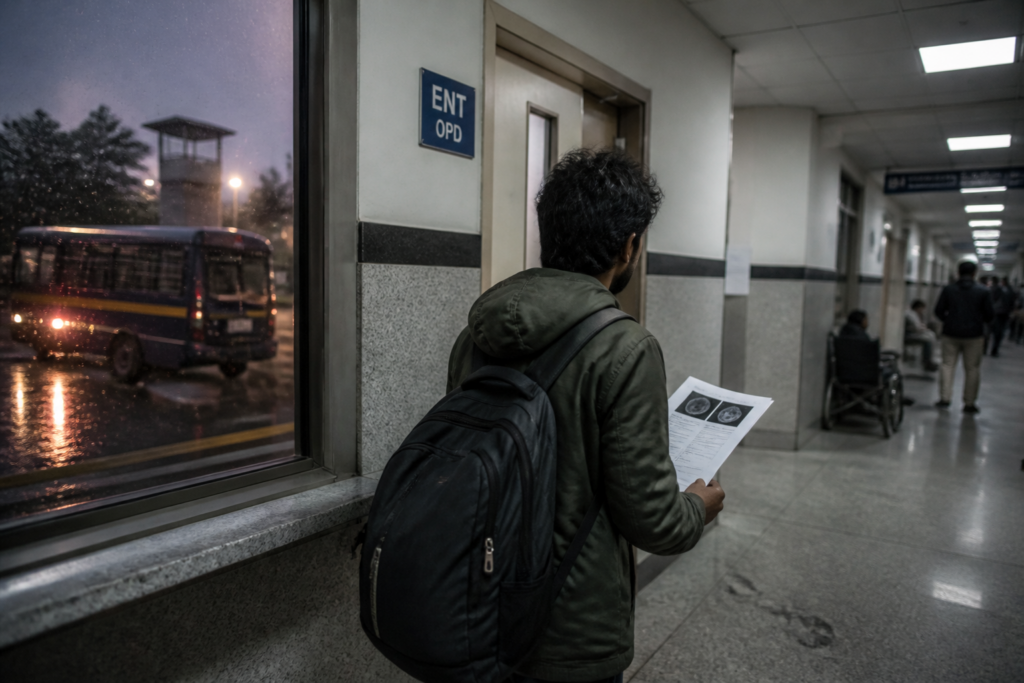
The case of Delhi protester Fidal Royas, whose medical reports record a perforated right eardrum after he alleged assault in police detention, raises a question larger than the injuries suffered on October 11: what happens to medical evidence when a person is detained, treated and released without a clear, accessible chain of records?
Royas, a 27-year-old from Kerala, travelled to Delhi to participate in protests demanding the resignation of Chief Election Commissioner Gyanesh Kumar. According to the report by The Hindu, he was detained during protests on October 2 and October 10 without reporting an assault. On October 11, however, he said he was beaten after police allegedly saw him recording or speaking in a video about violence against detainees.
The account remains an allegation by Royas, but the medical consequences are documented in reports from Government Medical College, Kozhikode. The reports, citing his testimony, describe an assault by Delhi police officers and record injuries to his right cheek, hand, back and other parts of his body. They also record damage to the right eardrum and normal to mild hearing loss linked to the perforation. Doctors have prescribed medication and follow-up care, and are expected to determine within two weeks whether surgery is necessary.
That distinction between an alleged assault and a documented injury is central to understanding the case. The medical record establishes that Royas suffered an ear injury; it does not, by itself, establish who caused it. The reported account of police violence is supported in the article by Royas’s testimony and purported videos showing him being dragged from a detention bus, but the material supplied does not include an independent finding by a court, police inquiry or investigating agency.
The institutional issue begins with the movement of a detainee between different systems. Royas said he was detained from Connaught Place and held in a bus before being taken to a location near Mahipalpur. He said he was released at about 7 p.m. and later taken to Ram Manohar Lohia Hospital in Delhi. According to his account, delays and the absence of specialised care at night meant that treatment was not completed in the capital. He subsequently returned to Kerala for further examination.
For a person injured during detention, this movement matters because medical treatment and accountability depend on records being created, preserved and made available. A hospital report is not simply a clinical document. In cases involving alleged custodial violence, it can become part of the evidence needed to reconstruct when an injury occurred, what treatment was provided and whether the person’s account was recorded promptly.
The Hindu has separately reported that several protesters injured during detention said they were denied injury reports and treatment documents in Delhi. Others reportedly had to seek copies of medico-legal case files and hospital records, with some later being told that documents had been issued by mistake. The supplied report does not establish whether every such account relates to the same hospital, police unit or administrative decision. It does, however, point to a recurring difficulty: the injured person may have to pursue the very records that are supposed to document the state’s response to an injury in custody.
This is where the case moves beyond a dispute between an individual protester and police personnel. Detention creates an unequal information environment. Police control the movement of the detainee and, in many instances, the immediate setting in which detention occurs. Hospitals control clinical records and medico-legal documentation. The detainee may leave with pain, partial information and no straightforward way to obtain a complete record of what happened.
The account also highlights the role of mobile phone recordings in contested public spaces. Royas said he was attacked after police saw him recording a video about violence against detainees. The report says purported videos show him being violently dragged out of the bus. The article does not establish the complete sequence before or after the footage, identify all individuals visible in it or report any official authentication. Even so, the alleged link between recording and assault is significant because it places evidence-gathering itself at the centre of the dispute.
When a detainee’s recording is interrupted or removed, the burden of proof can shift towards medical records, witness accounts and official documentation. That makes the preservation and disclosure of those records especially important. A person who cannot access a medico-legal case file may struggle to establish the chronology of an injury, while a video that lacks context may be challenged as incomplete. The reliability of the eventual inquiry therefore depends not only on whether evidence exists, but also on whether all parties can access it.
The available evidence in Royas’s case has several layers. There is his first-person account of being hit, kicked and slapped; the medical report from Government Medical College, Kozhikode; his reported treatment at Ram Manohar Lohia Hospital; and purported video footage of him being removed from the detention bus. There is no police response included in the supplied article, and no official finding on the alleged assault is reported. That means the central question of responsibility remains unresolved in the material available.
The medical evidence nevertheless has immediate significance. A perforated eardrum can cause pain and hearing loss, and the report records normal to mild hearing loss in Royas’s right ear. The possibility of surgery means that the injury may require treatment beyond the initial medication and follow-up advice. The supplied material does not specify the eventual surgical decision, the cost of treatment or who would bear it. Those limits matter: the report establishes a serious medical concern but does not establish the final outcome.
The case also shows why the location of treatment can affect accountability. Royas travelled from Delhi to Kerala after saying that treatment at the Delhi hospital was incomplete. Once care continues in another State, the medical record becomes geographically divided. The injury is alleged to have occurred in Delhi, the first reported hospital visit was in Delhi, and the later documented diagnosis came from a government medical college in Kozhikode. Any inquiry would therefore need to account for records generated by more than one institution and for the time between the alleged assault and the later examination.
Responsibility is similarly distributed. Police are responsible for the conduct and safety of detainees in their custody. Hospitals are responsible for clinical care and the handling of medical and medico-legal records. The injured person must be able to obtain information about treatment and documentation without being required to navigate an opaque administrative process. The report does not say that these responsibilities were formally assigned or breached in this particular case, but the reported difficulty in obtaining records exposes the consequences when the chain is unclear.
For Delhi’s protest policing, the broader test is not only whether a crowd is dispersed or a detainee is released. It is whether the system can account for what happens between detention and release. That includes identifying where people are taken, recording injuries promptly, ensuring access to appropriate treatment and preserving documents that can be examined later. These are administrative functions, but they determine whether allegations can be assessed through evidence rather than competing narratives.
The report leaves several questions open. It does not state whether a complaint was registered, whether an internal police inquiry began, whether the purported video was examined by investigators or whether the Delhi police disputed Royas’s account. It also does not establish whether the alleged assault occurred inside the bus, outside it or at another location during detention. These are not minor omissions: they define the scope of any future accountability process.
What the available evidence confirms is narrower but still important. Royas was detained during Delhi protests; he later reported being assaulted; medical reports from Kozhikode recorded a perforated right eardrum and mild hearing loss; and he may require surgery. The evidence supplied does not resolve responsibility for the injury. The institutional question is whether police, hospitals and investigators can provide a complete, accessible record that allows the allegation to be tested. The next significant developments will be the medical decision on surgery and any official response or inquiry into the alleged assault and access to treatment records.


