

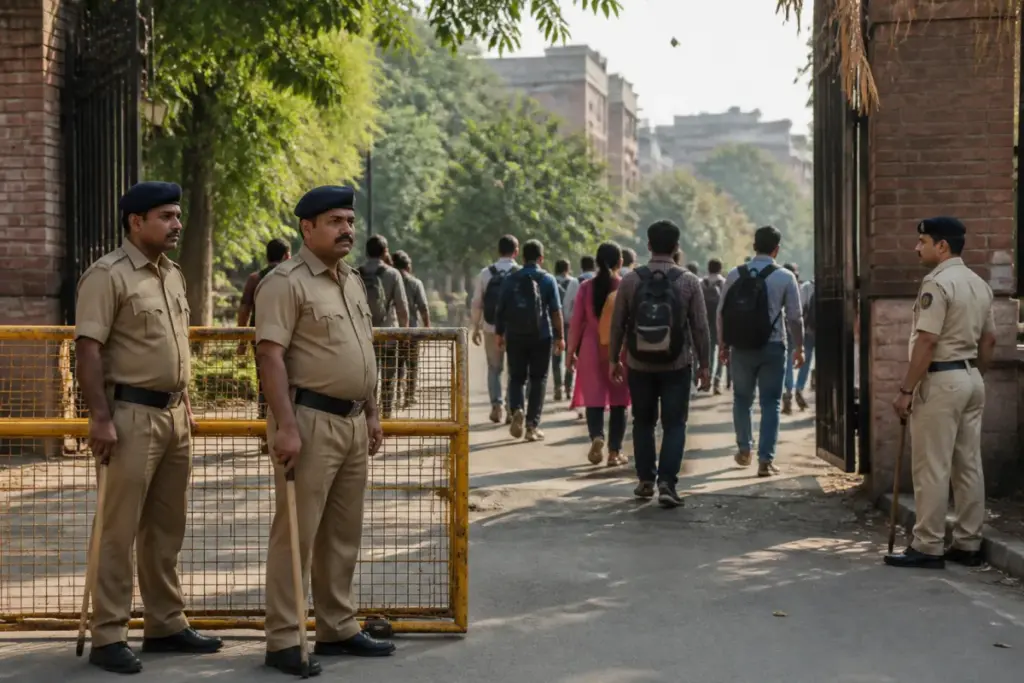
A report by Jagran – New Delhi says Delhi Police and central security agencies have increased vigilance around major educational institutions, including Jawaharlal Nehru University and the University of Delhi, after student protests and unrest in France. The reported measures include monitoring social media, calls originating outside India and activities around university campuses and foreign diplomatic areas. The claims have not been independently confirmed through an official police statement or order supplied in the report.
According to the report, the Delhi Police Special Cell, the Local Intelligence Unit and the Special Branch have been placed on alert in sensitive areas. It attributes the information to unnamed intelligence sources and an unidentified Special Cell officer. The report says agencies are assessing whether events in France could influence protests or unrest in Delhi, particularly through online networks and student organisations.
The account places university campuses at the centre of the reported security response. It names JNU and DU as institutions being watched, while referring more broadly to student organisations, student leaders and groups associated by the report with left-wing politics. The report says the focus is on statements, proposed demonstrations, foreign-linked seminars and possible ideological or digital connections with groups in France and Europe.
Those assertions carry important distinctions. The report does not identify any specific student leader as having committed an offence, nor does it report that any individual has been arrested or formally accused. It says that, at this stage, there is no direct action against leaders and that the reported exercise is an intelligence assessment. It also does not provide the names of the officials who allegedly authorised or described the monitoring.
The reported digital-monitoring component adds another layer to the issue. Jagran says agencies are examining whether images and videos from France are being edited and circulated in an Indian context, and whether online content could provoke students. It also says some unnamed political handles were portraying violence in France as legitimate anger against the system. No specific posts, accounts, takedown notices, legal provisions or platform actions are identified in the supplied report.
The report links the heightened alert to protests in France that it says began over inflation, unemployment and the education system. It states that demonstrations were held at around 110 locations on 17 October, involving an estimated 550,000 to 800,000 people, with incidents of looting, arson and clashes with police in several cities. It further refers to proposed demonstrations on 24 and 31 October associated with the Yellow Vest movement. These international developments are presented as the trigger for the reported assessment in Delhi, but the supplied material does not establish a direct operational link between the French protests and any planned action in India.
For Delhi’s urban administration, the reported alert illustrates how public institutions, transport-linked spaces, university campuses and diplomatic districts can become part of a single security map during periods of international unrest. The report says that educational institutions and prominent public places have received additional security attention. It does not specify whether this has changed access rules, campus operations, policing arrangements, traffic management or event permissions.
That missing information is central to understanding the citizen impact. Increased visible security may affect students, staff, visitors and public gatherings, but the supplied report does not record responses from JNU, DU, student groups, civil-liberties organisations or residents. It also does not clarify whether the monitoring is limited to publicly available online material or includes other forms of surveillance, nor does it state the legal and administrative safeguards governing such activity.
The report says senior Delhi Police officials consider the French unrest an internal matter for France. It adds that if French police or international agencies formally approach Delhi Police or Indian counterparts, assistance would be provided under applicable rules. This indicates that the reported Indian response is currently described as precautionary rather than as part of a confirmed international investigation.
The story also places the alert within a wider official concern about movements that spread through social media and combine different groups, including students, trade unions, farmers and the Yellow Vest movement in France. The report says Indian agencies are assessing whether a similar coalition could be attempted in India. However, it provides no evidence of such a coalition being formed in Delhi, no details of a specific planned protest and no documentary record of communication between Indian and European groups.
The institutional question is therefore not simply whether security agencies are monitoring potential unrest. It is how such monitoring is authorised, defined and communicated when universities and public spaces are involved. A security alert based on a foreign event can have consequences for campus autonomy, public assembly and the relationship between students and the police. Those consequences cannot be assessed fully without knowing the scope of the alert, the agencies involved, the duration of the measures and the legal basis cited by authorities.
The supplied report establishes that Jagran has published an account of heightened vigilance and attributes the claims to unnamed sources within or familiar with security agencies. It does not establish an official public confirmation of the alert, a written directive, a named police briefing or an independently verified connection between the French protests and any threat in Delhi. Confirmation from Delhi Police, the Union government, the concerned universities and, where relevant, the agencies responsible for digital monitoring would be required to establish the central facts.
Until that information is available, the reported alert should be treated as an attributed claim rather than a confirmed change in Delhi’s security or campus-management policy. The developments requiring monitoring are an official police communication, any formal advisory to universities, changes to public-event permissions, and evidence of a specific India-linked threat or investigation.


