

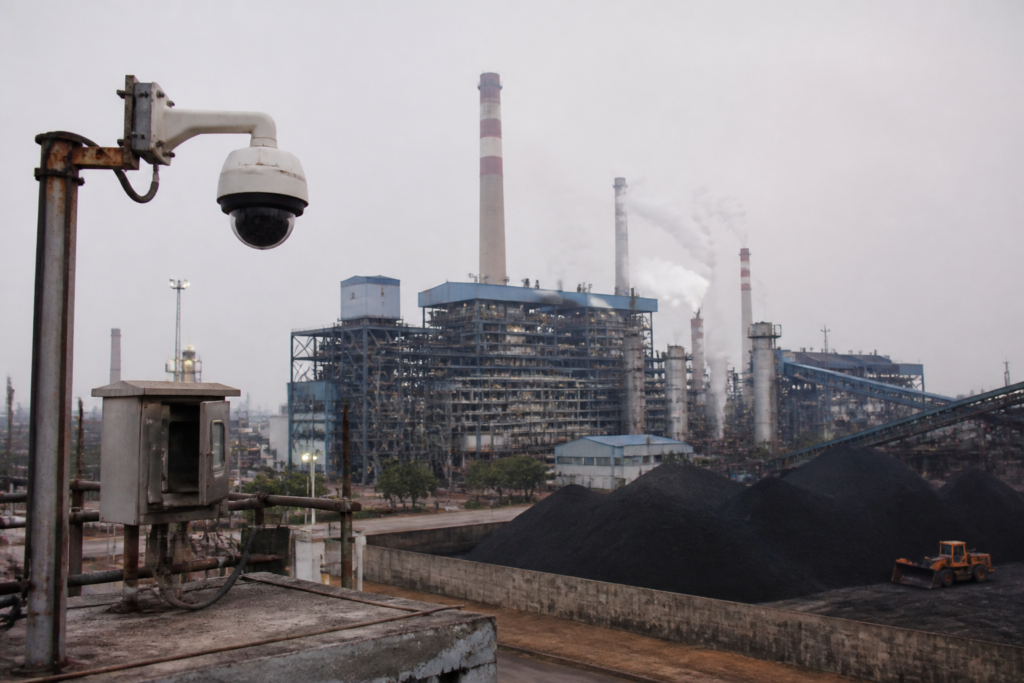
Delhi-NCR industries in 17 highly polluting categories must install and operationalise pan-tilt-zoom (PTZ) cameras by November 30 under a Commission for Air Quality Management (CAQM) order aimed at strengthening real-time monitoring of emissions and pollution-control compliance.
The cameras will transmit live video feeds to designated servers or portals operated by the Central Pollution Control Board (CPCB), state pollution control boards and the Delhi Pollution Control Committee (DPCC). The requirement applies to all specified industrial units across the National Capital Region, expanding an earlier direction that covered only select categories, including food-processing and textile units.
CAQM’s October 15 order requires industries to position cameras at fuel-feeding and charging points connected to boilers, thermic fluid heaters, furnaces, kilns and other fuel-fired equipment, wherever applicable. Units using gaseous fuels must place cameras to capture gas meters, gauges and other related metering systems.
The order also covers stack-emission monitoring points, Online Continuous Emission Monitoring System (OCEMS) sampling points and portholes, as well as areas where fume-extraction systems are installed. CAQM said industries must ensure that cameras provide adequate coverage of relevant operations without significant blind spots. Additional cameras will be required where a single unit cannot cover all prescribed locations.
The commission issued the direction after inspections by its flying squads found instances of industries using unapproved fuels despite restrictions on their use. CAQM has identified industrial emissions, including particulate matter released through stacks and fugitive emissions from industrial processes, as a significant contributor to air pollution in the NCR.
The monitoring requirement comes ahead of the winter period, when unfavourable weather conditions can limit the dispersion of pollutants. The order is intended to allow pollution-control authorities to remotely observe industrial operations and assess whether units are complying with fuel restrictions and other emissions-control requirements.
Under the arrangement, the cameras will use the Real Time Streaming Protocol (RTSP) to send video feeds to the designated CPCB, SPCB or DPCC systems. CAQM directed the CPCB, in coordination with the relevant state pollution control boards and the DPCC, to establish the technical arrangements and associated infrastructure needed to receive and access these feeds.
The respective state pollution control boards and the DPCC will be responsible for monitoring compliance and ensuring implementation within their jurisdictions. Industries covered by the order must complete installation and operationalisation of the required PTZ cameras by November 30.


