

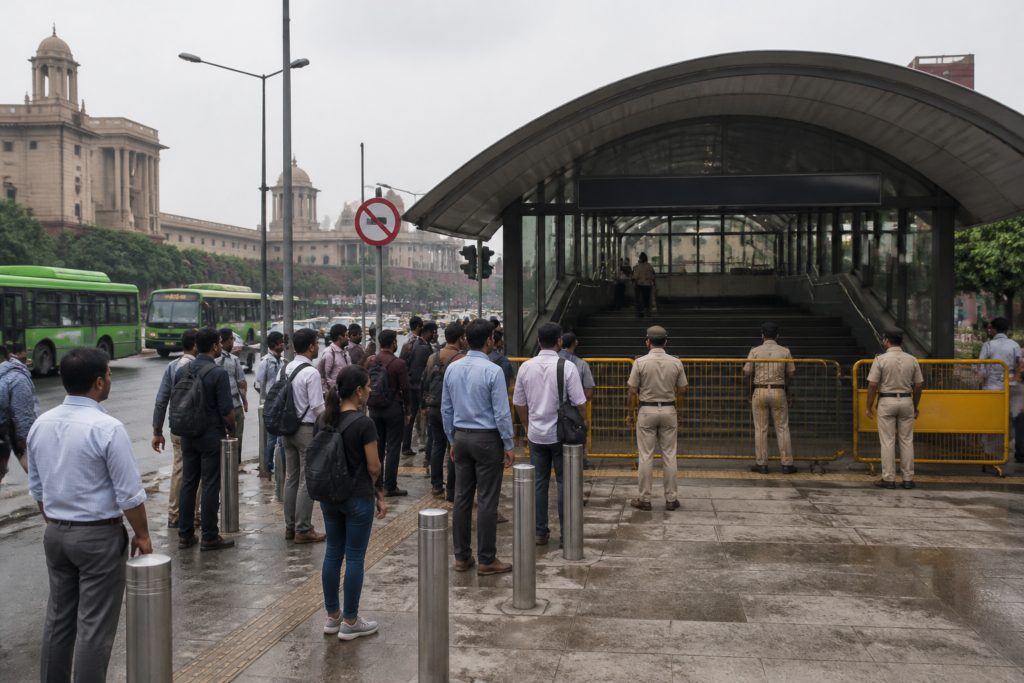
Delhi’s security response to proposed protests on October 10 shows how quickly the functioning of a capital city can be reorganised around the possibility of public-order disruption. In an affidavit filed before the Supreme Court, the Delhi Police said it reviewed security arrangements in Jantar Mantar and other parts of New Delhi, proposed restricting access at 45 metro stations, sought traffic diversions and limited mobile internet services. The affidavit also said no one was illegally detained and that action was taken only against those who violated orders issued under Section 163 of the Bharatiya Nagarik Suraksha Sanhita.
The document, filed on behalf of Police Commissioner Anurag Kumar, was submitted in the context of the court’s directions concerning the October 10 arrangements. Its details offer more than a record of police deployment. They illustrate the administrative chain through which a protest-related security assessment can affect public transport, road movement, communications and access to important government districts.
The police said the review was necessary because Jantar Mantar and other areas of New Delhi had proposed demonstrations. The affidavit referred to Delhi’s concentration of important government institutions, vulnerable areas, VIP routes, visits by foreign dignitaries and other large events as reasons for maintaining heightened vigilance. In operational terms, that meant treating mobility around central Delhi not simply as a transport issue but as part of a wider law-and-order plan.
## Delhi Metro closures and the management of urban movement
The most consequential measure concerned the Delhi Metro. The police said it sent the Delhi Metro Rail Corporation a proposal to keep entry and exit gates at 45 stations closed from 9 pm on October 9 until 6 pm on October 10. The stated concern was that crowds could move towards sensitive areas and potentially disrupt public order. The police also requested a reduction in metro train frequency.
This is significant because station access is one of the few levers through which authorities can influence the movement of large numbers of people across Delhi in a short period. Closing gates at multiple stations can affect not only demonstrators but also office workers, visitors, residents, service staff and passengers making journeys unrelated to the protest. The affidavit, however, does not provide a station-wise list of the 45 stations, passenger numbers affected, the duration for which each station remained closed or the operational impact on individual routes.
The police also wrote to the DMRC to restore normal metro operations from 10 pm on October 10. The affidavit said the Supreme Court’s direction relating to the metro had already been implemented. This indicates that the transport response involved communication between the police and the metro operator rather than a standalone decision by the rail system. It also highlights the importance of clearly defined authority during emergency restrictions: police assessments may trigger requests, while the transport agency must translate them into station-level operating decisions.
The material supplied in the affidavit does not establish whether all 45 stations ultimately remained closed for the entire proposed period or whether the requested reduction in frequency was implemented uniformly. That distinction matters for evaluating the proportionality and practical effect of the response. A proposal, an operational order and an action carried out on the ground are not necessarily the same thing.
## Traffic diversions extended the security perimeter
Road movement was also reorganised. According to the police, traffic diversions were implemented from 6 am on October 10 and 11 at several major roads and intersections. The public was advised to plan journeys in advance, avoid non-essential travel and monitor traffic updates. A total of 88 diversion flex signboards were installed for traffic management.
The measures show how a security plan around central Delhi can extend beyond the immediate protest location. Diversions at major intersections can redirect congestion into adjoining neighbourhoods and alter access to offices, hospitals, markets, courts and public transport interchanges. The affidavit records the number of signboards, but it does not provide details of the roads affected, the duration of each diversion, traffic volumes or the number of commuters who experienced delays.
That missing operational information limits what can be concluded about the effectiveness of the diversions. The police account establishes that advance communication and physical signage were part of the plan. It does not, by itself, demonstrate whether the arrangements prevented congestion, whether emergency access was maintained or how the diversions affected people travelling for essential work.
The two-day reference to October 10 and 11 is also important. While the proposed demonstrations were linked to October 10, traffic restrictions continued into the following morning, suggesting that the authorities planned for residual effects or continued sensitivity around the area. The affidavit does not explain the criteria used to decide when the diversions could be withdrawn.
## Mobile internet restrictions and the communication question
The police said internet services were not shut down completely. Instead, restrictions were imposed only on mobile internet services under the applicable rules, with the situation reviewed continuously. The distinction is operationally important because mobile data is widely used for navigation, live traffic information, ride-hailing, digital payments, workplace communication and access to public updates.
At the same time, the affidavit does not specify the geographical area covered by the restriction, the exact duration, the order under which it was imposed or the criteria used for periodic review. Without those details, the supplied material cannot establish how broadly the restriction affected residents and visitors or how it interacted with the traffic and metro measures.
The police’s description frames the restriction as a targeted law-and-order measure rather than a complete communications shutdown. That claim is attributable to the affidavit and should not be treated as an independent assessment of the restriction’s necessity or impact. The key institutional issue is whether the public receives clear information about the scope, legal basis and end point of such measures when they are imposed.
## Detention safeguards and Section 163 orders
The affidavit also addressed civil liberties concerns. Delhi Police said that no person was illegally detained in compliance with the court’s directions. It said lawyers, journalists and other professionals were not prevented from performing their duties, and that action was taken only against people who violated orders issued under Section 163 of the Bharatiya Nagarik Suraksha Sanhita.
The police further stated that notices relating to Section 163 were displayed in the designated areas. Notices around the Supreme Court complex were reviewed and removed where necessary. These details point to the role of public notification in enforcement: restrictions are expected to be communicated in the areas where they apply, while enforcement is linked to breaches of a formally issued order.
However, the affidavit’s account remains the police’s submission to the court. The supplied report does not include the court’s final assessment, an independent account of people affected by the restrictions, or a detailed record of arrests, detentions and prosecutions. The distinction is essential. A government or police affidavit can establish what an authority has told the court; it does not automatically establish that every contested aspect has been judicially accepted.
## The wider urban governance issue
The October 10 arrangements reveal the interdependence of Delhi’s institutions. The police assessed public-order risks, communicated with the metro operator, coordinated traffic changes, regulated mobile connectivity and monitored compliance with restrictions. Each measure affected a different urban system, but the consequences were experienced together by people moving through the city.
This creates a governance challenge. Security agencies may need to respond quickly to credible risks, while transport operators and civic authorities must preserve access and communicate changes to the public. The quality of that response depends not only on deployment but also on documentation: which stations were affected, what alternatives were available, how traffic was monitored, how long restrictions lasted and when normal operations resumed.
The affidavit supplies some measurable details—45 metro stations proposed for access restrictions and 88 traffic diversion signs—but leaves other public-impact indicators unstated. There is no information in the supplied material on passenger disruption, traffic delays, economic losses, emergency-service movement or the number of people detained for alleged violations. Those gaps do not invalidate the police account, but they limit a full assessment of the urban cost of the measures.
The episode therefore sits at the intersection of public safety and everyday urban access. In a city where metro stations and major roads connect residential areas with government districts, restrictions designed for a sensitive zone can rapidly affect journeys far beyond the protest site. The affidavit confirms the scale and range of the planned response, while the unanswered questions concern its implementation, proportionality and consequences for citizens.
Delhi Police said it was continuing to monitor law-and-order and traffic conditions and would take further appropriate steps if required. The next point of significance is the Supreme Court’s consideration of the affidavit and the court’s assessment of whether the measures complied with its directions.


