

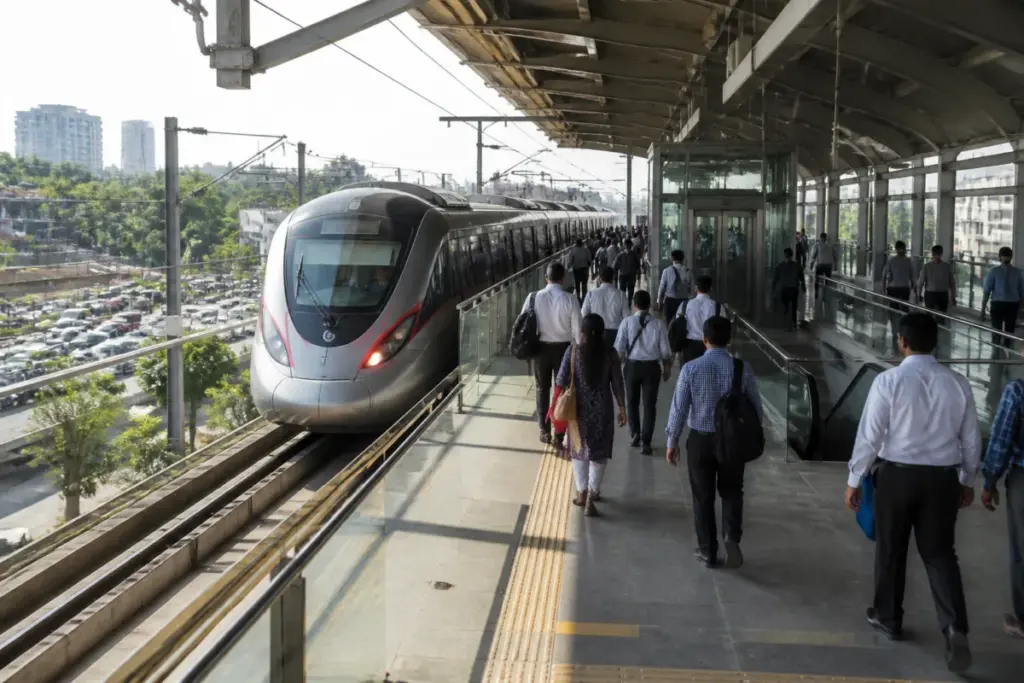
The Delhi-Meerut RRTS ridership surge is beginning to show what regional rail can do when a long-distance corridor is connected to the everyday transport systems of a large metropolitan region. Average daily ridership rose from 47,745 in July 2025 to 94,936 in July 2026, nearly doubling within a year. By August 2026, the corridor was carrying an average of 1.13 lakh passengers a day, with a record single-day footfall of 1,68,510 on August 28.
The increase followed the full commissioning of the 82-km Delhi-Meerut rapid rail corridor in February 2026. The line had opened in stages, beginning with the 17-km Sahibabad-Duhai Depot section in October 2023. Extensions reached Modinagar North in March 2024 and Meerut South in August 2024 before the complete corridor became operational.
The numbers are important, but they do not simply describe a successful transport launch. They show how the usefulness of a regional rail line depends on whether it is integrated into the wider urban system. For passengers, the corridor is not an isolated railway between Delhi and Meerut. It is one part of a chain that may also include the Delhi Metro, Indian Railways, inter-state bus terminals, city buses, walking routes, parking facilities and station access infrastructure.
That chain is visible in the experience of passengers such as Shweta Sharma, who lives in Partapur in Meerut. Her son takes the Namo Bharat train to Sarai Kale Khan and then changes to the Delhi Metro to reach JIMS Kalkaji for 10 am lectures. He returns home by evening. Sharma described the journey as being “as good as staying in Delhi”, a reflection of how improved regional connectivity can expand access to education and other city-based activities without requiring a move to the Capital.
The rise in ridership accelerated after the entire corridor opened. Average daily use increased from 63,999 in February 2026 to 87,682 in March, then to 92,364 in April and 93,877 in May. It crossed one lakh in June, reaching 1.02 lakh, and rose further in August. The figures indicate that the corridor continued to attract passengers after the initial effect of the full opening, rather than experiencing only a short-lived launch-period spike.
Officials attributed the growth to better connectivity with the Delhi Metro, Indian Railways, inter-state bus terminals and city bus services. They also pointed to first- and last-mile connectivity, accessible station infrastructure, parking and passenger amenities. These factors are often treated as supporting details in infrastructure announcements, but the ridership pattern suggests that they are central to whether a regional service becomes usable for ordinary trips.
Sarai Kale Khan illustrates this relationship. The station is part of a major transport hub that includes Hazrat Nizamuddin Railway Station, the Delhi Metro’s Pink Line, the Veer Haqiqat Rai Interstate Bus Terminal, city bus services and the Namo Bharat corridor. Ridership at the Namo Bharat station increased by around 30% after a foot overbridge connected it with Hazrat Nizamuddin Railway Station, according to earlier reporting by The Indian Express.
That change points to a basic institutional and design lesson: a transfer is not complete when two services are located on the same map. Passengers need a practical, safe and convenient way to move between them. Transport planners cited in the report noted that commuters may accept a train-to-Metro interchange only when it does not involve broken footpaths, unsafe crossings or conflicts with rickshaws. The quality of the transfer can therefore influence the value of the entire corridor.
The concentration of passengers at key stations reinforces this point. Sarai Kale Khan, New Ashok Nagar, Anand Vihar, Ghaziabad and Begumpul together account for more than 40% of total ridership. These stations function as interchange points, employment destinations or gateways to other parts of the National Capital Region. Their performance suggests that the corridor is being used not only for travel between terminal points, but also as part of a wider network of urban movements.
The passenger profile also appears broader than a conventional office commute. July 2026 data showed that Sunday ridership was only 15-20% lower than weekday ridership. Officials said passenger movement remained high across operational hours, with a slight increase during office hours, and attributed the use to education, business, leisure and other purposes. The relatively limited Sunday decline indicates that the service is supporting a range of activities across the region.
Accessibility is another dimension of the corridor’s expanding use. Sanjay Yadav, a wheelchair user from Pallavpuram Phase 1 in Meerut, said he had previously depended on expensive cab services because public transport was difficult to use. After taking his first Namo Bharat journey in March 2025, he began making regular trips independently. He attributed this to lifts, ramps and level boarding.
This account does not establish that the corridor is uniformly accessible. It does show, however, how station design can alter the set of transport choices available to passengers who are poorly served by conventional public transport. For a regional system, accessibility is not only a question of compliance or station equipment. It affects whether people can undertake journeys independently and whether the service can replace more expensive, less efficient travel options for particular users.
The use of premium coaches also indicates that passengers are assessing the service on comfort and perceived safety, not only on speed. Neena Oberoi, who travels to Meerut, said she preferred the premium coach because of its comfort and safety, describing it as especially useful for women. Such preferences can influence repeat use, although the available data does not quantify how many passengers choose premium coaches or whether these facilities affect overall ridership.
The corridor’s growth must also be read against its long-term projections. Data for July 2026 suggests that current ridership remains below the 7.4 lakh average daily passengers projected by the Delhi Integrated Multi-Modal Transit Systems for 2028. That comparison is not straightforward. The projection was closely connected to the development of a wider RRTS network, while the Delhi-Meerut line is currently the first operational corridor in that planned system.
The Delhi-Karnal corridor and part of the Delhi-Alwar corridor are still awaiting approval. According to the report, each would take at least five to six years to become operational after receiving the necessary approvals. Until those lines are built, the Delhi-Meerut corridor cannot benefit from the full network effects envisaged for the regional rapid transit system.
This distinction matters because transport networks often gain value through connections rather than through individual lines alone. An isolated corridor can provide faster travel between two regions, but a connected network creates more possible journeys, interchange points and destinations. An official quoted in the report compared the anticipated effect with the growth of the Delhi Metro, saying that ridership could rise significantly once other lines become operational. That remains a stated expectation, not an established outcome.
There is also a limit to what ridership data can currently demonstrate. Rising passenger numbers show that more people are using the service, but they do not reveal how many have shifted from private vehicles, taxis or buses. They also do not establish whether congestion on roads between Delhi and Meerut has fallen. A passenger travelling on the corridor may be making a new journey, replacing a previous train or bus trip, or switching from another mode. Without that information, the corridor’s effect on road traffic and emissions remains unconfirmed in the supplied evidence.
The data does establish that the service is becoming embedded in daily regional life. The combination of rising monthly ridership, high Sunday use, strong performance at interchange stations and accounts from students, women travellers and wheelchair users suggests that the corridor is serving more than a narrow peak-hour commuter market. Its public value is being shaped by connections at both ends of the journey and by the ease with which passengers can transfer, walk, park or access stations.
The larger urban question is whether the National Capital Region can build a genuinely integrated regional transport system rather than a collection of separate projects. The Delhi-Meerut corridor has expanded the practical geography of education, work, business and leisure for some passengers. But its eventual contribution will depend on approvals for other corridors, the quality of interchange infrastructure and whether access improvements continue beyond the stations themselves.
For now, the evidence supports two conclusions. The fully operational 82-km line has produced a substantial increase in use, and integration with other transport modes appears to be a major reason. At the same time, current ridership does not yet meet the longer-term projection associated with a wider RRTS network, and the available figures do not show how many car or road trips have been replaced. Future assessment will need to track the development of additional RRTS lines, the performance of major interchange stations and the modes from which new passengers are shifting.


