

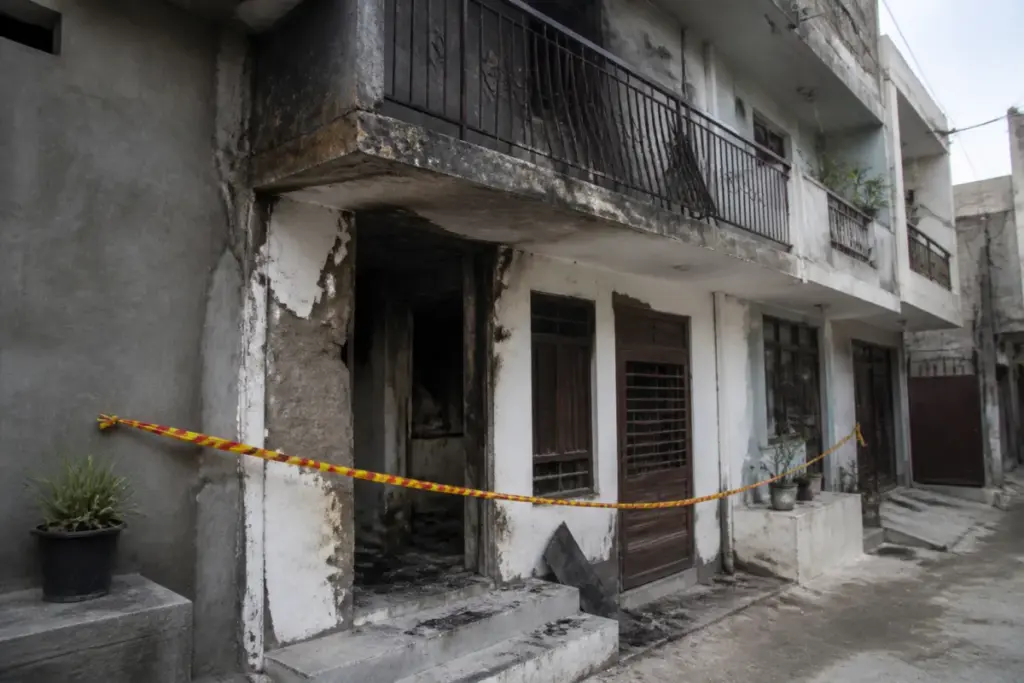
The Delhi LPG blast in Najafgarh did not end when the flames were extinguished. Over the following 12 days, four members of one family died from burn injuries, while two children survived with injuries and lost parental care. The incident has exposed how a domestic gas leak, an enclosed room and a possible ignition source can combine into a lethal urban safety failure.
The explosion took place on the night of September 22 in a ground-floor home in Ranaji Enclave, according to police. Six people, including children, suffered burn injuries and were first taken to IGI Hospital before being shifted to Safdarjung Hospital. Monika, 29, died on September 28; her brother Keshav, 25, died on October 1; Keshav’s wife, Sonam, 24, died on October 3; and their mother, Kamlesh, 50, died the following day.
The human consequences extend beyond the death toll. Keshav and Sonam’s three-month-old son, Yuvansh, now lives with his grandfather, Ramji Lal. Monika’s four-year-old daughter, Diya, also survived with injuries. Monika had been visiting her parents with Diya when the blast occurred. Her husband and other family members live in Badshahpur, Gurgaon, according to the report.
Police have not established the exact cause. A senior police officer said a domestic LPG cylinder may have leaked, allowing gas to accumulate inside a room and form a combustible gas-air mixture. The mixture may then have ignited after coming into contact with a possible ignition source. The wording is important: the police account describes a preliminary possibility, not a final finding.
What is established is the physical setting in which the explosion occurred. Police said the room was completely shut, with no opening on any side. Investigators believe this may have influenced the spread and intensity of the flames. The incident occurred on the ground floor, but the impact reached the first floor, where a gate was damaged. Those who suffered serious injuries had burns covering about 60% of their bodies, the officer said.
This combination of circumstances points to a recurring challenge in dense residential areas: household safety depends not only on the condition of a cylinder or regulator, but also on how gas behaves inside a building. A leak in an open or ventilated space may disperse differently from one inside a closed room. In the Najafgarh case, the absence of openings is part of the police’s preliminary explanation for the intensity of the fire, although the final cause remains pending.
The incident therefore sits at the intersection of utility use and building design. LPG is used inside homes, but the consequences of a leak are shaped by walls, doors, room sizes and ventilation openings. A domestic accident can quickly become a built-environment emergency when combustible gas accumulates in an enclosed space and an ignition source is present.
The case also shows how the impact of a fire is not measured only by the moment of ignition. Six people were injured, four later died and two children were left dependent on surviving relatives. The 12-day sequence between the blast and the final death demonstrates the prolonged medical and social consequences of severe burns. The event moved from a household emergency to a family-care crisis.
The police response has proceeded through a criminal investigation. An FIR was registered at Najafgarh police station under Sections 287 and 106(1) of the Bharatiya Nyaya Sanhita. The first provision concerns negligent conduct involving fire or combustible matter, while the second concerns causing death by negligence. The case will therefore examine not only what ignited the gas, but whether negligence involving combustible material can be established.
That legal framework matters because domestic gas incidents are often treated as isolated household mishaps. An FIR creates an institutional route for determining responsibility, but it does not itself establish culpability. The police must still determine the exact cause, the source of any leak, the presence of an ignition source and whether negligence can be linked to the deaths.
The report also records a previous LPG-related fire incident in Delhi. In February, a firefighter died and at least 13 people, including fire and police personnel, were injured after an LPG cylinder exploded during a building fire in Majlis Park. The two incidents are not presented as having the same cause, and the available material does not establish a common failure. They do, however, show that LPG-related emergencies can affect both residents and first responders.
The Majlis Park reference adds an important public-safety dimension. When a cylinder explodes during a building fire, emergency personnel face risks while entering, containing and evacuating a structure. In a residential blast such as the Najafgarh incident, occupants may have little time to react, particularly when the leak is not detected before ignition. In both settings, the interaction between fuel, enclosed space, building layout and emergency response becomes decisive.
The evidence supplied in the Najafgarh report does not establish how the cylinder was installed, whether the appliance or regulator had been inspected, whether occupants detected a smell before the explosion, or whether the building complied with any applicable safety requirements. It also does not state whether the room had windows that were blocked, sealed or otherwise unavailable for ventilation. Those unanswered questions should remain part of the investigation rather than being filled with assumption.
The same limits apply to the broader question of prevention. The available report does not provide data on the number of domestic LPG leaks in Delhi, the frequency of cylinder-related fires, inspection practices, household awareness or the role of distributors and local authorities. Without those figures, the Najafgarh incident cannot by itself demonstrate a citywide trend. It can, however, identify the precise conditions that investigators are examining: suspected leakage, gas accumulation, a possible ignition source and an enclosed room.
This is where the urban significance of the case lies. Housing safety is not confined to formal fire stations, large commercial buildings or public infrastructure. It is also produced inside ordinary homes, where utility systems operate in rooms that may have been altered, partitioned or closed for privacy and security. The police description of the room makes ventilation a central factual issue in this case, even though the final cause is yet to be established.
The incident also raises questions about how responsibility is distributed. Residents operate cylinders and appliances; distributors supply and service equipment; building occupants control how rooms are used; and public agencies investigate fires and deaths. The supplied material does not identify a failure by any one of these actors. It does show that a household incident can require police investigation, hospital treatment, fire-service exposure and extended family support at the same time.
For the two surviving children, the consequences are immediate and long-term. Yuvansh has lost both parents, while Diya has lost her mother and suffered injuries herself. The report identifies their current family arrangements but does not provide information about medical follow-up, rehabilitation, compensation or official assistance. Those details are not established in the available evidence and should not be presumed.
The Najafgarh blast therefore remains both a criminal case and a warning about the limits of treating domestic energy safety as a private matter. Police have described a possible mechanism, registered an FIR and documented the scale of the injuries. They have not yet established the exact cause. The next significant development will be the investigation’s determination of how the leak occurred, what ignited the accumulated gas and whether negligence can be proved under the sections invoked in the FIR.


