

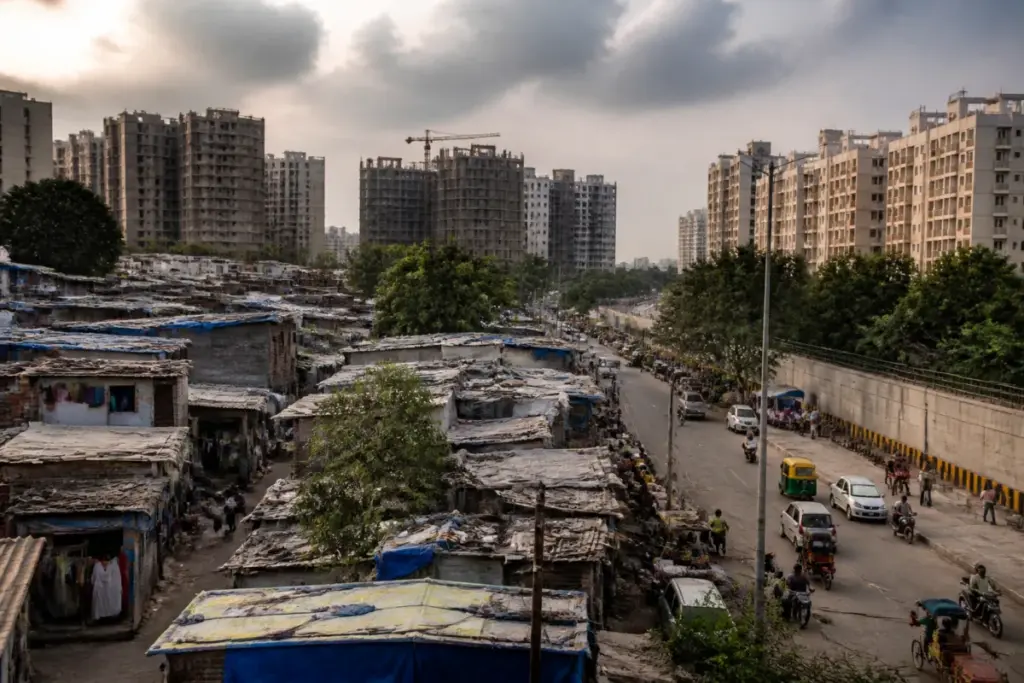
Delhi’s move to redevelop JJ clusters in Seelampur, Sultanpuri and Lajpat Nagar through the public-private partnership route is being presented as a way to combine formal housing for residents with productive use of high-value urban land. But the central challenge is not only constructing multi-storey EWS flats. It is establishing who qualifies, whether redevelopment can remain genuinely in situ, and whether the financial model can support housing without displacing the communities it is meant to rehabilitate.
The Delhi Urban Shelter Improvement Board has begun the process by seeking expressions of interest for a transaction adviser. The adviser is expected to assess the feasibility of redevelopment at the three locations, secure regulatory clearances and help DUSIB select a private developer. This places the projects at an early institutional stage. No final developer, construction schedule, approved layout or confirmed housing capacity has been announced in the supplied report.
That distinction matters because the PPP model depends on several decisions being resolved before construction can begin. The feasibility exercise will examine land values, surrounding infrastructure, connectivity, prevailing property prices and development potential. It will also review the Master Plan for Delhi, zonal plans, building bye-laws, land-use restrictions and permissible floor area ratio. These are not technical details at the margins of the project. They will determine how much can be built, what uses can be permitted and whether the value generated from a portion of the land can finance rehabilitation on the same site or nearby.
The proposal therefore links three separate objectives: improving living conditions, rehabilitating eligible residents and creating enough development value to make the project financially viable. Officials said the transaction adviser would prepare conceptual layouts and preliminary cost estimates covering housing units, built-up area, parking, utilities and other facilities. The study will also recommend the mix of residential and commercial development required to balance construction costs, market demand and revenue generation.
This structure reflects a recurring problem in urban redevelopment. Public agencies often control land but face limited fiscal capacity to rebuild at the scale required. Private participation can bring capital and execution capacity, but a private developer will also require a viable development programme. In the Delhi proposal, that tension is built into the assignment itself: the adviser must test whether the land can support both resident rehabilitation and a revenue-generating component. The outcome will depend on the relationship between permissible construction, market demand, infrastructure capacity and the cost of formal housing.
The three selected clusters also illustrate why location is central to the policy. Seelampur, Sultanpuri and Lajpat Nagar are not simply vacant redevelopment sites. They are established urban settlements whose residents include domestic workers, drivers, vegetable vendors and auto-rickshaw operators. These occupations connect the clusters to Delhi’s wider informal economy. Relocating residents far from existing employment and transport networks could alter household incomes and daily travel patterns, although the supplied report does not establish that relocation is planned.
The stated policy direction is instead in-situ or near-site rehabilitation. Under the proposed Jahan Jhuggi, Wahan Makan scheme, residents are to receive multi-storey EWS flats at or near their existing locations, broadly within a 0-3 km radius wherever feasible. This approach recognises that a settlement’s value to residents is not limited to the structure in which they live. Proximity to jobs, schools, markets, public transport and social networks can be as important as the physical quality of a dwelling. However, the report does not provide details on how temporary accommodation, construction phasing, access to services or resident consent would be handled during redevelopment.
The most consequential unresolved issue is the beneficiary database. Delhi has 675 officially recognised JJ clusters, while officials estimate that the actual number may be around 750. The last comprehensive survey, conducted in 2014, identified nearly 700 clusters and around 3.3 lakh households. The gap between officially recognised and estimated settlements points to the administrative difficulty of planning a city-wide rehabilitation programme without current information.
The Delhi government is planning a fresh survey to count settlements and households and identify beneficiaries for its proposed in-situ rehabilitation programme. This is more than a data-gathering exercise. A beneficiary list determines who receives a formal dwelling, who may be excluded and how many units a project must finance. It also affects the financial model because the number of eligible households directly influences construction costs, the amount of land available for other uses and the scale of any revenue-sharing arrangement.
The decision to extend the JJ basti identification cut-off date from January 1, 2006, to January 1, 2025, is likely to widen the population considered under the scheme. The supplied material does not state how many additional households may become eligible as a result. It does, however, establish that the policy is attempting to expand coverage while the underlying database is still being refreshed. This creates a sequencing challenge: redevelopment feasibility, beneficiary identification and policy eligibility must be aligned before project commitments can be made with confidence.
For DUSIB, the transaction adviser will therefore perform both a financial and an administrative function. The adviser’s work is expected to include projected cash flows and revenue-sharing arrangements, but it must also translate planning rules and household numbers into a workable development proposal. If the verified beneficiary count changes substantially during the survey, the preliminary cost estimates and land-use calculations may also need to be revised. The report does not specify the proposed revenue share or the financial assumptions that will be used.
The policy’s reliance on formal EWS housing also raises questions about the meaning of rehabilitation. Moving households from informal settlements into multi-storey buildings changes the requirements for maintenance, common services, parking, utilities and building management. The report says that these facilities will be covered in the preliminary layouts and cost estimates, but it does not provide the proposed maintenance arrangements or explain how recurring costs would be allocated among residents, the government and the private developer.
This is particularly important because the existing clusters are described as lacking adequate housing and civic amenities, while their residents support essential urban services and informal economic activity. Formalisation can improve access to housing and amenities, but the long-term result depends on whether the new buildings remain affordable to occupy and maintain. The supplied information confirms the intention to provide formal housing; it does not yet establish the post-occupancy management framework.
The redevelopment plan also has a land-use dimension. The adviser will examine the permitted FAR, land-use restrictions and the balance between residential and commercial development. That balance will shape the physical form of the rebuilt neighbourhoods. More commercial development may improve project viability, but the report provides no details on its location, scale or relationship to residents’ needs. Similarly, the proposed parking, utilities and built-up area remain subjects for assessment rather than confirmed project features.
The broader urban question is whether Delhi can use public land and private capital to improve housing without treating existing communities mainly as obstacles to land optimisation. The PPP structure is intended to make rehabilitation financially workable, but its legitimacy will depend on the connection between the land value created and the housing promised to eligible residents. That connection must be visible in the project design, beneficiary process and implementation timeline.
At this stage, the evidence confirms an institutional beginning, not a completed redevelopment programme. DUSIB has initiated the search for a transaction adviser for three JJ clusters. Feasibility studies, regulatory reviews, conceptual layouts, cost estimates, financial modelling and developer selection are still ahead. The proposed wider programme also depends on a fresh survey and an expanded identification cut-off date. The developments to watch are the appointment of the adviser, publication of the feasibility findings, confirmation of eligible households, the proposed housing and commercial mix, and the final terms offered to private developers.


