

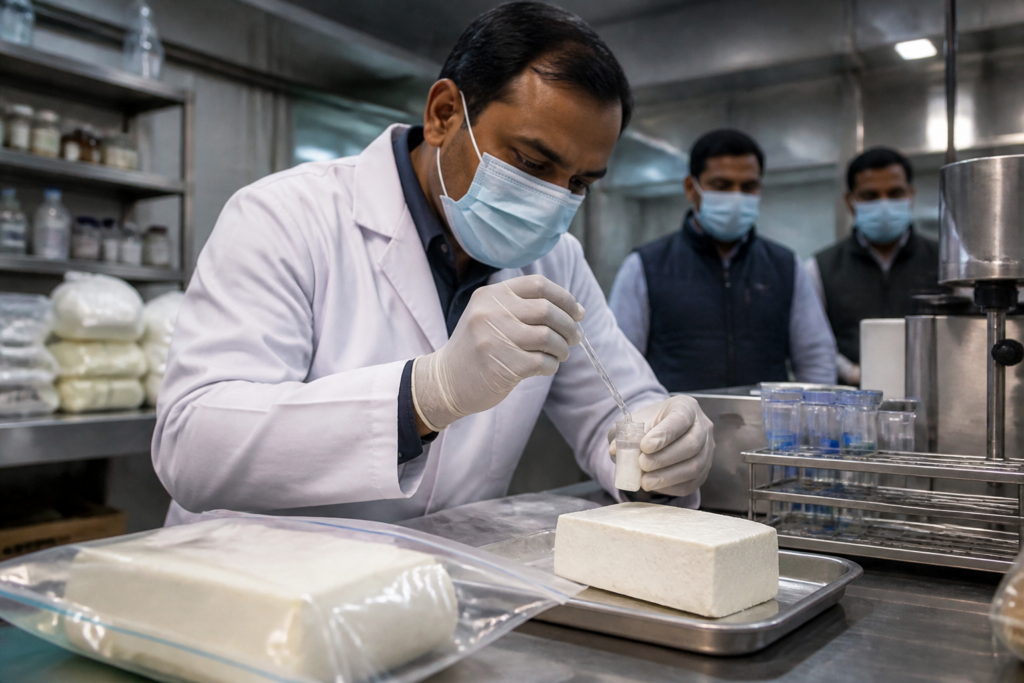
The Delhi High Court has sought responses from the Centre, the Food Safety and Standards Authority of India (FSSAI) and the Delhi government on a plea seeking a crackdown against non-dairy products sold or represented as paneer, with the petitioners urging inspections and testing before the festive season.
A division bench of Acting Chief Justice Nitin Sambre and Justice Sanjay Sharma sought the authorities’ responses on Wednesday but declined to grant interim relief. The public interest litigation was filed by law student Ridhima Singh and advocate Avlokiteshwar Sidharth.
The petitioners told the court that chhena and paneer are commonly used in prasad and are linked to religious and cultural sentiments. Their plea referred to enforcement measures taken in Maharashtra concerning “analogue/non-dairy paneer”, as well as subsequent actions in Gujarat, Punjab and Chhattisgarh.
The PIL asks authorities to prevent the manufacture, supply and sale of dairy-analogue or non-dairy products being passed off as paneer. It cites the Food Safety and Standards Act, 2006, and seeks action across manufacturing units, hotels, restaurants, caterers, cloud kitchens and e-commerce food businesses.
The petitioners have also sought an immediate special enforcement drive by the Delhi government and its food safety commissioner during the festive season. The proposed drive would involve inspection, sampling and testing of paneer and products represented as paneer, followed by action against operators found to be non-compliant.
The plea had requested interim directions requiring state authorities to complete a specified amount of sampling before the festive period. The petitioners argued that the matter was time-sensitive because Dussehra and Diwali were approaching and claimed that failing to act could cause “grave injustice”.
The petition also raises a specific enforcement problem in food-service and digital ordering markets. According to the plea, a customer ordering paneer from a hotel, restaurant, caterer, cloud kitchen or online food business may not be able to examine the original packaging or determine whether the product is genuine dairy paneer. The petitioners said a substitute could look and taste like paneer without clear disclosure to the consumer.
The Maharashtra experience was presented in the petition as a comparable example for Delhi, particularly because both are large metropolitan food markets. The petitioners argued that action by multiple statutory authorities showed that the issue had been recognised and that preventive measures could be taken under existing law.
The next step is for the Centre, FSSAI and Delhi government to respond to the High Court’s notice. The court’s order does not, at this stage, impose the requested interim sampling drive or any immediate enforcement deadline.


