

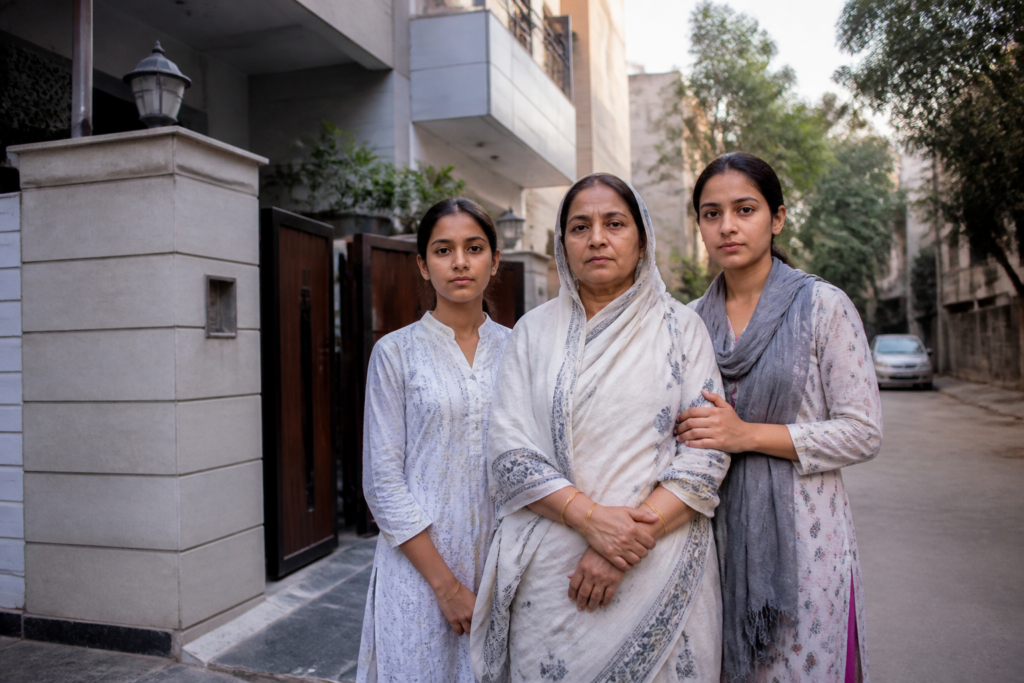
The Delhi High Court has held that a widowed daughter-in-law who cannot support herself through her own income, property or her deceased husband’s estate may be entitled to maintenance from her father-in-law, including a place to live. The court said this statutory protection can continue even after the husband’s death when the woman has no alternative accommodation.
A bench of Justice Neena Bansal Krishna was examining an appeal filed by the legal representatives of a deceased man against an order requiring them to vacate a property in Paschim Vihar and pay income allegedly earned from its unauthorised occupation. The property is owned by the woman’s father-in-law.
The deceased man had been living at the property with his wife and daughters. During the proceedings, he died and his widow and two daughters were brought on record as his legal representatives. They continued to live at the property, after which the father-in-law sought their eviction.
The widow argued that the property constituted her shared household under the Protection of Women from Domestic Violence Act, 2005. She claimed that she had an independent right to reside there and that her right to accommodation did not end with her husband’s death.
The High Court accepted that the property was her shared household. It held that the death of the husband did not automatically terminate the widow’s right to reside there. The bench also examined Section 19 of the Hindu Adoptions and Maintenance Act, 1956, which provides for maintenance by a father-in-law to a widowed daughter-in-law subject to statutory conditions.
The court referred to Section 3(b) of the Act, which defines maintenance to include food, clothing, residence, education, medical attendance and treatment. On that basis, it said the obligation was not limited to financial assistance. It could also include arranging shelter for an eligible widowed daughter-in-law.
The case involved an additional housing-security question because the father-in-law was not residing in the disputed property, while the widow had lived there with her daughters for more than two decades. The court noted that she had no other available place to live.
The ruling therefore preserved the order relating to possession of the property. The decision places accommodation within the practical meaning of maintenance in a case involving a widowed daughter-in-law, while the entitlement remains subject to the legal conditions under the 1956 Act. It also reinforces that eviction disputes involving women who claim a shared household cannot be considered only as property-possession matters when statutory residence and maintenance rights are involved.


