

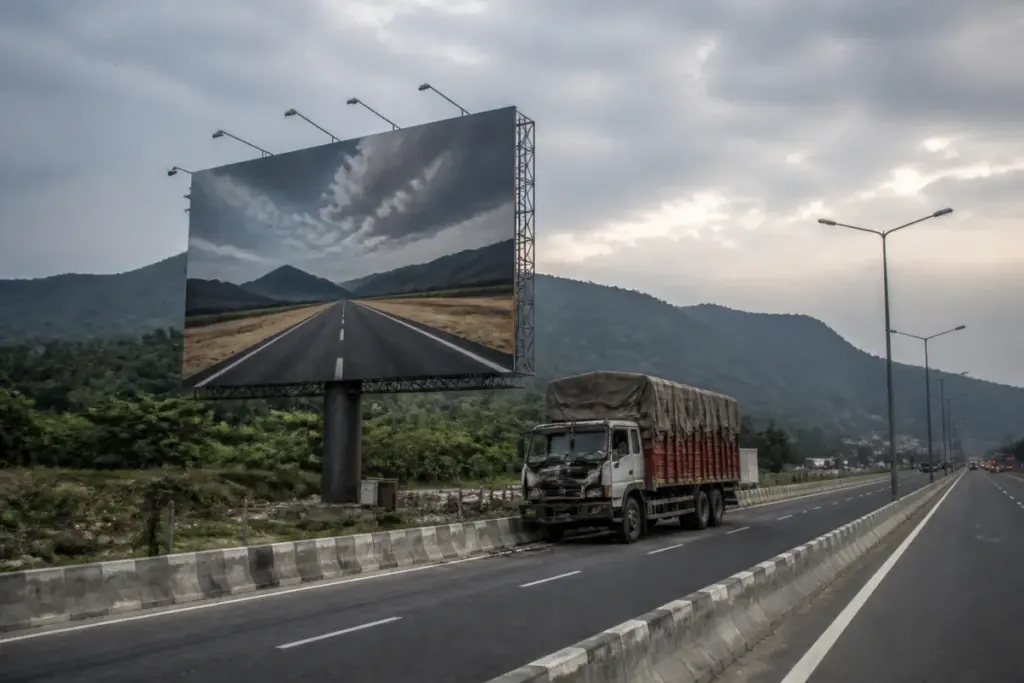
A viral video reportedly showing a truck crashing into a roadside hoarding on the Delhi–Dehradun Expressway has raised questions about whether highly realistic road imagery can create a safety risk for drivers, but the incident has not been independently verified.
Live Hindustan reported that the truck driver allegedly mistook a large roadside painting for an actual road lane and drove towards it. The report cited a post shared on X and said the painting appeared realistic enough to resemble a road. It also attributed the description of the incident to coverage by NDTV.
According to the report, the truck struck the hoarding structure and suffered substantial damage to its front section. The available report does not identify the driver, confirm the driver’s condition or state whether any other vehicle or person was involved. It also does not provide an official statement from the National Highways Authority of India, the expressway operator, local police or any other agency responsible for the road.
The video reportedly shows a large hoarding placed alongside the expressway, with an image of a road lane painted on it. The hoarding carries a welcome message for visitors arriving in Uttarakhand. The report says social media users have responded in different ways, with some praising the realism of the artwork and others questioning whether such an image should have been installed beside a high-speed road.
That distinction is central to the story. A roadside advertisement or public artwork next to an expressway is not judged only by its visual quality. Its placement, angle, contrast, lighting and resemblance to traffic infrastructure can affect how it is perceived by drivers, particularly at speed. However, the supplied report does not establish that the painting caused the crash, whether the driver was travelling within the speed limit or whether visibility, road geometry, weather or another factor contributed to the collision.
The Delhi–Dehradun Expressway is reported to be 213 kilometres long and to pass through Delhi, Uttar Pradesh and Uttarakhand. Live Hindustan reported that the project cost more than Rs 12,000 crore and that it was inaugurated in April. The expressway is intended to reduce travel time between Delhi and Dehradun from roughly seven to eight hours to about two and a half hours.
Those details make the question of roadside visual design relevant beyond a single viral clip. High-speed corridors depend on clear visual separation between the carriageway, road edges, signs, advertisements and surrounding structures. But the available material does not show whether the hoarding was approved under applicable rules, who commissioned it, whether a safety inspection took place or whether officials have ordered its removal or modification.
The report also does not establish the precise location of the hoarding on the expressway. Without that information, it is not possible to determine the responsible authority or assess the road layout at the site. The video’s date, the circumstances of the crash and the authenticity of the footage also require confirmation.
Until an official agency, the expressway operator, police records, the hoarding’s owner or other primary documentation confirms the incident, the crash should be treated as an allegation associated with a viral video rather than an established road-safety finding. The immediate developments requiring monitoring are confirmation of the video and collision, the driver’s condition, identification of the site and any official action concerning the hoarding.


