

Delhi recorded its first ‘poor’ air-quality day of the season on Wednesday, October 21, with the Air Quality Index (AQI) reaching 245, the highest level recorded in 100 days. The deterioration prompted the Commission for Air Quality Management (CAQM) to impose Stage I of the Graded Response Action Plan (GRAP) across Delhi-NCR.
The Central Pollution Control Board classifies an AQI between 201 and 300 as ‘poor’. Delhi’s AQI was last at a comparable level on July 13, when it stood at 246, according to the report. The rise comes as temperatures begin to fall, conditions that can reduce the dispersion of pollutants in the city’s atmosphere.
The Air Quality Early Warning System has forecast that Delhi’s air is likely to remain in the ‘poor’ category until October 23. Its outlook for the following six days also indicates that air quality is likely to remain poor. A ventilation index below 6,000 square metres per second, combined with average wind speeds below 10 kmph, is considered unfavourable for the dispersal of pollutants.
Under Stage I of GRAP, authorities are required to implement measures applicable when air quality enters the poor category. The development comes ahead of a wider set of winter pollution measures that are scheduled to remain in force from November 1, 2026, to January 31, 2027. Those measures include staggered office timings, increased parking charges, inspections of pollution hotspots and restrictions affecting construction activity, according to the report.
The Decision Support System for Air Quality Management in Delhi, developed by the Indian Institute of Tropical Meteorology, identified transport within Delhi as the largest contributor to the city’s pollution on Tuesday, accounting for 20.5% of the estimated load. Stubble burning contributed up to 8%, while residential sources accounted for 5.2%.
Other estimated contributions included peripheral industries at 4.3%, construction at 2.8%, waste burning at 1.8% and road dust at 1.4%. The system also attributed 1.3% to other sources. Across the National Capital Region, Jhajjar was listed as contributing 8%, followed by Gurugram at 5.7%, Sonipat at 4.8% and Ghaziabad at 3.04%.
The reported deterioration occurred a day after Vijayadashami, when Ravan effigies were burnt at several locations in the city. However, no direct link has been established between the celebrations and the change in air quality.
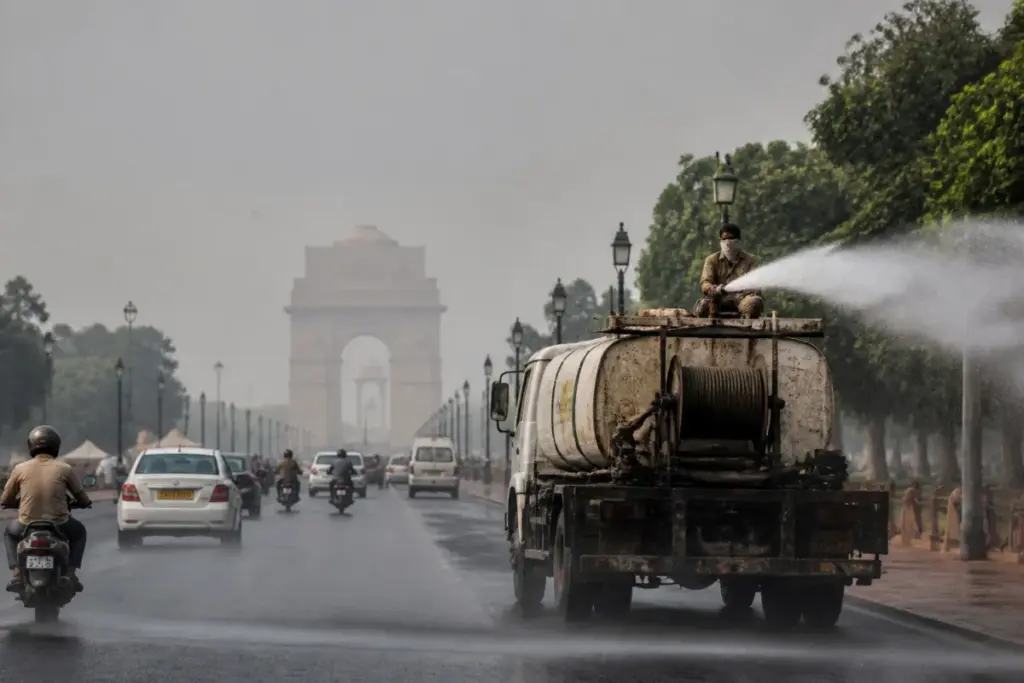
A truck-mounted water sprinkler was deployed near India Gate on October 19 as part of efforts to mitigate pollution on roads. The immediate official response now includes the implementation of GRAP Stage I across Delhi-NCR, while the air-quality forecast will determine how conditions develop through October 23 and the subsequent six-day outlook period.


